Key takeaways
- Therapeutic hypothermia is indicated for infants ≥36 weeks gestational age with documented peripartum hypoxia-ischemia and moderate to severe encephalopathy, started within the first 6 hours of age.
- Target cooling temperature is 33.5°C for 72 hours, followed by slow rewarming at 0.5°C per hour.
- Block A (peripartum hypoxia-ischemia) requires only one of four criteria: pH ≤7.00, base deficit ≥16 mmol/L, Apgar ≤5 at 10 min, or assisted ventilation at birth continued ≥10 min.
- Block B (encephalopathy) is satisfied with ≥3 of 6 Sarnat exam categories at moderate or severe degree, or with seizures alone.
- For infants 35 0/7 to 35 6/7 weeks or those presenting 6-24 hours after birth, evidence is limited and the decision should be individualized with the family rather than automatic.
References
- El-Dib M, de Vries LS. Neurophysiological Monitoring. In: Meijler G, Mohammad K, eds. Neonatal Brain Injury. Springer, Cham; 2024. Fig. 16.2. Open access, CC BY 4.0.
- AAP clinical report (Pediatrics, 2026)
- Zanelli SA, Wusthoff CJ, Lucke AM, Kaufman DA; Committee on Fetus and Newborn; Section on Neurology. Therapeutic Hypothermia for Neonatal Hypoxic-Ischemic Encephalopathy: Clinical Report. Pediatrics. 2026;157(2):e2025073627. doi: 10.1542/peds.2025-073627.
- El-Dib M, de Vries LS. Neurophysiological Monitoring. In: Meijler G, Mohammad K, eds. Neonatal Brain Injury. Springer, Cham; 2024. doi: 10.1007/978-3-031-55972-3_16. Open access, CC BY 4.0 license.
Therapeutic Hypothermia in HIE
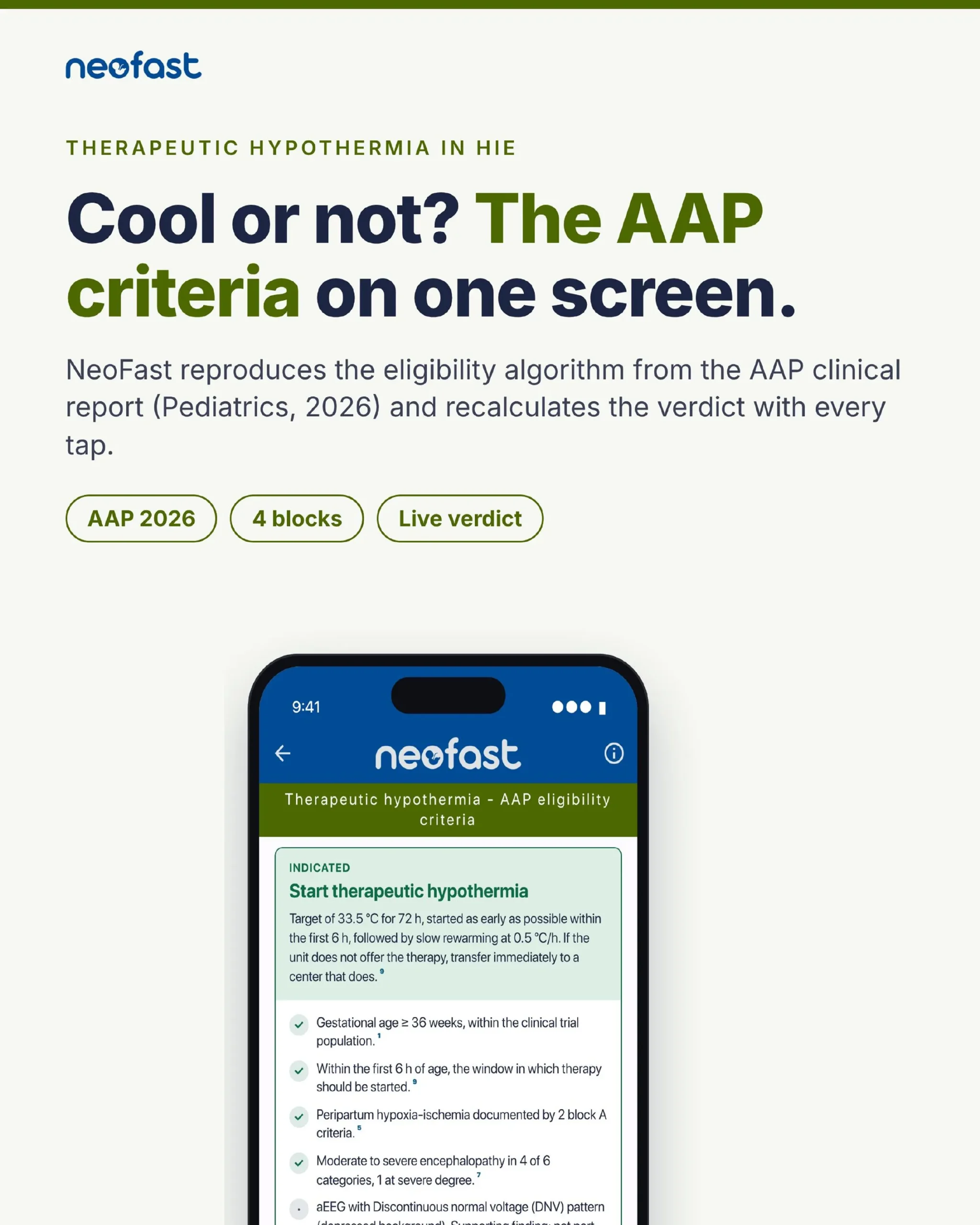
THERAPEUTIC HYPOTHERMIA IN HIE
Cool or not? The AAP criteria on one screen.
NeoFast reproduces the eligibility algorithm from the AAP clinical report (Pediatrics, 2026) and recalculates the verdict with every tap.
- AAP 2026
- 4 blocks
- Live verdict
Therapeutic hypothermia – AAP eligibility criteria
INDICATED
Start therapeutic hypothermia
Target of 33.5 °C for 72 h, started as early as possible within the first 6 h, followed by slow rewarming at 0.5 °C/h. If the unit does not offer the therapy, transfer immediately to a center that does.9
- Gestational age ≥ 36 weeks, within the clinical trial population.1
- Within the first 6 h of age, the window in which therapy should be started.9
- Peripartum hypoxia-ischemia documented by 2 block A criteria.5
- Moderate to severe encephalopathy in 4 of 6 categories, 1 at severe degree.7
- aEEG with Discontinuous normal voltage (DNV) pattern (depressed background). Supporting finding; not part…
How It Works
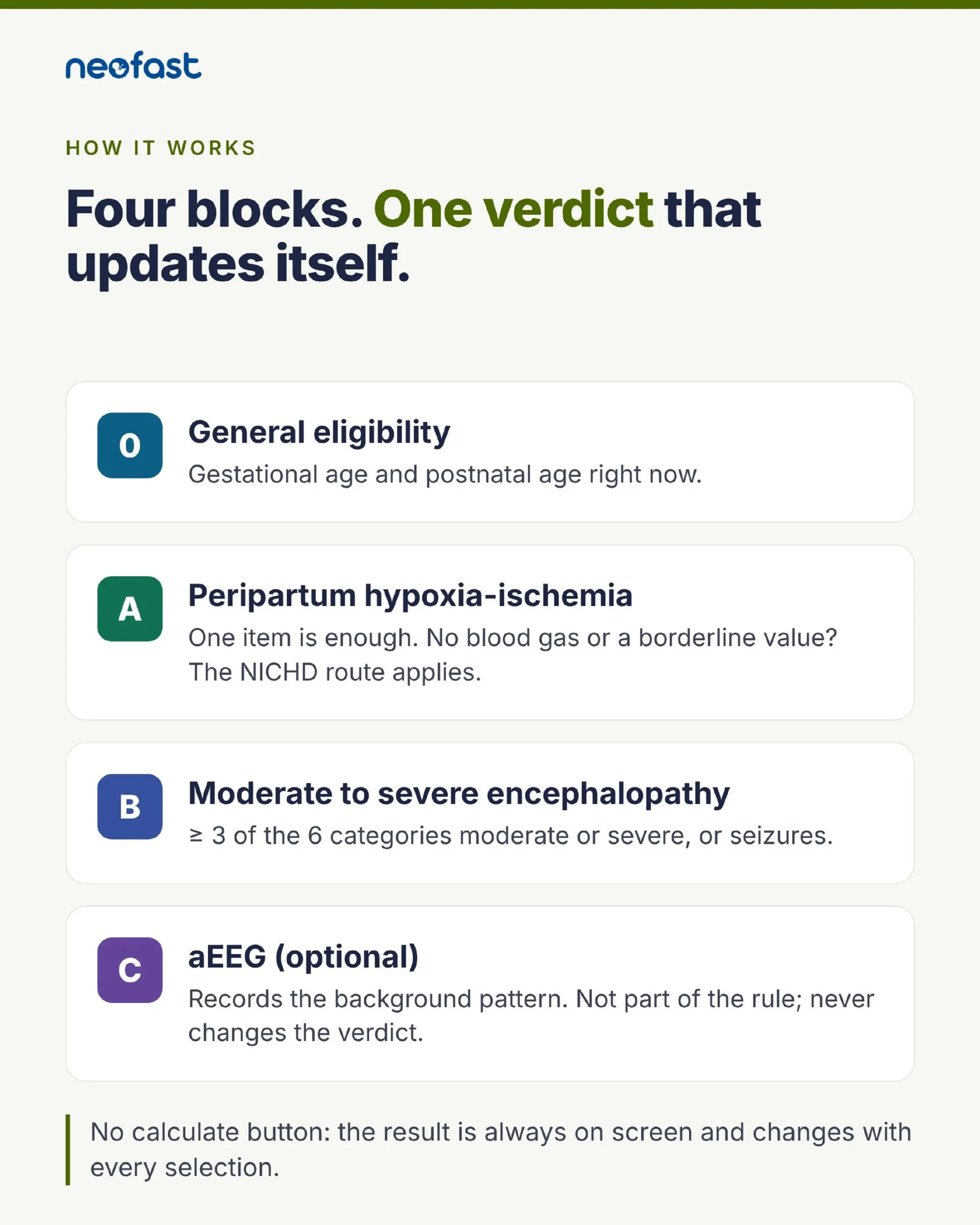
HOW IT WORKS
Four blocks. One verdict that updates itself.
0 — General eligibility
Gestational age and postnatal age right now.
A — Peripartum hypoxia-ischemia
One item is enough. No blood gas or a borderline value? The NICHD route applies.
B — Moderate to severe encephalopathy
≥ 3 of the 6 categories moderate or severe, or seizures.
C — aEEG (optional)
Records the background pattern. Not part of the rule; never changes the verdict.
No calculate button: the result is always on screen and changes with every selection.
Block 0 · General Eligibility
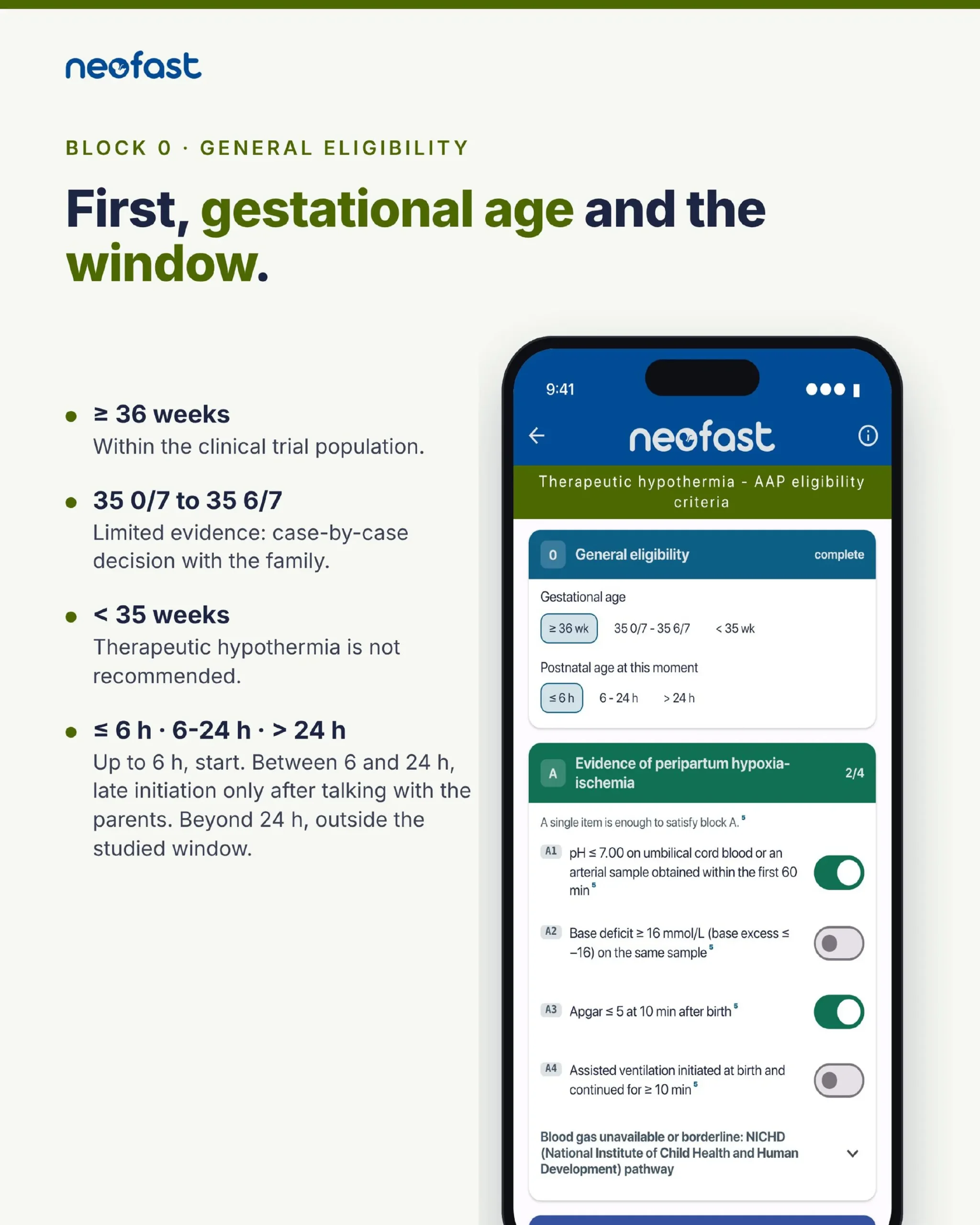
BLOCK 0 · GENERAL ELIGIBILITY
First, gestational age and the window.
- ≥ 36 weeks — Within the clinical trial population.
- 35 0/7 to 35 6/7 — Limited evidence: case-by-case decision with the family.
- < 35 weeks — Therapeutic hypothermia is not recommended.
- ≤ 6 h · 6-24 h · > 24 h — Up to 6 h, start. Between 6 and 24 h, late initiation only after talking with the parents. Beyond 24 h, outside the studied window.
Therapeutic hypothermia – AAP eligibility criteria
0 — General eligibility (complete)
Gestational age
- ≥ 36 wk (selected)
- 35 0/7 – 35 6/7
- < 35 wk
Postnatal age at this moment
- ≤ 6 h (selected)
- 6 – 24 h
- > 24 h
A — Evidence of peripartum hypoxia-ischemia (2/4)
A single item is enough to satisfy block A.5
- A1 — pH ≤ 7.00 on umbilical cord blood or an arterial sample obtained within the first 60 min5 (ON)
- A2 — Base deficit ≥ 16 mmol/L (base excess ≤ −16) on the same sample5 (OFF)
- A3 — Apgar ≤ 5 at 10 min after birth5 (ON)
- A4 — Assisted ventilation initiated at birth and continued for ≥ 10 min5 (OFF)
Blood gas unavailable or borderline: NICHD (National Institute of Child Health and Human Development) pathway
Block A · Peripartum Hypoxia-Ischemia
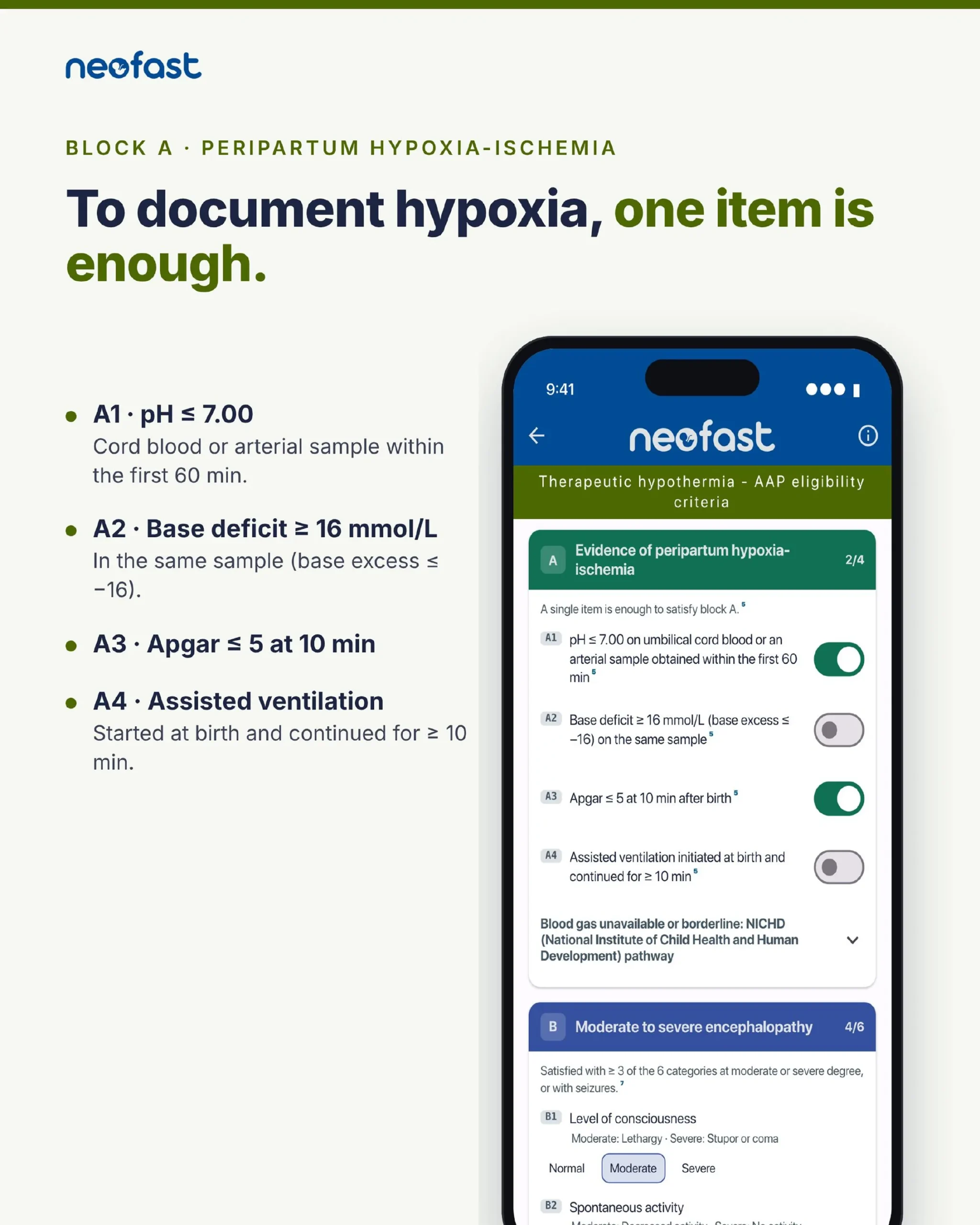
BLOCK A · PERIPARTUM HYPOXIA-ISCHEMIA
To document hypoxia, one item is enough.
- A1 · pH ≤ 7.00 — Cord blood or arterial sample within the first 60 min.
- A2 · Base deficit ≥ 16 mmol/L — In the same sample (base excess ≤ −16).
- A3 · Apgar ≤ 5 at 10 min
- A4 · Assisted ventilation — Started at birth and continued for ≥ 10 min.
Therapeutic hypothermia – AAP eligibility criteria
A — Evidence of peripartum hypoxia-ischemia (2/4)
A single item is enough to satisfy block A.5
- A1 — pH ≤ 7.00 on umbilical cord blood or an arterial sample obtained within the first 60 min5 (ON)
- A2 — Base deficit ≥ 16 mmol/L (base excess ≤ −16) on the same sample5 (OFF)
- A3 — Apgar ≤ 5 at 10 min after birth5 (ON)
- A4 — Assisted ventilation initiated at birth and continued for ≥ 10 min5 (OFF)
Blood gas unavailable or borderline: NICHD (National Institute of Child Health and Human Development) pathway
B — Moderate to severe encephalopathy (4/6)
Satisfied with ≥ 3 of the 6 categories at moderate or severe degree, or with seizures.7
- B1 — Level of consciousness — Moderate: Lethargy · Severe: Stupor or coma — Options: Normal, Moderate (selected), Severe
- B2 — Spontaneous activity — Moderate: Decreased activity · Severe: No activity
Block A · NICHD Route
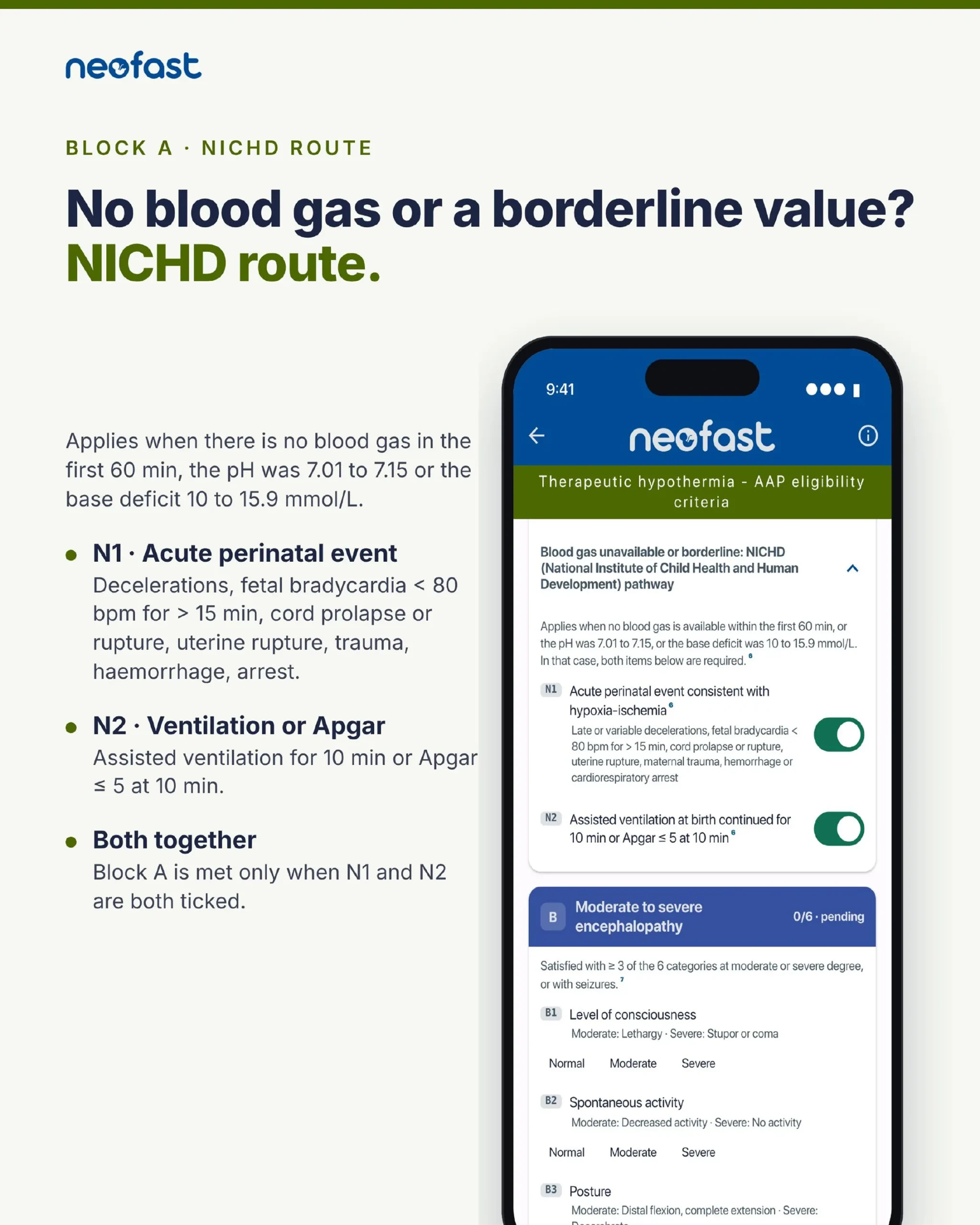
BLOCK A · NICHD ROUTE
No blood gas or a borderline value? NICHD route.
Applies when there is no blood gas in the first 60 min, the pH was 7.01 to 7.15 or the base deficit 10 to 15.9 mmol/L.
- N1 · Acute perinatal event — Decelerations, fetal bradycardia < 80 bpm for > 15 min, cord prolapse or rupture, uterine rupture, trauma, haemorrhage, arrest.
- N2 · Ventilation or Apgar — Assisted ventilation for 10 min or Apgar ≤ 5 at 10 min.
- Both together — Block A is met only when N1 and N2 are both ticked.
Therapeutic hypothermia – AAP eligibility criteria
Blood gas unavailable or borderline: NICHD (National Institute of Child Health and Human Development) pathway
Applies when no blood gas is available within the first 60 min, or the pH was 7.01 to 7.15, or the base deficit was 10 to 15.9 mmol/L. In that case, both items below are required.6
- N1 — Acute perinatal event consistent with hypoxia-ischemia6 — Late or variable decelerations, fetal bradycardia < 80 bpm for > 15 min, cord prolapse or rupture, uterine rupture, maternal trauma, hemorrhage or cardiorespiratory arrest (ON)
- N2 — Assisted ventilation at birth continued for 10 min or Apgar ≤ 5 at 10 min6 (ON)
B — Moderate to severe encephalopathy (0/6 · pending)
Satisfied with ≥ 3 of the 6 categories at moderate or severe degree, or with seizures.7
- B1 — Level of consciousness — Moderate: Lethargy · Severe: Stupor or coma — Normal, Moderate, Severe
- B2 — Spontaneous activity — Moderate: Decreased activity · Severe: No activity — Normal, Moderate, Severe
- B3 — Posture — Moderate: Distal flexion, complete extension · Severe: Decerebrate…
Block B · Encephalopathy
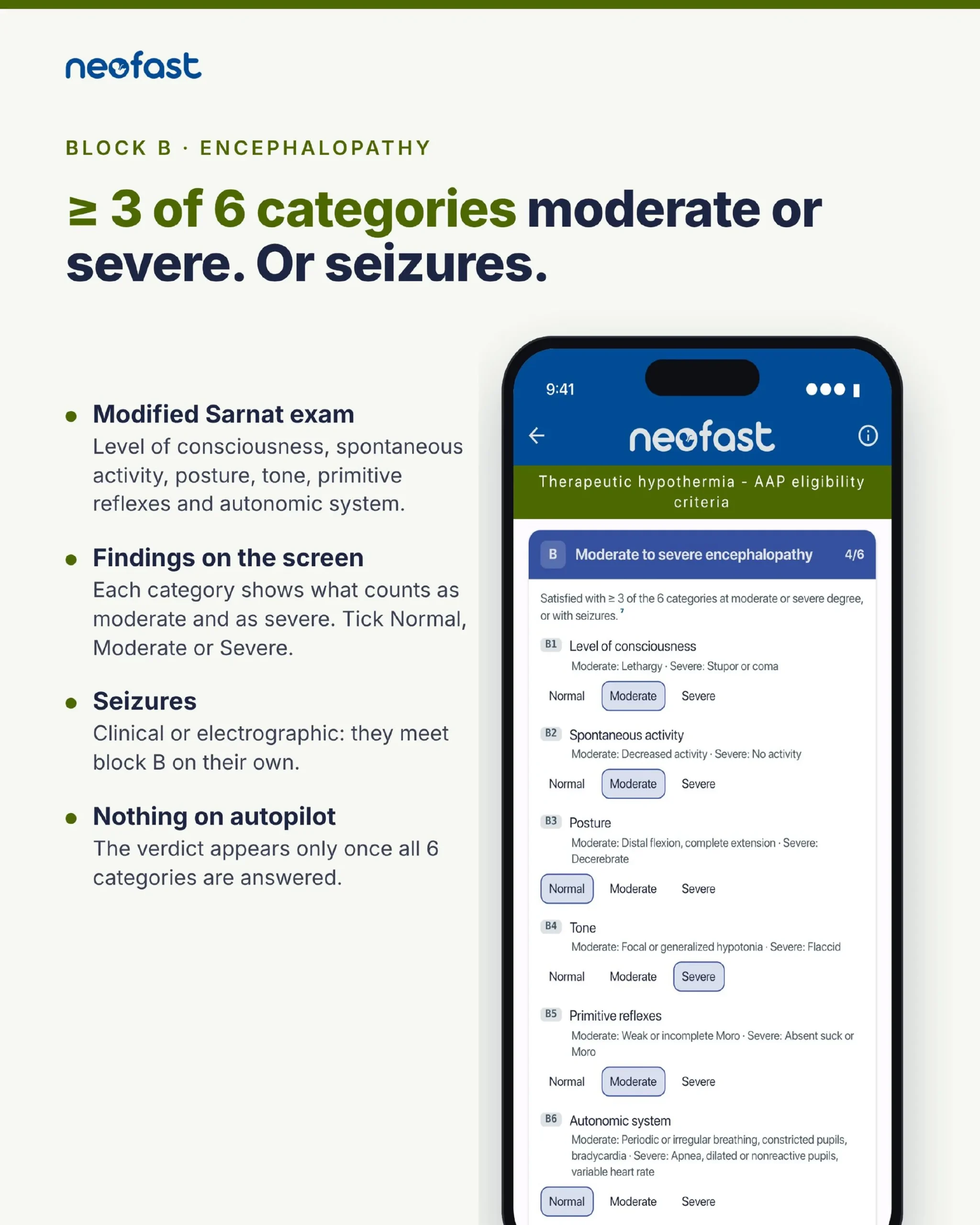
BLOCK B · ENCEPHALOPATHY
≥ 3 of 6 categories moderate or severe. Or seizures.
- Modified Sarnat exam — Level of consciousness, spontaneous activity, posture, tone, primitive reflexes and autonomic system.
- Findings on the screen — Each category shows what counts as moderate and as severe. Tick Normal, Moderate or Severe.
- Seizures — Clinical or electrographic: they meet block B on their own.
- Nothing on autopilot — The verdict appears only once all 6 categories are answered.
Therapeutic hypothermia – AAP eligibility criteria
B — Moderate to severe encephalopathy (4/6)
Satisfied with ≥ 3 of the 6 categories at moderate or severe degree, or with seizures.7
- B1 — Level of consciousness — Moderate: Lethargy · Severe: Stupor or coma — Moderate (selected)
- B2 — Spontaneous activity — Moderate: Decreased activity · Severe: No activity — Moderate (selected)
- B3 — Posture — Moderate: Distal flexion, complete extension · Severe: Decerebrate — Normal (selected)
- B4 — Tone — Moderate: Focal or generalized hypotonia · Severe: Flaccid — Severe (selected)
- B5 — Primitive reflexes — Moderate: Weak or incomplete Moro · Severe: Absent suck or Moro — Moderate (selected)
- B6 — Autonomic system — Moderate: Periodic or irregular breathing, constricted pupils, bradycardia · Severe: Apnea, dilated or nonreactive pupils, variable heart rate — Normal, Moderate, Severe
Block C · aEEG
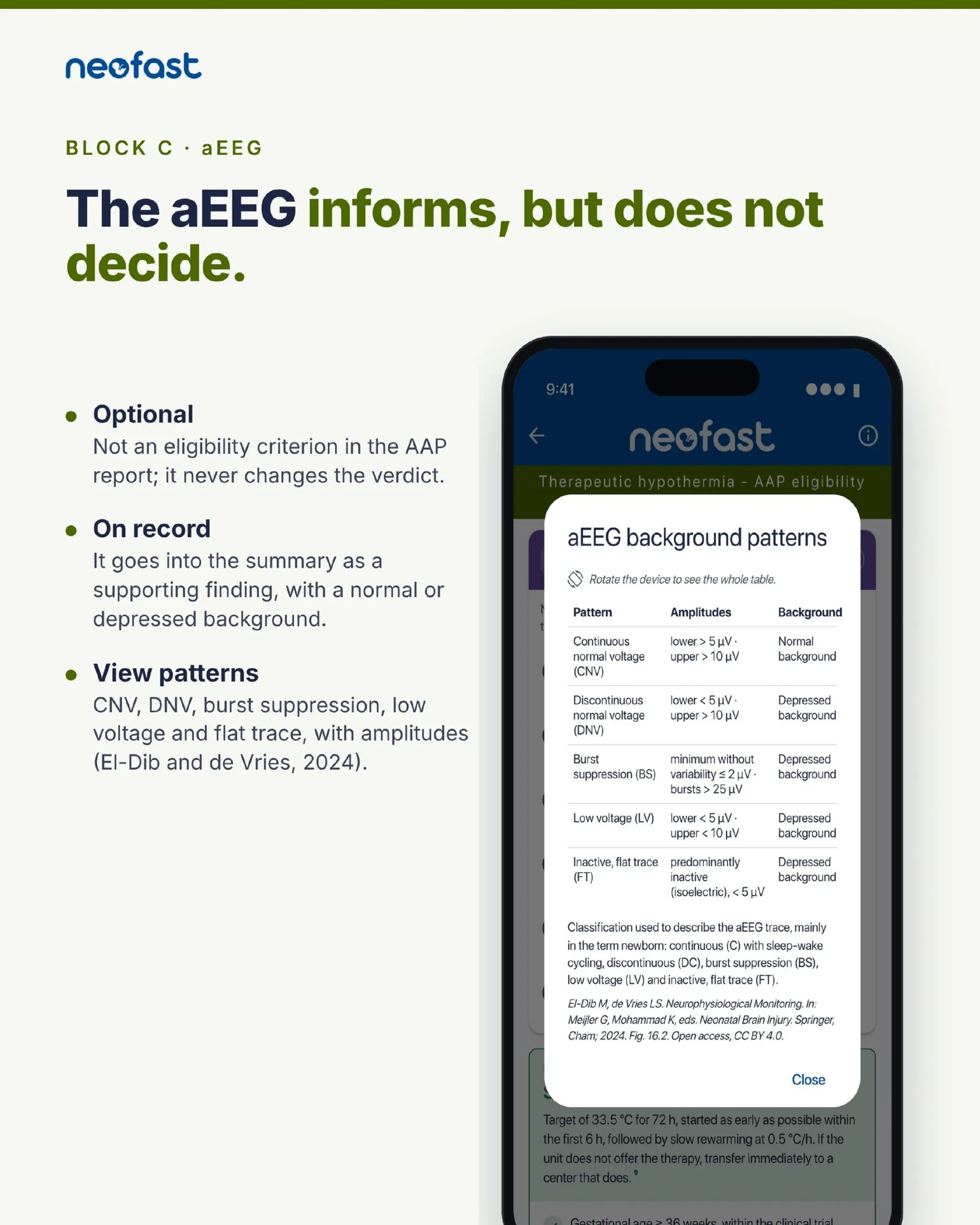
BLOCK C · aEEG
The aEEG informs, but does not decide.
- Optional — Not an eligibility criterion in the AAP report; it never changes the verdict.
- On record — It goes into the summary as a supporting finding, with a normal or depressed background.
- View patterns — CNV, DNV, burst suppression, low voltage and flat trace, with amplitudes (El-Dib and de Vries, 2024).
aEEG background patterns
Rotate the device to see the whole table.
| Pattern | Amplitudes | Background |
|---|---|---|
| Continuous normal voltage (CNV) | lower > 5 μV · upper > 10 μV | Normal background |
| Discontinuous normal voltage (DNV) | lower < 5 μV · upper > 10 μV | Depressed background |
| Burst suppression (BS) | minimum without variability ≤ 2 μV · bursts > 25 μV | Depressed background |
| Low voltage (LV) | lower < 5 μV · upper < 10 μV | Depressed background |
| Inactive, flat trace (FT) | predominantly inactive (isoelectric), < 5 μV | Depressed background |
Classification used to describe the aEEG trace, mainly in the term newborn: continuous (C) with sleep-wake cycling, discontinuous (DC), burst suppression (BS), low voltage (LV) and inactive, flat trace (FT).
The Verdict
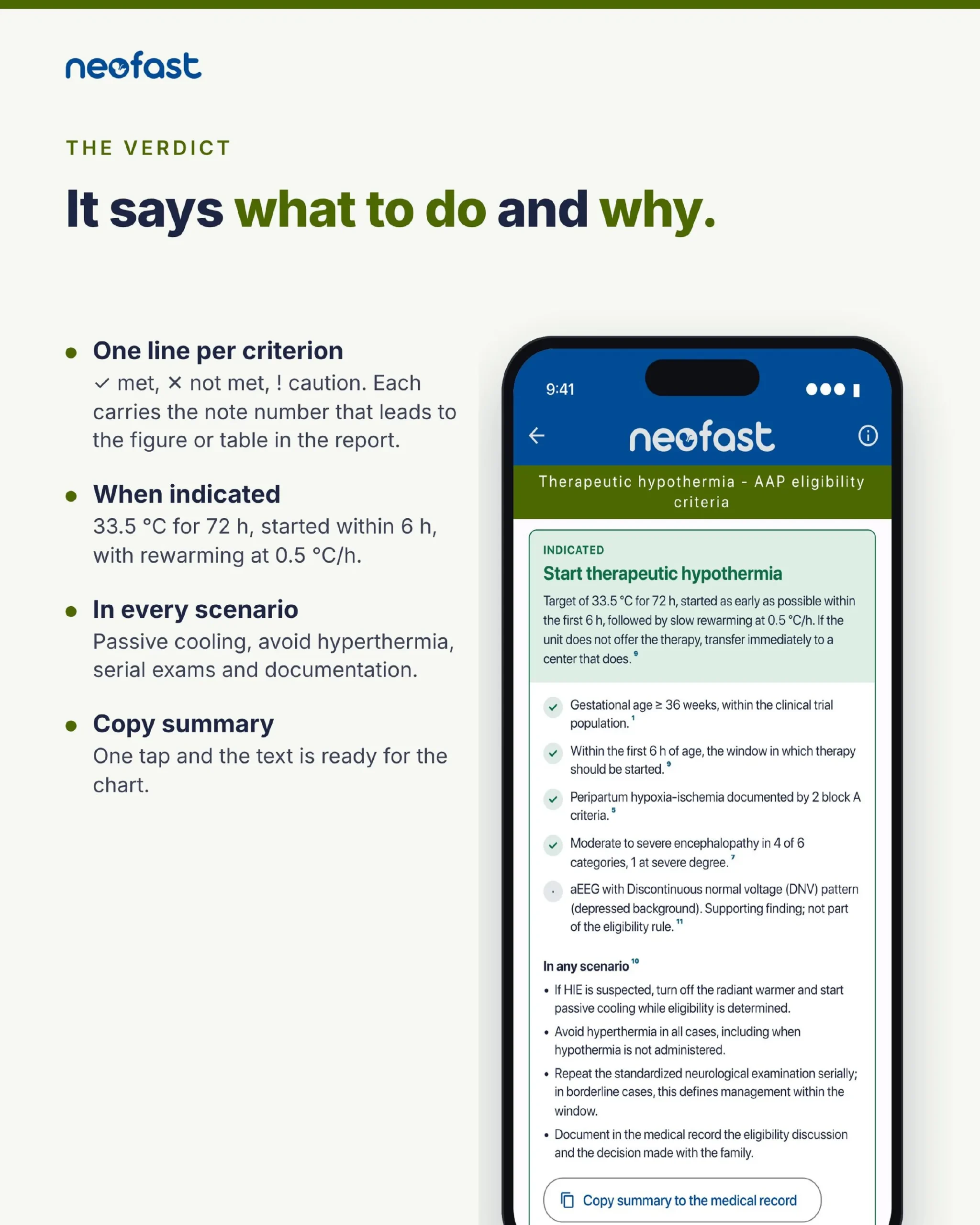
THE VERDICT
It says what to do and why.
- One line per criterion — ✓ met, ✗ not met, ! caution. Each carries the note number that leads to the figure or table in the report.
- When indicated — 33.5 °C for 72 h, started within 6 h, with rewarming at 0.5 °C/h.
- In every scenario — Passive cooling, avoid hyperthermia, serial exams and documentation.
- Copy summary — One tap and the text is ready for the chart.
Therapeutic hypothermia – AAP eligibility criteria
INDICATED
Start therapeutic hypothermia
Target of 33.5 °C for 72 h, started as early as possible within the first 6 h, followed by slow rewarming at 0.5 °C/h. If the unit does not offer the therapy, transfer immediately to a center that does.9
- Gestational age ≥ 36 weeks, within the clinical trial population.1
- Within the first 6 h of age, the window in which therapy should be started.9
- Peripartum hypoxia-ischemia documented by 2 block A criteria.5
- Moderate to severe encephalopathy in 4 of 6 categories, 1 at severe degree.7
- aEEG with Discontinuous normal voltage (DNV) pattern (depressed background). Supporting finding; not part of the eligibility rule.11
In any scenario10
- If HIE is suspected, turn off the radiant warmer and start passive cooling while eligibility is determined.
- Avoid hyperthermia in all cases, including when hypothermia is not administered.
- Repeat the standardized neurological examination serially; in borderline cases, this defines management within the window.
- Document in the medical record the eligibility discussion and the decision made with the family.
[Copy summary to the medical record]
Not Every Case Is Yes or No: Six Possible Answers, in Three Colours
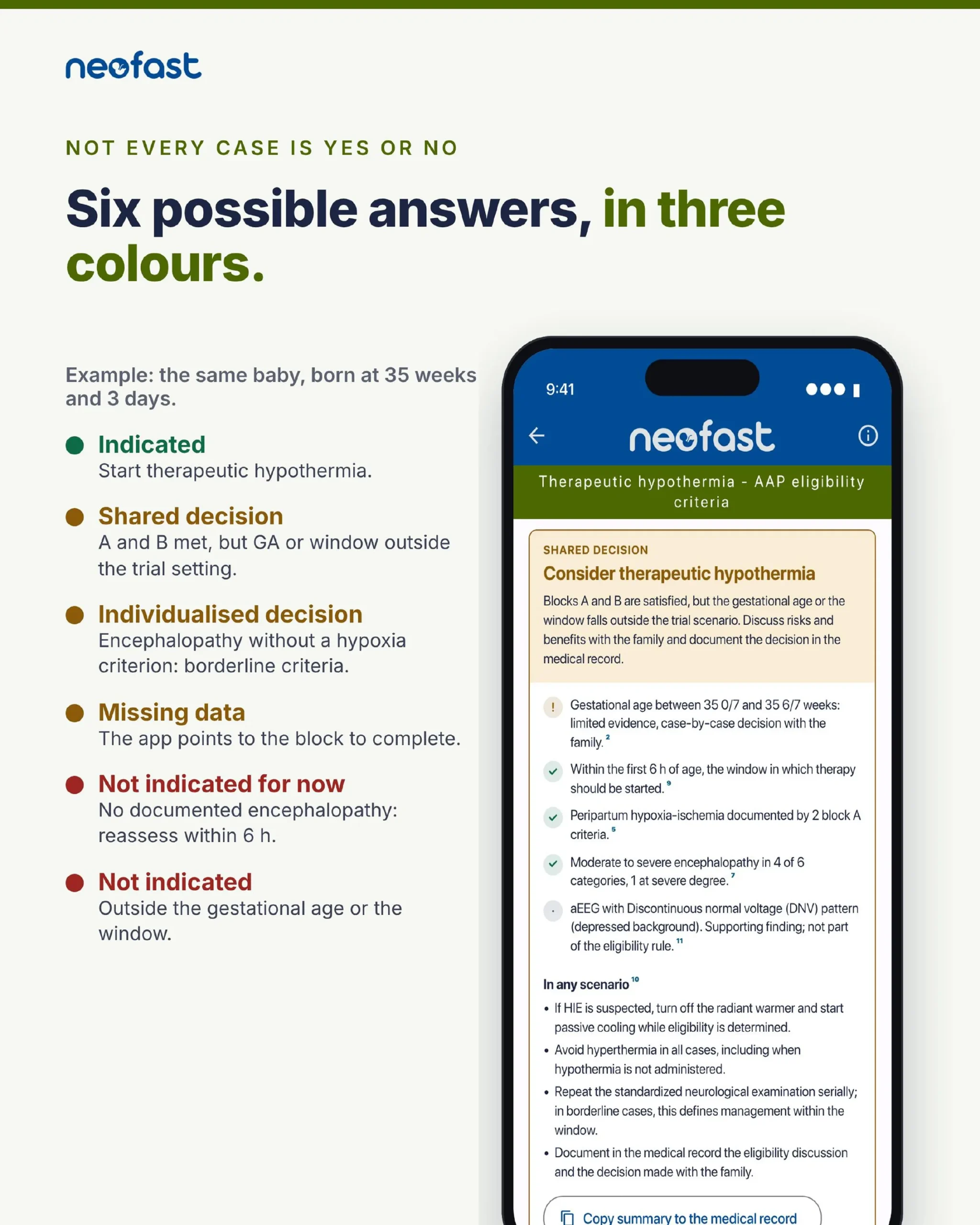
NOT EVERY CASE IS YES OR NO
Six possible answers, in three colours.
Example: the same baby, born at 35 weeks and 3 days.
- Indicated — Start therapeutic hypothermia.
- Shared decision — A and B met, but GA or window outside the trial setting.
- Individualised decision — Encephalopathy without a hypoxia criterion: borderline criteria.
- Missing data — The app points to the block to complete.
- Not indicated for now — No documented encephalopathy: reassess within 6 h.
- Not indicated — Outside the gestational age or the window.
App screenshot: Therapeutic hypothermia – AAP eligibility criteria
SHARED DECISION
Consider therapeutic hypothermia
Blocks A and B are satisfied, but the gestational age or the window falls outside the trial scenario. Discuss risks and benefits with the family and document the decision in the medical record.
- Gestational age between 35 0/7 and 35 6/7 weeks: limited evidence, case-by-case decision with the family.2
- Within the first 6 h of age, the window in which therapy should be started.9
- Peripartum hypoxia-ischemia documented by 2 block A criteria.5
- Moderate to severe encephalopathy in 4 of 6 categories, 1 at severe degree.7
- aEEG with Discontinuous normal voltage (DNV) pattern (depressed background). Supporting finding; not part of the eligibility rule.11
In any scenario10
- If HIE is suspected, turn off the radiant warmer and start passive cooling while eligibility is determined.
- Avoid hyperthermia in all cases, including when hypothermia is not administered.
- Repeat the standardized neurological examination serially; in borderline cases, this defines management within the window.
- Document in the medical record the eligibility discussion and the decision made with the family.
Copy summary to the medical record
In the App: Other Calculations and Scores — Therapeutic Hypothermia
IN THE APP
Other calculations and scores > Therapeutic hypothermia
Get NeoFast
App Store and Google Play · 30 days free on your first purchase.
Before using
The aEEG component is complementary, is not part of the AAP eligibility criteria and does not change the result.
The result is decision support and does not replace clinical judgment, the serial neurological examination by a trained examiner or the institution’s protocol. Responsibility for any action lies with the clinician caring for the patient.
REFERENCES
- Zanelli SA, Wusthoff CJ, Lucke AM, Kaufman DA; Committee on Fetus and Newborn; Section on Neurology. Therapeutic Hypothermia for Neonatal Hypoxic-Ischemic Encephalopathy: Clinical Report. Pediatrics. 2026;157(2):e2025073627. doi: 10.1542/peds.2025-073627.
- El-Dib M, de Vries LS. Neurophysiological Monitoring. In: Meijler G, Mohammad K, eds. Neonatal Brain Injury. Springer, Cham; 2024. doi: 10.1007/978-3-031-55972-3_16. Open access, CC BY 4.0 license.
Frequently asked questions
What are the AAP criteria for starting therapeutic hypothermia in HIE?
Gestational age ≥36 weeks, within the first 6 hours of age, documented peripartum hypoxia-ischemia (2 of 4 Block A criteria), and moderate to severe encephalopathy (4 of 6 categories, at least 1 severe), per the AAP clinical report.
What is the target temperature and duration for therapeutic hypothermia?
33.5°C for 72 hours, started as early as possible within the first 6 hours of age, followed by slow rewarming at 0.5°C per hour.
What is the NICHD route for Block A when blood gas is unavailable or borderline?
It applies when there is no blood gas within the first 60 minutes, pH is 7.01-7.15, or base deficit is 10-15.9 mmol/L. In this case, both N1 (an acute perinatal event like decelerations, fetal bradycardia <80 bpm for >15 min, cord prolapse/rupture, uterine rupture, trauma, hemorrhage, or arrest) and N2 (assisted ventilation ≥10 min or Apgar ≤5 at 10 min) must be present together.
Does aEEG determine eligibility for cooling?
No. aEEG (Block C) is optional and complementary; it is not part of the AAP eligibility criteria and never changes the verdict, though a Discontinuous normal voltage (DNV) pattern can be documented as a supporting finding.
What should be done for infants born at 35 0/7 to 35 6/7 weeks?
Evidence is limited at this gestational age, so the decision should be made case-by-case with the family rather than following the standard ≥36 weeks indication.