


关键要点
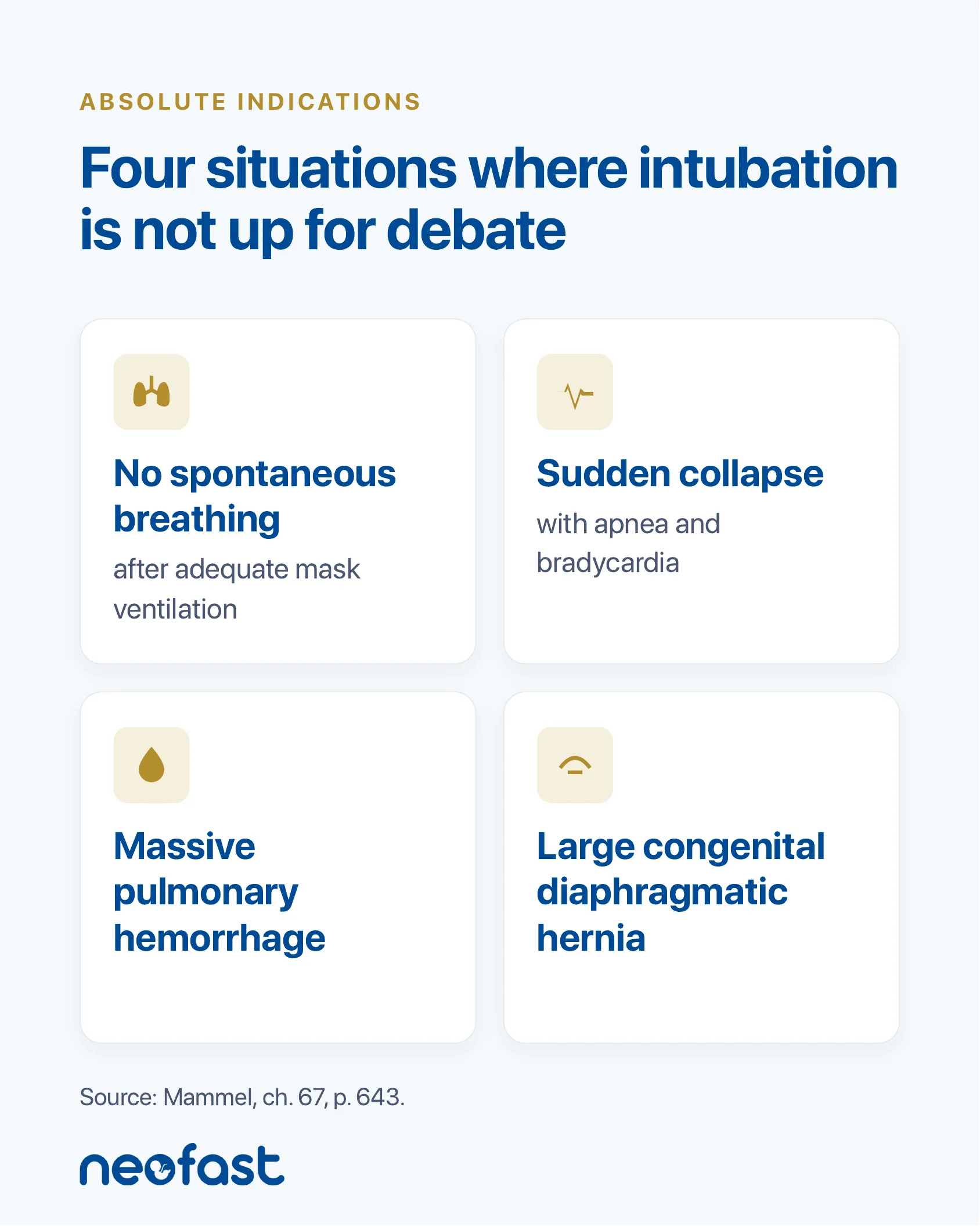
- 新生儿插管的四个绝对指征是充分面罩通气后无自主呼吸、突然虚脱伴呼吸暂停和心动过缓、大量肺出血和大型先天性膈疝。
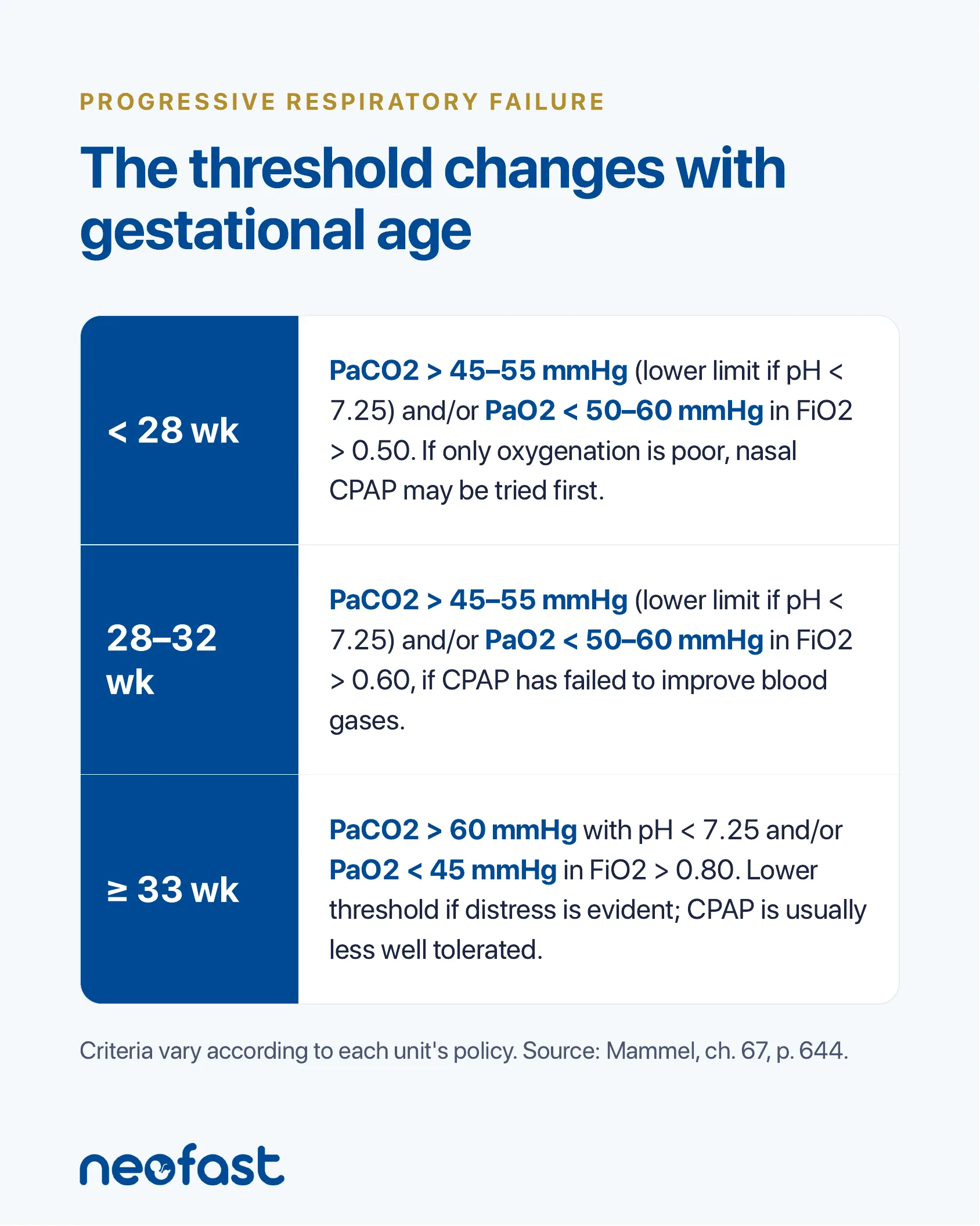
- 在胎龄少于28周的婴儿中,PaCO2 > 45–55 mmHg(pH < 7.25时下限更低)和/或FiO2 > 0.50时PaO2 < 50–60 mmHg时应插管,尽管如果仅为氧合不良,可先尝试鼻腔CPAP。
- 对于胎龄28–32周的婴儿,插管标准为PaCO2 > 45–55 mmHg和/或FiO2 > 0.60时PaO2 < 50–60 mmHg,在CPAP未能改善血气后进行。
- 在≥33周时,PaCO2 > 60 mmHg伴pH < 7.25和/或FiO2 > 0.80时PaO2 < 45 mmHg应插管,如果有明显的呼吸困难迹象则阈值更低,因为CPAP通常耐受性较差。
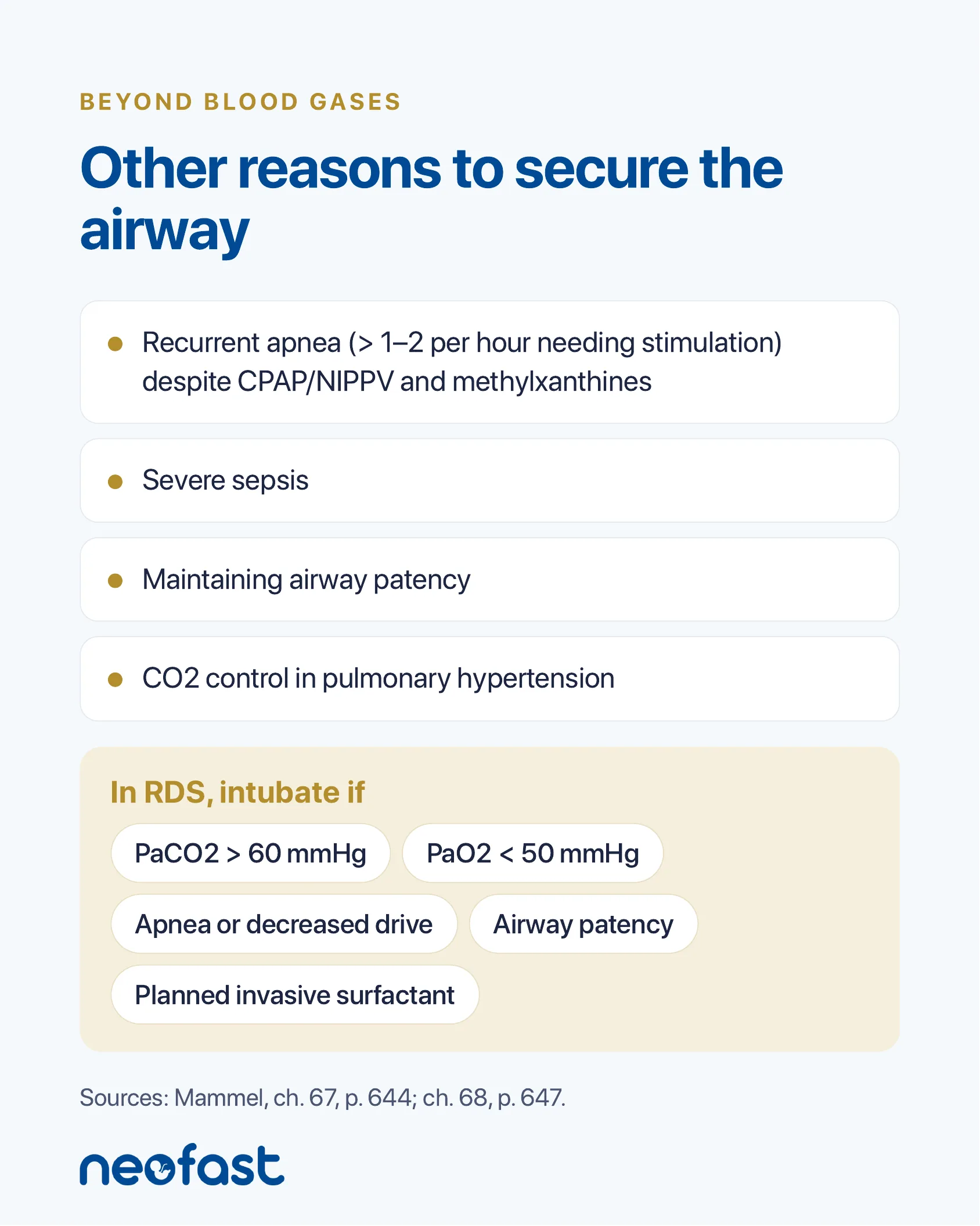
- 除血气指标外,在CPAP/NIPPV和甲基黄嘌呤类治疗后仍存在频繁呼吸暂停(>1–2次/小时需要刺激)、严重脓毒症、维持气道通畅或肺动脉高压中的CO2控制时,也应进行插管。
参考文献
- Mammel MC, van Kaam AHLC, Donn SM, editors. Manual of Neonatal Respiratory Care. 2022.
- Ch. 67, Indications for Mechanical Ventilation (Greenough A, Milner AD), pp. 643–644.
- Ch. 68, Respiratory Distress Syndrome (Donn SM), p. 647.
新生儿插管:何时适应?
新生儿气管插管:何时指示?
绝对指征、按胎龄的血气阈值和保护气道的其他原因。
绝对适应证
四种明确需要插管的情况
- 无自主呼吸 — 充分面罩通气后
- 突然虚脱 — 伴有呼吸暂停和心动过缓
- 大量肺出血
- 大型先天性膈疝
来源:Mammel,第67章,第643页。
进行性呼吸衰竭
阈值随胎龄变化
| 胎龄 | 标准 |
|---|---|
| < 28 周 | PaCO2 > 45–55 mmHg(如pH < 7.25时取下限)和/或FiO2 > 0.50时PaO2 < 50–60 mmHg。如仅氧合不良,可先尝试鼻CPAP。 |
| 28–32 周 | PaCO2 > 45–55 mmHg(如pH < 7.25时取下限)和/或FiO2 > 0.60时PaO2 < 50–60 mmHg,如CPAP未能改善血气。 |
| ≥ 33 周 | PaCO2 > 60 mmHg伴pH < 7.25和/或FiO2 > 0.80时PaO2 < 45 mmHg。如有明显呼吸困难迹象,阈值应降低;通常CPAP耐受性较差。 |
标准因各单位政策而异。来源:Mammel,第67章,第644页。
超越血气分析
保护气道的其他原因
- 尽管使用CPAP/NIPPV和甲基黄嘌呤,反复出现呼吸暂停(> 1–2次/小时需要刺激)
- 重症脓毒血症
- 维持气道通畅
- 肺动脉高压中的CO2控制
在RDS中,如果以下情况则插管
- PaCO2 > 60 mmHg
- PaO2 < 50 mmHg
- 呼吸暂停或呼吸驱动力下降
- 气道通畅
- 计划性有创表面活性剂
来源:Mammel,第67章,第644页;第68章,第647页。
在应用中:标准,一键即达
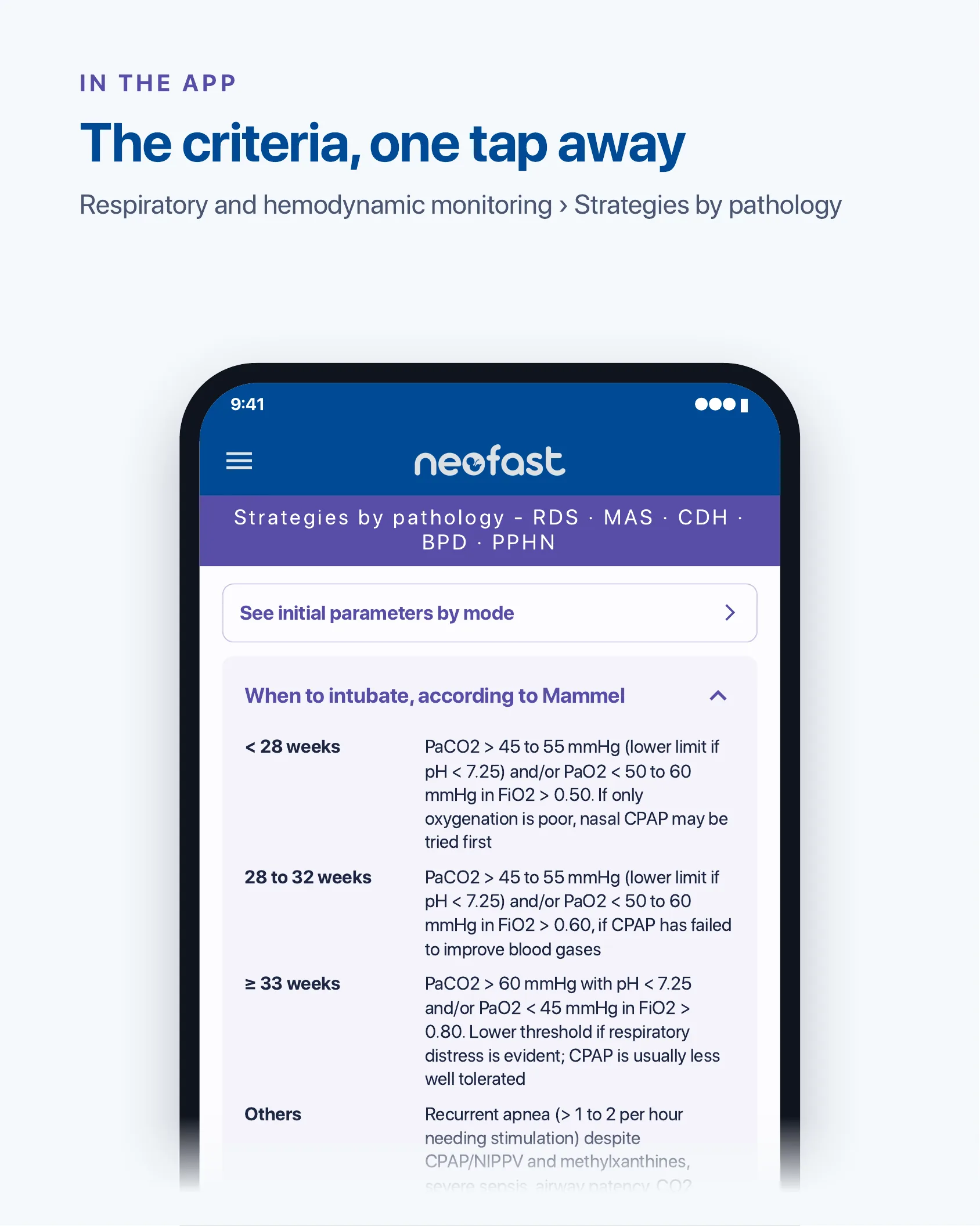
标准,点击即现
呼吸和血流动力学监测 > 按病理分类的策略
应用屏幕:按病理分类的策略 – RDS · MAS · CDH · BPD · PPHN
- 按模式查看初始参数
何时插管,根据Mammel
| 胎龄 | 标准 |
|---|---|
| < 28周 | PaCO2 > 45到55 mmHg(如pH < 7.25则下限)和/或PaO2 < 50到60 mmHg,FiO2 > 0.50。如仅氧合不良,可首先尝试鼻CPAP |
| 28到32周 | PaCO2 > 45到55 mmHg(如pH < 7.25则下限)和/或PaO2 < 50到60 mmHg,FiO2 > 0.60,如CPAP未能改善血气 |
| ≥ 33周 | PaCO2 > 60 mmHg且pH < 7.25和/或PaO2 < 45 mmHg,FiO2 > 0.80。如呼吸窘迫明显则降低阈值;CPAP通常耐受性较差 |
| 其他 | 尽管使用CPAP/NIPPV和甲基黄嘌呤,复发性呼吸暂停(> 1到2次/小时需刺激)、重症败血症、气道通畅性、CO2… |
在应用中:按体重快速序列
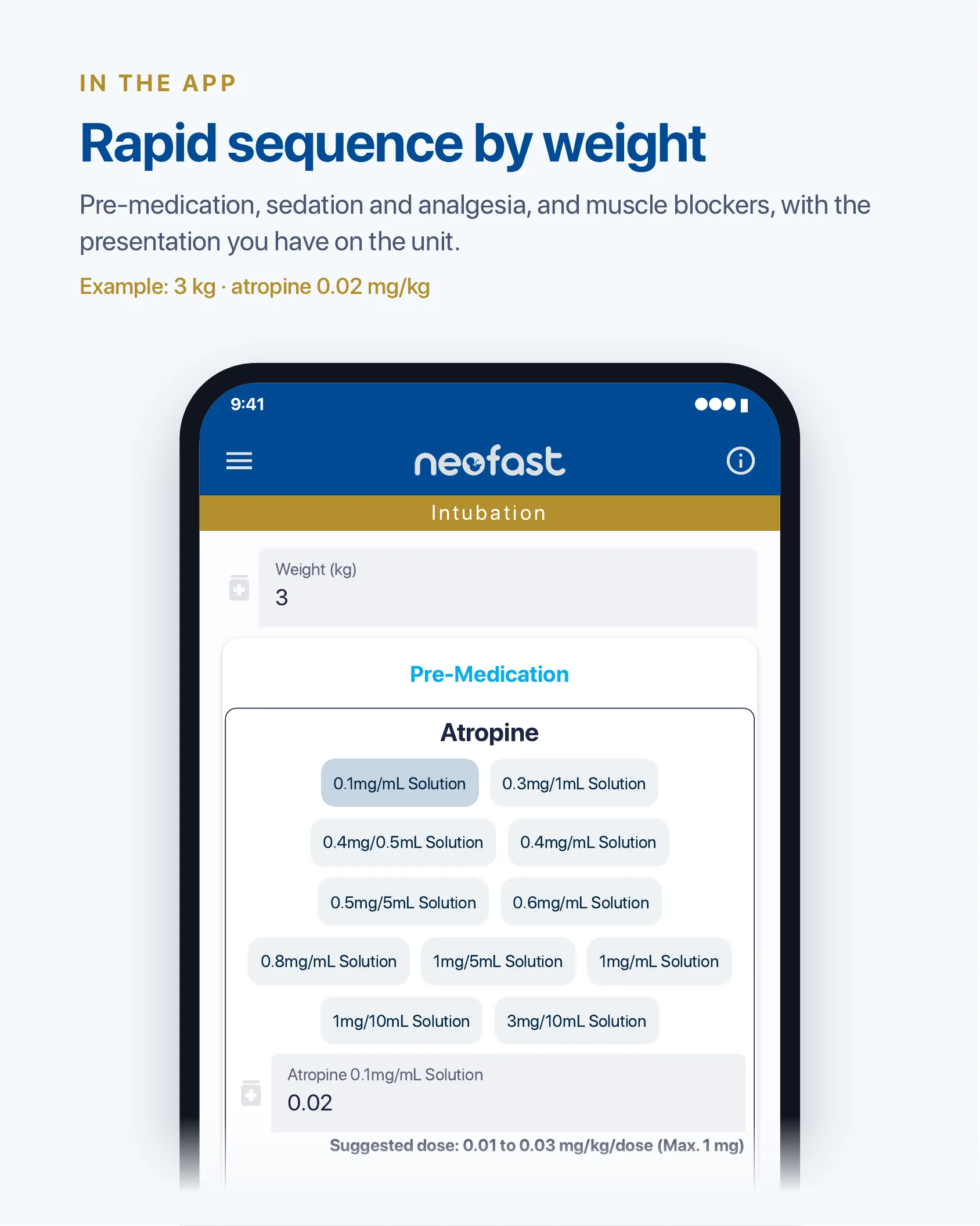
按体重快速序列
根据单位提供的预处理、镇静和镇痛以及肌肉松弛剂。
示例:3 kg · 阿托品 0.02 mg/kg
应用屏幕:插管
- 体重 (kg):3
预处理
阿托品
- 0.1mg/mL 溶液
- 0.3mg/1mL 溶液
- 0.4mg/0.5mL 溶液
- 0.4mg/mL 溶液
- 0.5mg/5mL 溶液
- 0.6mg/mL 溶液
- 0.8mg/mL 溶液
- 1mg/5mL 溶液
- 1mg/mL 溶液
- 1mg/10mL 溶液
- 3mg/10mL 溶液
阿托品 0.1mg/mL 溶液:0.02
建议剂量:0.01 至 0.03 mg/kg/剂(最大 1 mg)
在应用中:稀释液和体积,准备好抽取
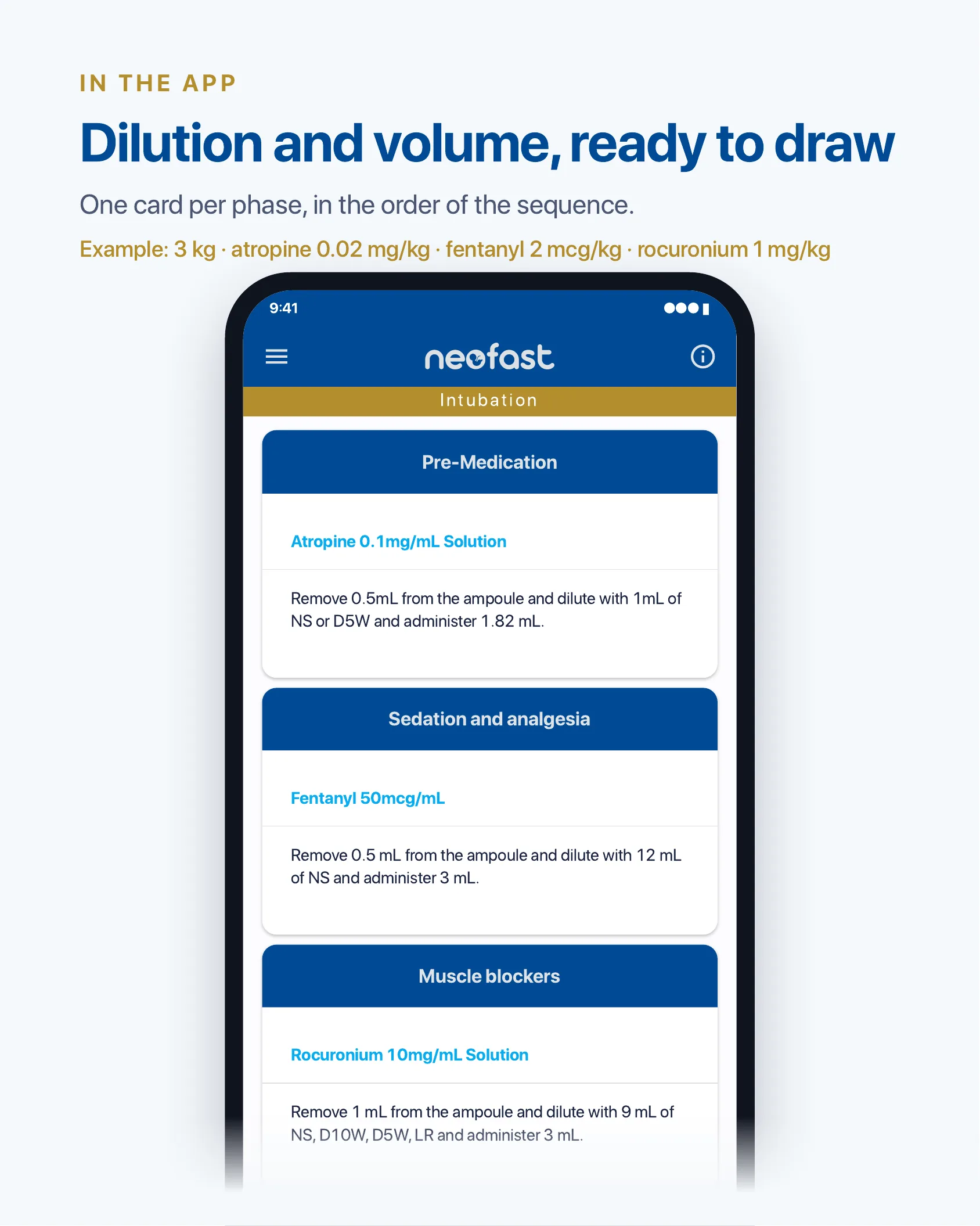
稀释和体积,准备抽取
每个阶段一张卡片,按序列顺序。
示例:3 kg · 阿托品 0.02 mg/kg · 芬太尼 2 mcg/kg · 罗库溴铵 1 mg/kg
应用屏幕:插管
预处理
阿托品 0.1mg/mL 溶液
从安瓿中取出 0.5mL,用 1mL NS 或 D5W 稀释,给予 1.82 mL。
镇静和镇痛
芬太尼 50mcg/mL
从安瓿中取出 0.5 mL,用 12 mL NS 稀释,给予 3 mL。
肌肉松弛药
罗库溴铵 10mg/mL 溶液
从安瓿中取出 1 mL,用 9 mL NS、D10W、D5W、LR 稀释,给予 3 mL。
插管后:监测呼吸机的工作情况
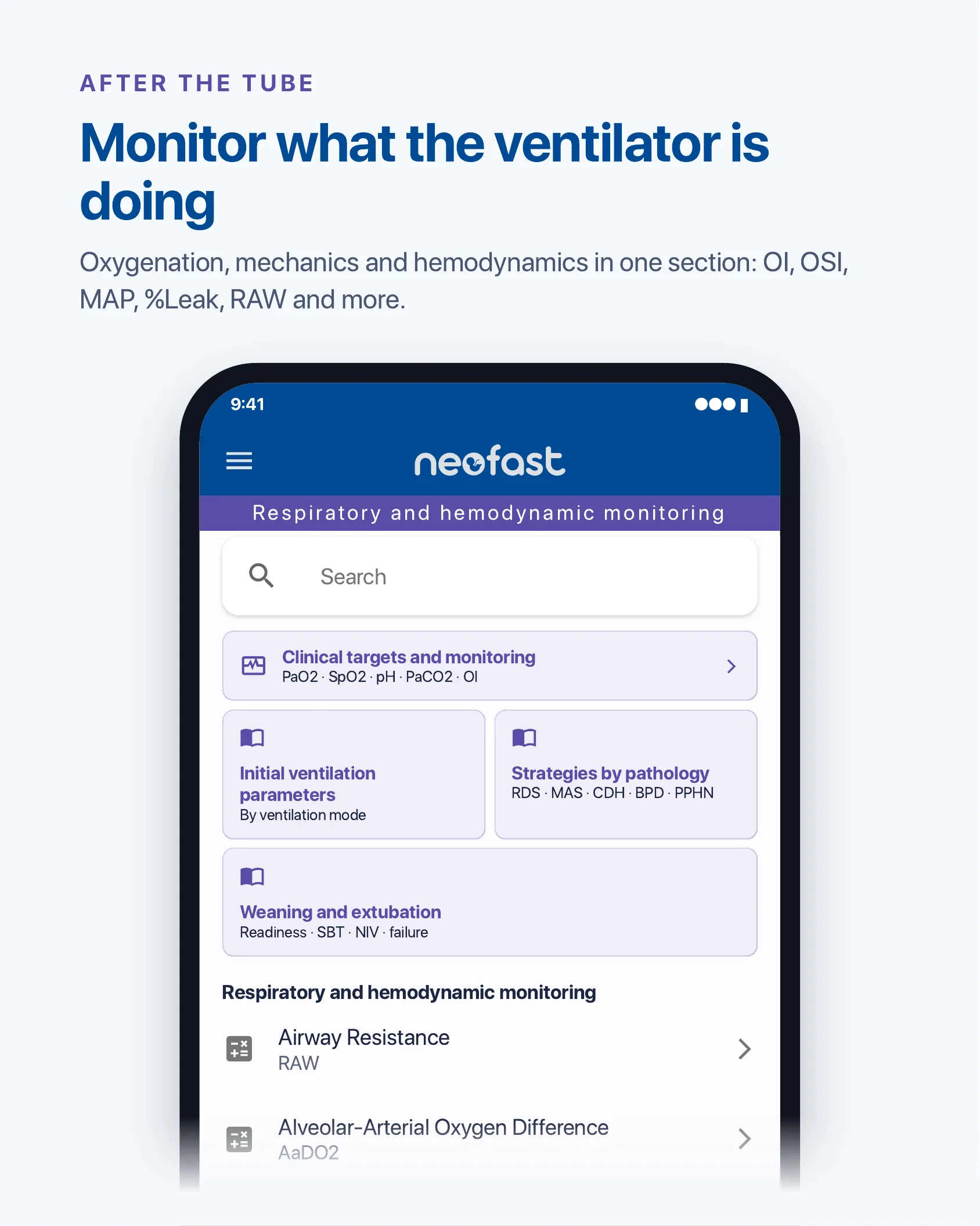
监测呼吸机的运行情况
氧合、力学和血流动力学在一个部分中:OI、OSI、MAP、%Leak、RAW 等。
应用屏幕:呼吸和血流动力学监测
- 临床目标和监测 — PaO2 · SpO2 · pH · PaCO2 · OI
- 初始机械通气参数 — 按机械通气模式
- 按病理学的策略 — RDS · MAS · CDH · BPD · PPHN
- 撤机和拔管 — 准备就绪 · SBT · NIV · 失败
呼吸和血流动力学监测
- 气道阻力 — RAW
- 肺泡-动脉氧分压差 — AaDO2
Neofast – 新生儿计算工具(引用来源)
neofast
引用来源的新生儿计算
气管插管序列、呼吸和血流动力学监测等NICU相关内容。
- App Store · Google Play
该应用计算并引用来源。
临床决策权属于医生。
常见问题
新生儿插管的绝对指征是什么?
四个绝对指征是:充分面罩通气后无自主呼吸、伴心动过缓的突然虚脱和呼吸暂停、大量肺出血和大型先天性膈疝。
28周以下早产儿的血气哪些阈值指示需要插管?
PaCO2 > 45–55 mmHg(如果pH < 7.25使用下限)和/或FiO2 > 0.50时PaO2 < 50–60 mmHg时插管;如果仅氧合不良,可先尝试鼻CPAP。
28–32周的新生儿根据血气何时应该插管?
如果PaCO2 > 45–55 mmHg(pH < 7.25时使用下限)和/或FiO2 > 0.60时PaO2 < 50–60 mmHg,且仅在CPAP未能改善血气后才插管。
胎龄≥33周新生儿的插管标准是什么?
PaCO2 > 60 mmHg且pH < 7.25和/或FiO2 > 0.80时PaO2 < 45 mmHg时插管;如果有呼吸窘迫证据,使用较低阈值,因为这个年龄通常对CPAP耐受性较差。
除血气阈值外,还有哪些临床情况需要插管?
其他指征包括尽管使用CPAP/NIPPV和甲基黄嘌呤仍反复呼吸暂停(>1–2次/小时需要刺激),严重脓毒症、维持气道通畅和呼吸窘迫综合征中的CO2控制;在RDS中,PaCO2 > 60 mmHg、PaO2 < 50 mmHg、呼吸暂停或呼吸驱动力下降、气道通畅需要或计划进行有创表面活性剂治疗时插管。