Key takeaways
- On HFJV, exhalation is passive, so a rate that is too fast traps gas and PaCO2 rises instead of falling; rate has only a small effect on PaCO2.
- Starting HFJV settings are a rate of 420 cycles/min (7 Hz) with a fixed, ultra-short inspiratory time of 0.02 s, within the usual range of 300–450 cycles/min (Goldsmith range: 240–660 cycles/min).
- In conditions with long time constants, lower rates are needed: 240–320 cycles/min for meconium aspiration, 300–340 for severe PIE, and 240–280 for a 2 mm tube.
- PEEP is the main driver of MAP on HFJV: 6–7 cmH2O for FiO2 <0.30, 7–8 cmH2O for FiO2 0.30–0.50, and 9–12 cmH2O for FiO2 >0.50.
- The bedside rule for overexpansion or rising CO2 on HFJV is to lower the rate, not the PEEP, since adequate PEEP keeps the airways open and preserves lung volume.
References
- Mammel MC, van Kaam AHLC, Donn SM (eds.). Manual of Neonatal Respiratory Care. Springer, 2022. Ch. 41, High-Frequency Jet Ventilation (Keszler M), pp. 387–394.
- Goldsmith JP, Karotkin EH, Keszler M, Gautham KS (eds.). Goldsmith’s Assisted Ventilation of the Neonate, 7th ed. Elsevier, 2022. Ch. 24, High-Frequency Ventilation.
High-Frequency Jet Ventilation
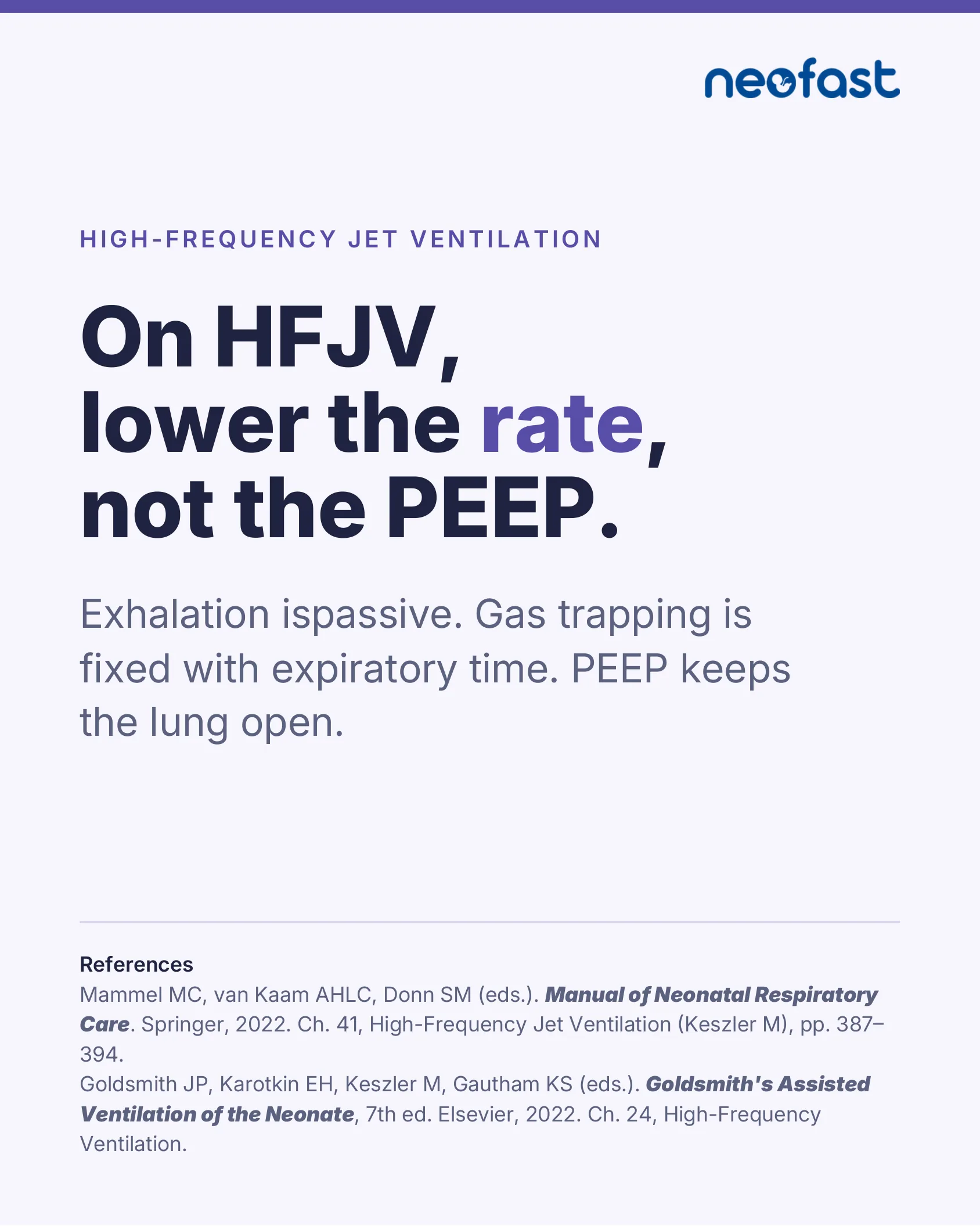
HIGH-FREQUENCY JET VENTILATION
On HFJV, lower the rate, not the PEEP.
Exhalation ispassive. Gas trapping is fixed with expiratory time. PEEP keeps the lung open.
Why It Matters

WHY IT MATTERS
Exhalation on the jet is passive.
- A rate that is too fast traps gas. PaCO2 rises instead of falling.
- Rate has only a small effect on PaCO2.
Mammel, ch. 41, pp. 388–389
Starting Settings
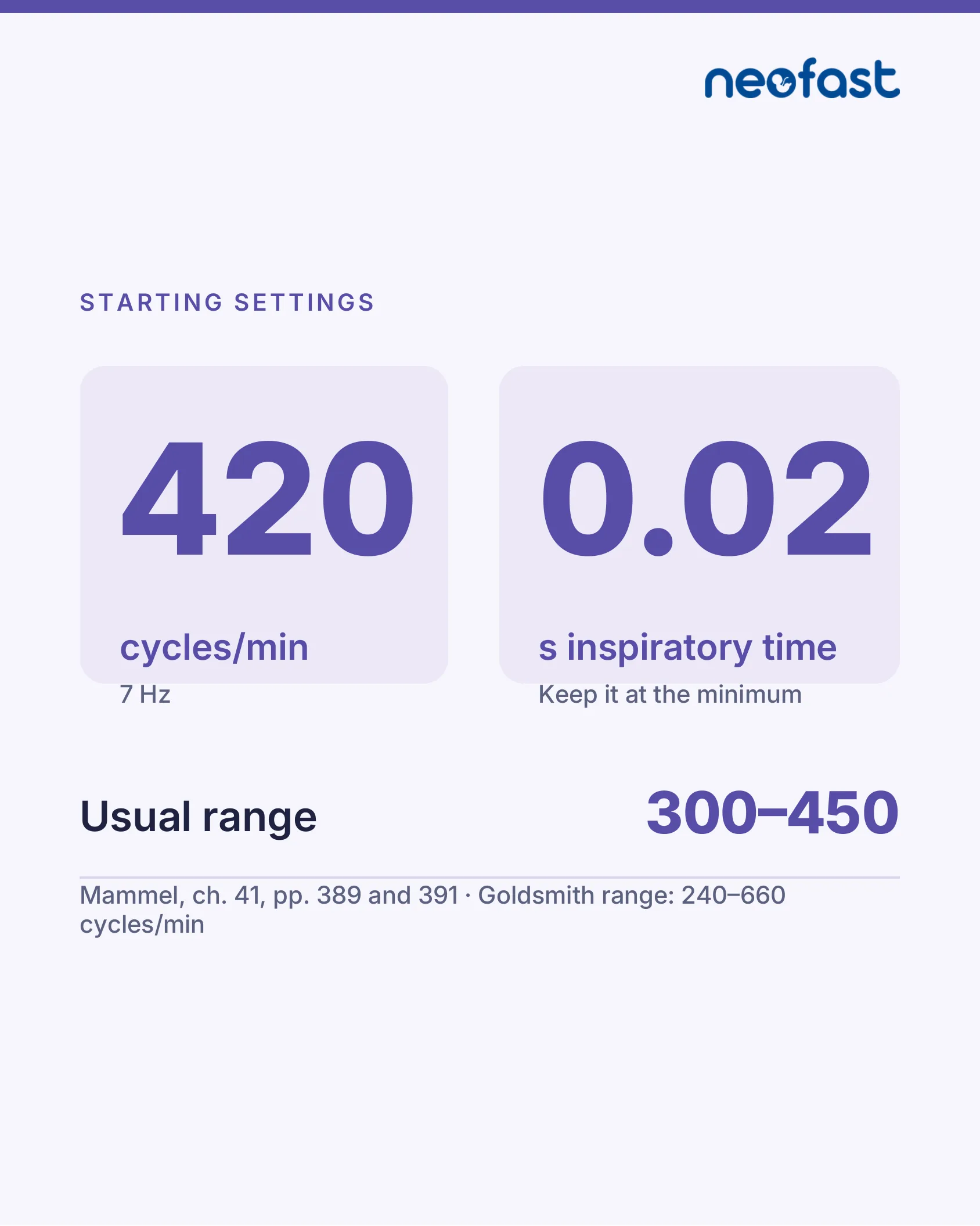
STARTING SETTINGS
| 420 | 0.02 |
|---|---|
| cycles/min 7 Hz | s inspiratory time Keep it at the minimum |
Usual range: 300–450
Mammel, ch. 41, pp. 389 and 391 · Goldsmith range: 240–660 cycles/min
Long Time Constants

LONG TIME CONSTANTS
Go slower when air needs time to leave.
| Condition | Rate (cycles/min) |
|---|---|
| Meconium aspiration | 240–320 |
| Severe PIE | 300–340 |
| 2 mm tube | 240–280 |
cycles/min · Mammel, ch. 41, pp. 391–392
Oxygenation
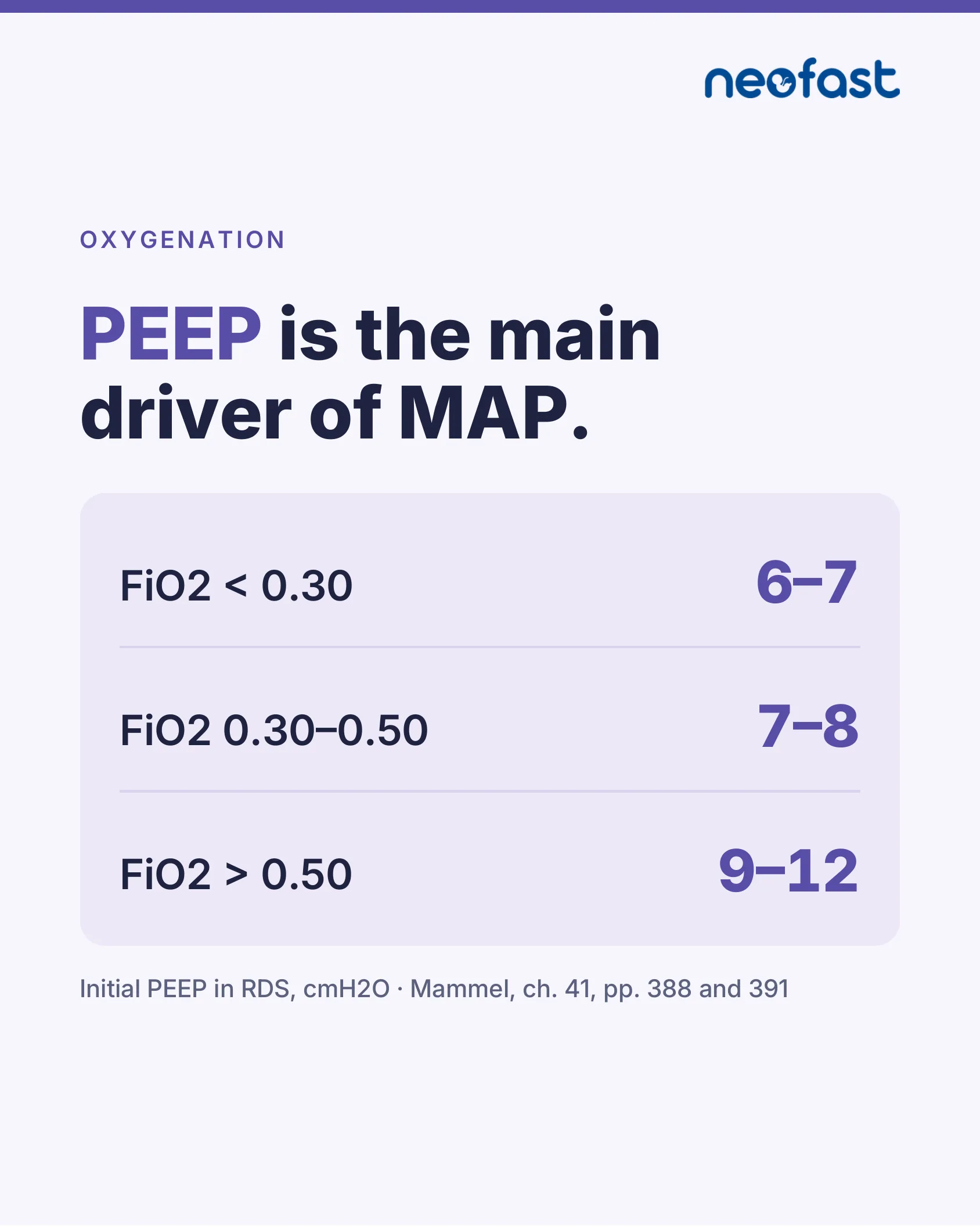
OXYGENATION
PEEP is the main driver of MAP.
| FiO2 | PEEP (cmH2O) |
|---|---|
| FiO2 < 0.30 | 6–7 |
| FiO2 0.30–0.50 | 7–8 |
| FiO2 > 0.50 | 9–12 |
Initial PEEP in RDS, cmH2O · Mammel, ch. 41, pp. 388 and 391
The Bedside Rule

THE BEDSIDE RULE
Overexpansion or rising CO2?
Lower the rate.
Not the PEEP.
Adequate PEEP keeps the airways open and the lung volume.
Mammel, ch. 41, pp. 392–393
In The App

IN THE APP
Every setting, with its source.
- Respiratory and hemodynamic monitoring
- Initial ventilation parameters
- HFJV
HFJV — High-frequency jet ventilation
Passive expiration. Rescue in air leak and obstructive disease.
| Frequency | 420 cycles/min at start (7 Hz). Usual range: 300 to 450 cycles/min (Mammel); 240 to 660 (Goldsmith) |
| Lower rate | MAS: 240 to 320 · Severe PIE: 300 to 340 · 2 mm tube: 240 to 280 cycles/min |
| Ti | 0.02 s, fixed and ultra-short. Only in large infants on a low rate or near the PIP limit: increase by 0.004 s at a time, up to 0.034 s |
| I:E | At least 1:4, preferably 1:5 or above, to avoid gas trapping |
| PIP | 15 to 45 cmH2O. Coming from conventional ventilation: keep the same PIP. Direct start: the pressure that gives visible chest wall movement, without excess |
| CO2 adjustment | PIP ±1 to 2 cmH2O at a time (increase to lower PaCO2). When lowering PIP, raise PEEP if needed to maintain MAP |
| PEEP | 7 to 12 cmH2O, often higher than on conventional ventilation, to keep the lung recruited. In extremely preterm infants, 6 to 8 cmH2O |
| Initial PEEP by FiO2 | < 0.30: 6 to 7 · 0.30 to 0.50: 7 to 8 · > 0.50: 9 to 12 cmH2O |
| FiO2 not below 0.35 | Increase PEEP, unless there is air… |

neofast
Neonatal calculators and guides, with the reference behind every number.
Download on the App Store and Google Play
neofastapp.com
The app calculates and cites the source. Clinical decisions belong to the care team.
Frequently asked questions
What is the starting rate and inspiratory time for HFJV?
Start at 420 cycles/min (7 Hz) with a fixed inspiratory time of 0.02 s. The usual range is 300–450 cycles/min (Mammel), with a wider Goldsmith range of 240–660 cycles/min.
Why does increasing the HFJV rate sometimes raise PaCO2 instead of lowering it?
Exhalation on the jet is passive, so a rate that is too fast traps gas, causing PaCO2 to rise instead of fall. Rate has only a small effect on PaCO2 overall.
What HFJV rates should be used in meconium aspiration syndrome, severe PIE, or with a 2 mm endotracheal tube?
Use slower rates when air needs more time to leave: 240–320 cycles/min for meconium aspiration, 300–340 cycles/min for severe PIE, and 240–280 cycles/min for a 2 mm tube.
What PEEP should be used initially on HFJV based on FiO2 in RDS?
For FiO2 <0.30, use PEEP 6–7 cmH2O; for FiO2 0.30–0.50, use 7–8 cmH2O; for FiO2 >0.50, use 9–12 cmH2O. PEEP is the main driver of MAP on HFJV.
What is the bedside rule when a neonate on HFJV shows overexpansion or rising CO2?
Lower the rate, not the PEEP. Adequate PEEP keeps the airways open and preserves lung volume, while exhalation remains passive and gas trapping is governed by expiratory time.