关键要点
- 在高频喷射通气中,呼气是被动的,因此频率过快会导致气体滞留,PaCO2升高而非下降;频率对PaCO2的影响很小。
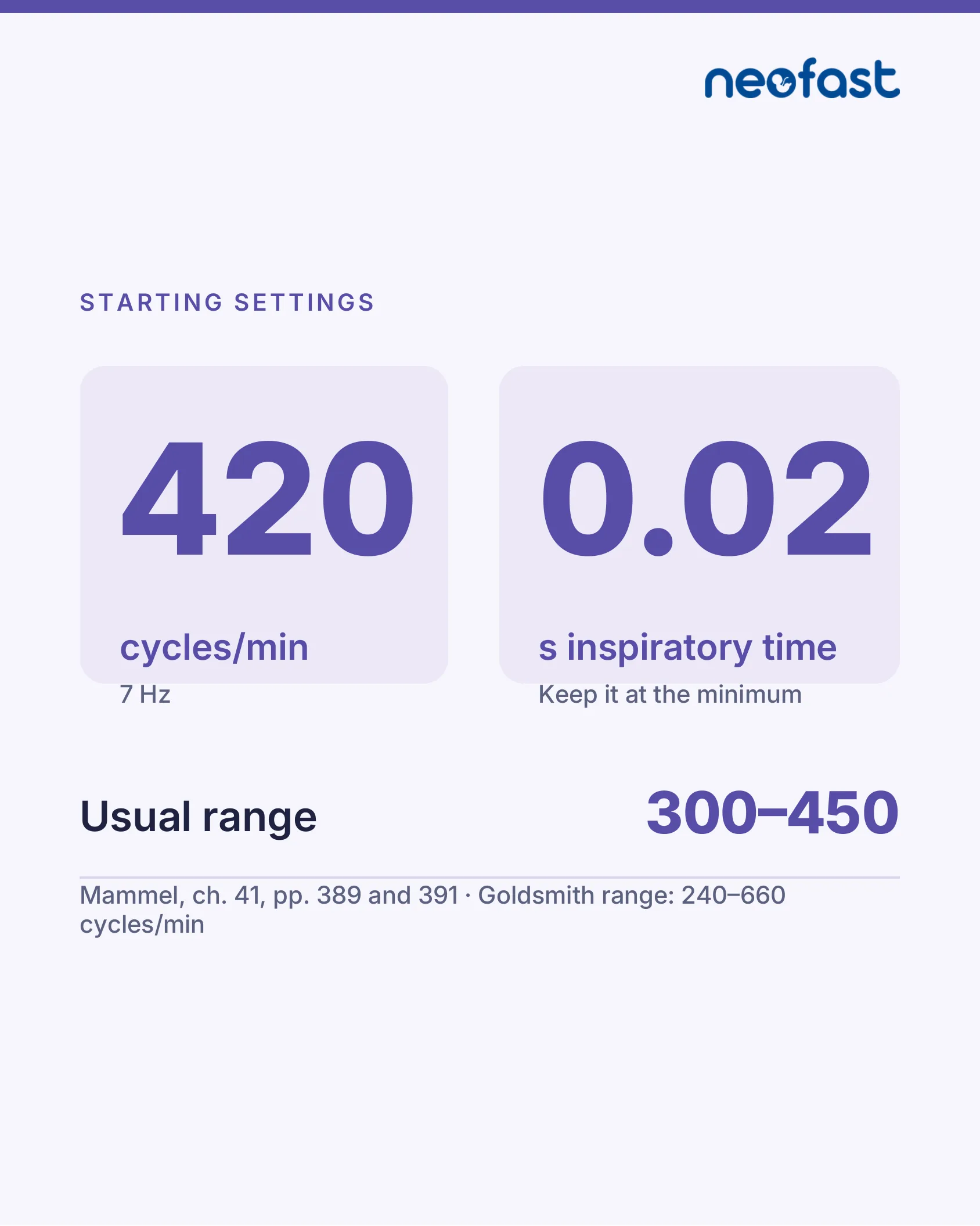
- 高频喷射通气起始设置为420次/分钟(7 Hz),吸气时间固定且极短,为0.02秒,在通常范围300-450次/分钟内(Goldsmith范围:240-660次/分钟)。
- 在时间常数长的情况下,需要较低频率:胎粪吸入为240-320次/分钟,严重肺间质气肿为300-340次/分钟,2毫米管径为240-280次/分钟。
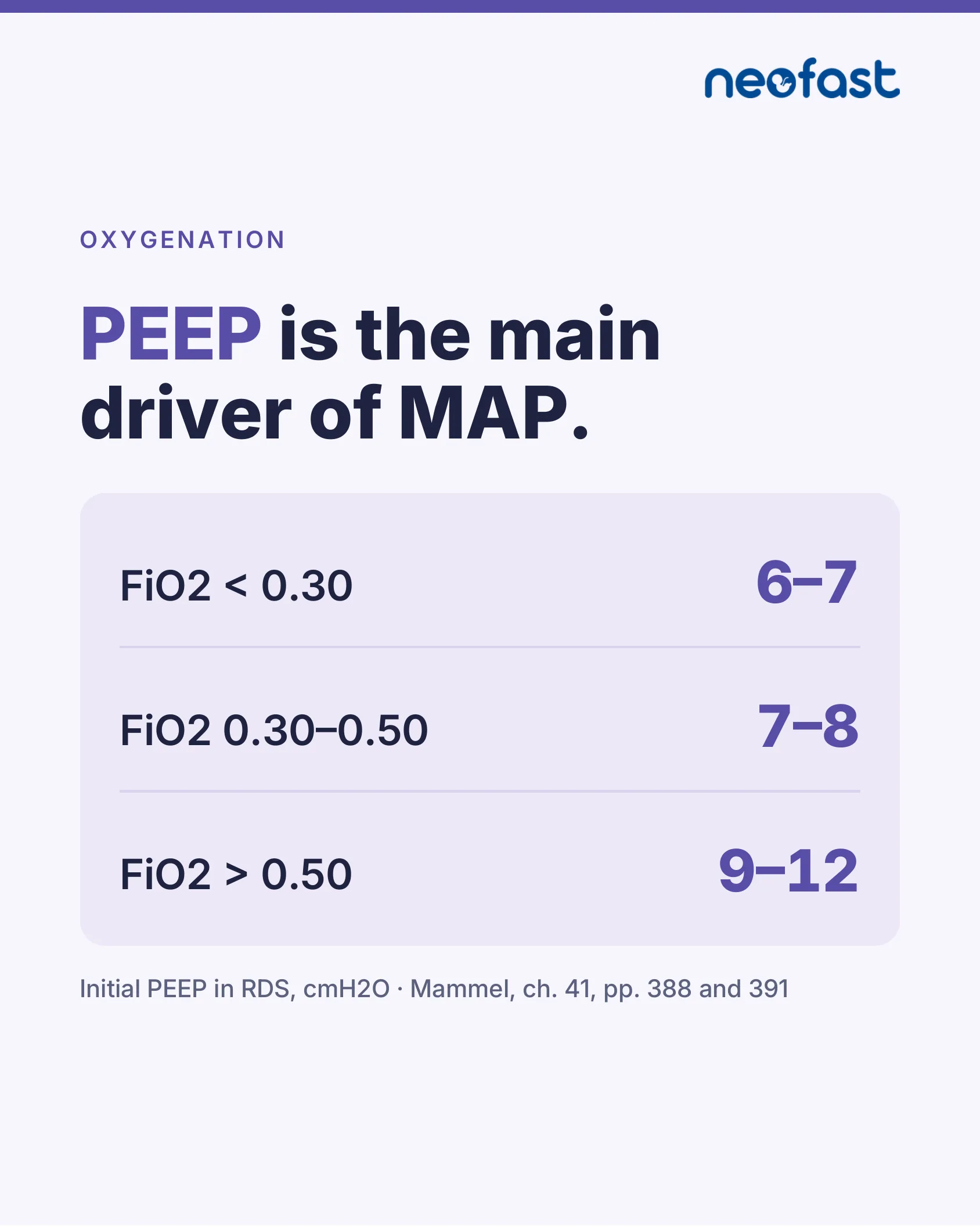
- PEEP是高频喷射通气中平均气道压的主要驱动力:FiO2 <0.30时为6-7 cmH2O,FiO2 0.30-0.50时为7-8 cmH2O,FiO2 >0.50时为9-12 cmH2O。
- 床旁处理高频喷射通气过度膨胀或CO2上升的原则是降低频率而非降低PEEP,因为充分的PEEP可以保持气道开放并维持肺容积。
参考文献
- Mammel MC, van Kaam AHLC, Donn SM (eds.). Manual of Neonatal Respiratory Care. Springer, 2022. Ch. 41, High-Frequency Jet Ventilation (Keszler M), pp. 387–394.
- Goldsmith JP, Karotkin EH, Keszler M, Gautham KS (eds.). Goldsmith’s Assisted Ventilation of the Neonate, 7th ed. Elsevier, 2022. Ch. 24, High-Frequency Ventilation.
高频喷气通气
高频喷气通气
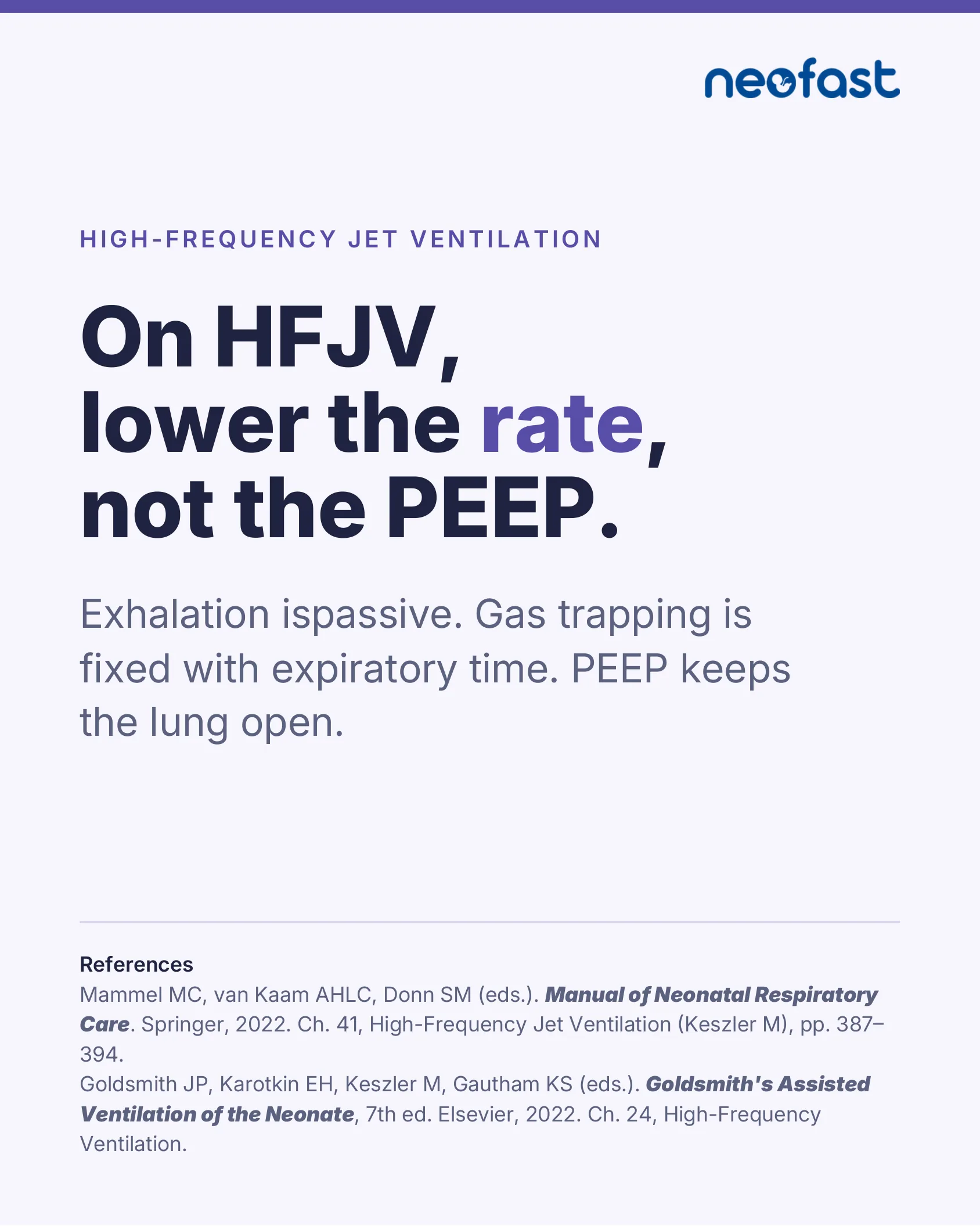
在HFJV中,降低频率,而不是PEEP。
呼气是被动的。气体滞留通过呼气时间固定。PEEP保持肺开放。
为什么这很重要

为什么这很重要
喷气时的呼气是被动的。
- 速率过快会导致气体潴留。PaCO2 升高而非下降。
- 速率对PaCO2的影响很小。
Mammel, ch. 41, pp. 388–389
起始设置
初始设置
| 420 | 0.02 |
|---|---|
| cycles/min 7 Hz | s 吸气时间 保持最小值 |
常用范围: 300–450
Mammel, ch. 41, pp. 389 and 391 · Goldsmith range: 240–660 cycles/min
长时间常数

长时间常数
当空气需要时间排出时,应放慢速度。
| 病症 | 速率(周期/分钟) |
|---|---|
| 胎粪吸入 | 240–320 |
| 重症PIE | 300–340 |
| 2毫米导管 | 240–280 |
周期/分钟 · Mammel,第41章,第391–392页
氧合
氧合
PEEP是MAP的主要驱动因素。
| FiO2 | PEEP (cmH2O) |
|---|---|
| FiO2 < 0.30 | 6–7 |
| FiO2 0.30–0.50 | 7–8 |
| FiO2 > 0.50 | 9–12 |
RDS初始PEEP,cmH2O · Mammel,第41章,第388和391页
床旁法则

床旁规则
过度膨胀或二氧化碳升高?
降低速率。
不要降低PEEP。
适当的PEEP可以保持气道开放和肺容积。
Mammel, ch. 41, pp. 392–393
在应用程序中

应用程序中
每项设置及其来源。
- 呼吸和血流动力学监测
- 初始通气参数
- HFJV
HFJV — 高频射流通气
被动呼气。在漏气和阻塞性疾病中的急救措施。
| 频率 | 启动时420次/分钟(7 Hz)。通常范围:300至450次/分钟(Mammel);240至660(Goldsmith) |
| 较低速率 | MAS: 240至320 · 严重PIE: 300至340 · 2 mm导管: 240至280次/分钟 |
| Ti | 0.02 s,固定且超短。仅在大早产儿低速率或接近PIP限制时:每次增加0.004 s,最多至0.034 s |
| I:E | 至少1:4,最好1:5或更高,以避免气体潴留 |
| PIP | 15至45 cmH2O。来自常规通气:保持相同PIP。直接启动:产生可见胸壁运动但无过度的压力 |
| CO2调整 | PIP每次±1至2 cmH2O(增加以降低PaCO2)。降低PIP时,如需维持MAP则提高PEEP |
| PEEP | 7至12 cmH2O,常常高于常规通气,以保持肺部开张。在极度早产儿中,6至8 cmH2O |
| 按FiO2初始PEEP | < 0.30: 6至7 · 0.30至0.50: 7至8 · > 0.50: 9至12 cmH2O |
| FiO2不低于0.35 | 增加PEEP,除非存在漏气… |

neofast
新生儿计算器和指南,每个数字背后都有参考依据。
在 App Store 和 Google Play 上下载
neofastapp.com
该应用可进行计算并引用来源。临床决策由医疗团队制定。
常见问题
HFJV 的起始速率和吸气时间是多少?
从 420 cycles/min (7 Hz) 开始,固定吸气时间为 0.02 s。通常范围是 300–450 cycles/min (Mammel),Goldsmith 更宽的范围是 240–660 cycles/min。
为什么增加 HFJV 速率有时会升高 PaCO2 而不是降低它?
喷气口的呼气是被动的,所以速率过快会导致气体滞留,PaCO2 升高而不是下降。速率对 PaCO2 的整体影响很小。
在胎粪吸入综合征、严重 PIE 或使用 2 mm 气管导管时应使用哪些 HFJV 速率?
当空气需要更多时间离开时使用较低的速率:胎粪吸入 240–320 cycles/min,严重 PIE 300–340 cycles/min,2 mm 导管 240–280 cycles/min。
在 RDS 中,基于 FiO2 在 HFJV 上初始应使用多少 PEEP?
FiO2 <0.30 时,使用 PEEP 6–7 cmH2O;FiO2 0.30–0.50 时,使用 7–8 cmH2O;FiO2 >0.50 时,使用 9–12 cmH2O。PEEP 是 HFJV 上 MAP 的主要驱动力。
当新生儿在 HFJV 上出现过度膨胀或 CO2 升高时的床边规则是什么?
降低速率,而不是 PEEP。充分的 PEEP 保持气道开放并维持肺容积,而呼气保持被动,气体滞留由呼气时间控制。