Key takeaways
- Four absolute indications for newborn intubation are no spontaneous breathing after adequate mask ventilation, sudden collapse with apnea and bradycardia, massive pulmonary hemorrhage, and large congenital diaphragmatic hernia.
- In infants under 28 weeks gestational age, intubate for PaCO2 > 45–55 mmHg (lower limit if pH < 7.25) and/or PaO2 < 50–60 mmHg in FiO2 > 0.50, though nasal CPAP may be tried first if only oxygenation is poor.
- For infants 28–32 weeks, intubation criteria are PaCO2 > 45–55 mmHg and/or PaO2 < 50–60 mmHg in FiO2 > 0.60, once CPAP has failed to improve blood gases.
- At ≥33 weeks, intubate for PaCO2 > 60 mmHg with pH < 7.25 and/or PaO2 < 45 mmHg in FiO2 > 0.80, with a lower threshold if distress is evident since CPAP is usually less well tolerated.
- Beyond blood gases, intubation is also warranted for recurrent apnea (>1–2 per hour needing stimulation) despite CPAP/NIPPV and methylxanthines, severe sepsis, maintaining airway patency, or CO2 control in pulmonary hypertension.
References
- Mammel MC, van Kaam AHLC, Donn SM, editors. Manual of Neonatal Respiratory Care. 2022.
- Ch. 67, Indications for Mechanical Ventilation (Greenough A, Milner AD), pp. 643–644.
- Ch. 68, Respiratory Distress Syndrome (Donn SM), p. 647.
Intubating the newborn: when is it indicated?
Intubating the newborn: when is it indicated?
Absolute indications, blood-gas thresholds by gestational age, and the other reasons to secure the airway.
Absolute indications
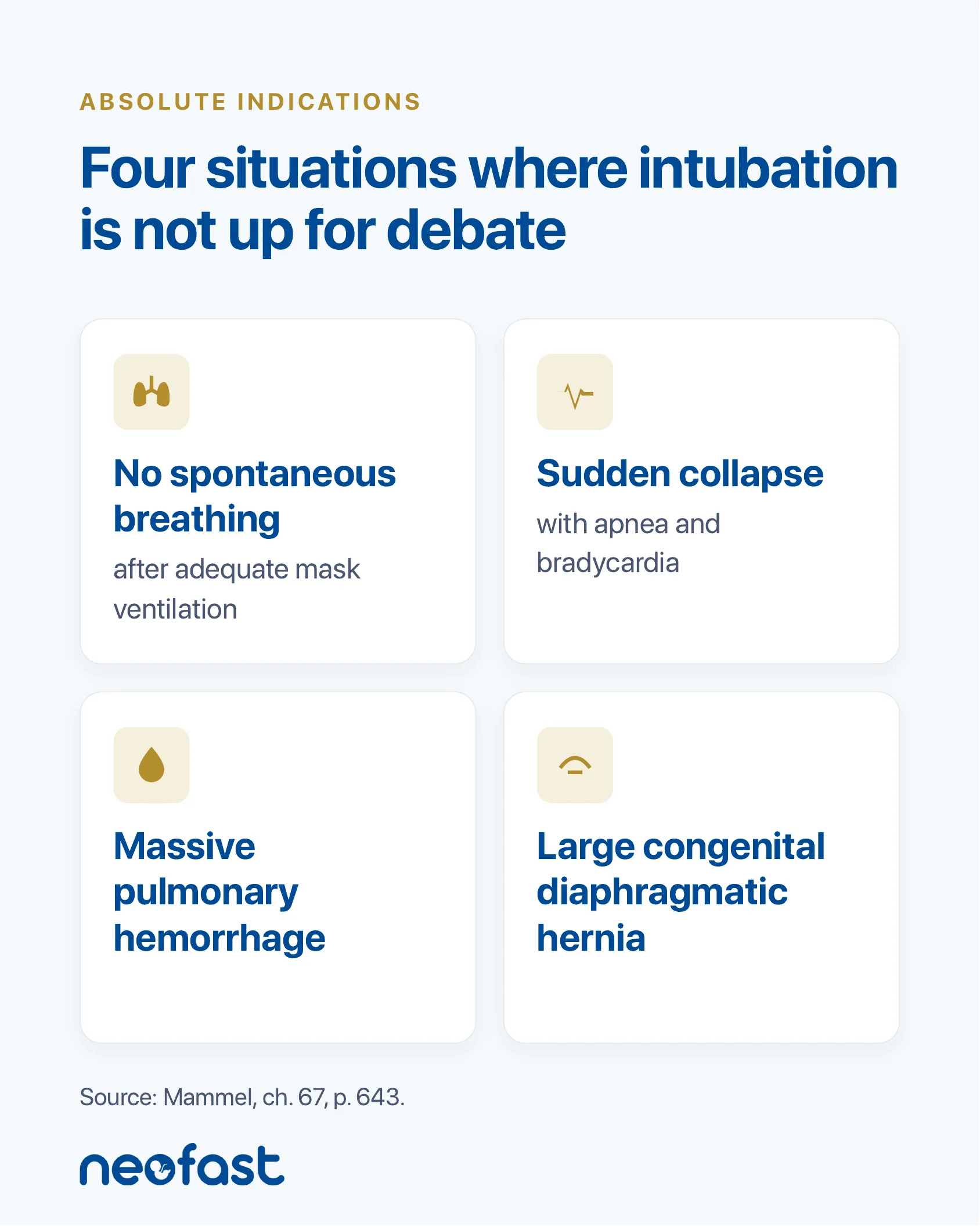
Four situations where intubation is not up for debate
- No spontaneous breathing — after adequate mask ventilation
- Sudden collapse — with apnea and bradycardia
- Massive pulmonary hemorrhage
- Large congenital diaphragmatic hernia
Source: Mammel, ch. 67, p. 643.
Progressive respiratory failure
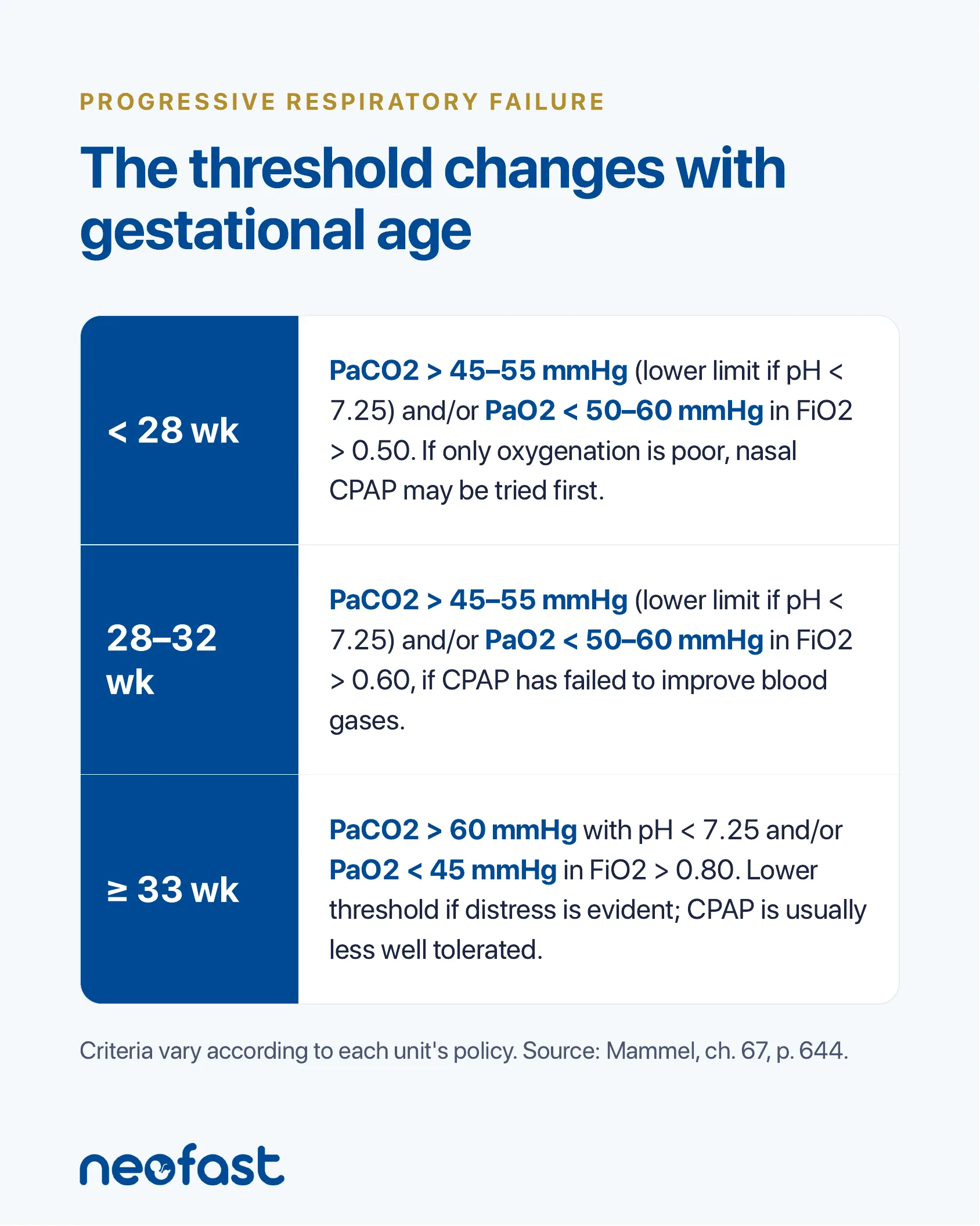
The threshold changes with gestational age
| Gestational age | Criteria |
|---|---|
| < 28 wk | PaCO2 > 45–55 mmHg (lower limit if pH < 7.25) and/or PaO2 < 50–60 mmHg in FiO2 > 0.50. If only oxygenation is poor, nasal CPAP may be tried first. |
| 28–32 wk | PaCO2 > 45–55 mmHg (lower limit if pH < 7.25) and/or PaO2 < 50–60 mmHg in FiO2 > 0.60, if CPAP has failed to improve blood gases. |
| ≥ 33 wk | PaCO2 > 60 mmHg with pH < 7.25 and/or PaO2 < 45 mmHg in FiO2 > 0.80. Lower threshold if distress is evident; CPAP is usually less well tolerated. |
Criteria vary according to each unit’s policy. Source: Mammel, ch. 67, p. 644.
Beyond blood gases
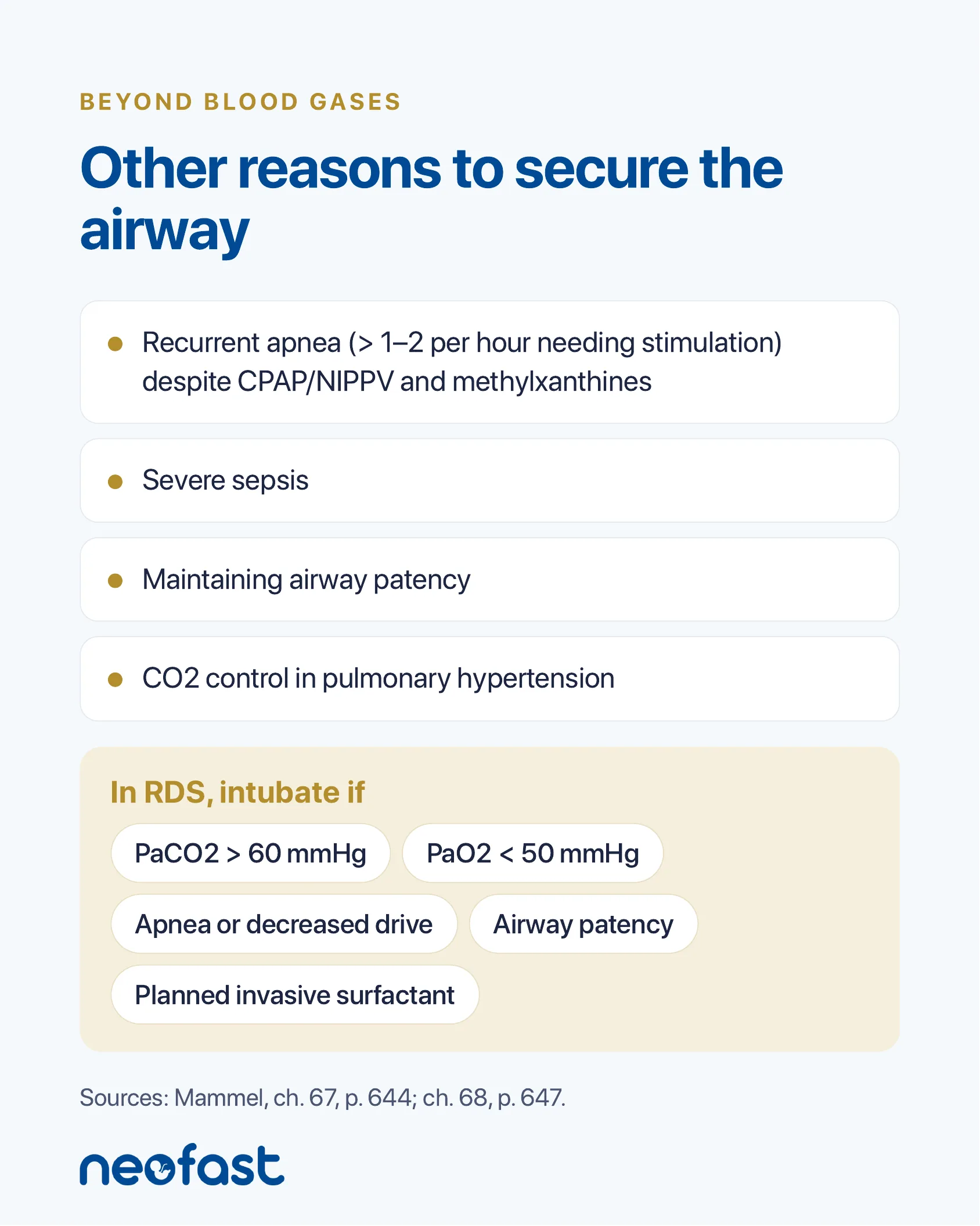
Other reasons to secure the airway
- Recurrent apnea (> 1–2 per hour needing stimulation) despite CPAP/NIPPV and methylxanthines
- Severe sepsis
- Maintaining airway patency
- CO2 control in pulmonary hypertension
In RDS, intubate if
- PaCO2 > 60 mmHg
- PaO2 < 50 mmHg
- Apnea or decreased drive
- Airway patency
- Planned invasive surfactant
Sources: Mammel, ch. 67, p. 644; ch. 68, p. 647.
In the app: The criteria, one tap away
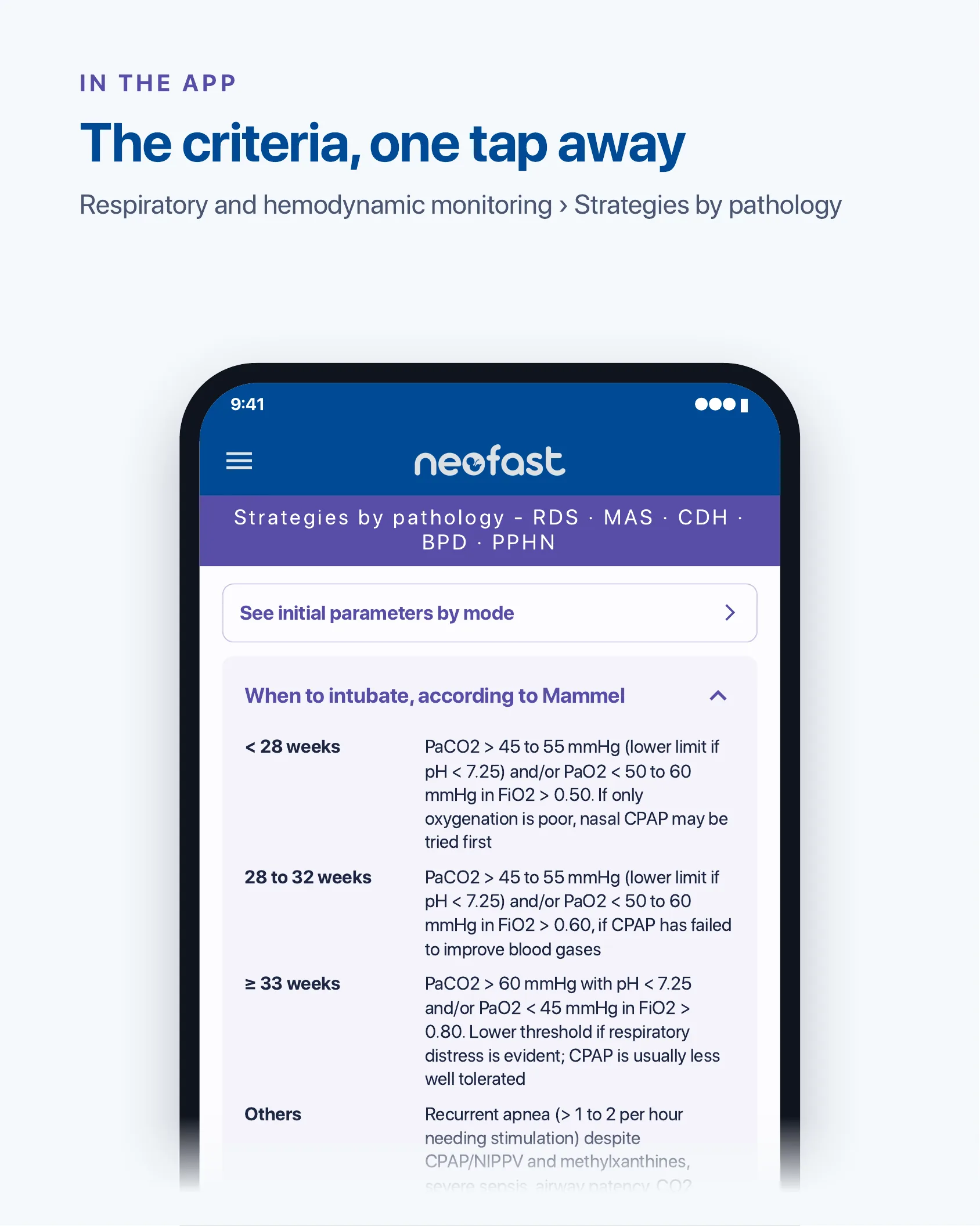
The criteria, one tap away
Respiratory and hemodynamic monitoring > Strategies by pathology
App screen: Strategies by pathology – RDS · MAS · CDH · BPD · PPHN
- See initial parameters by mode
When to intubate, according to Mammel
| Gestational age | Criteria |
|---|---|
| < 28 weeks | PaCO2 > 45 to 55 mmHg (lower limit if pH < 7.25) and/or PaO2 < 50 to 60 mmHg in FiO2 > 0.50. If only oxygenation is poor, nasal CPAP may be tried first |
| 28 to 32 weeks | PaCO2 > 45 to 55 mmHg (lower limit if pH < 7.25) and/or PaO2 < 50 to 60 mmHg in FiO2 > 0.60, if CPAP has failed to improve blood gases |
| ≥ 33 weeks | PaCO2 > 60 mmHg with pH < 7.25 and/or PaO2 < 45 mmHg in FiO2 > 0.80. Lower threshold if respiratory distress is evident; CPAP is usually less well tolerated |
| Others | Recurrent apnea (> 1 to 2 per hour needing stimulation) despite CPAP/NIPPV and methylxanthines, severe sepsis, airway patency, CO2… |
In the app: Rapid sequence by weight
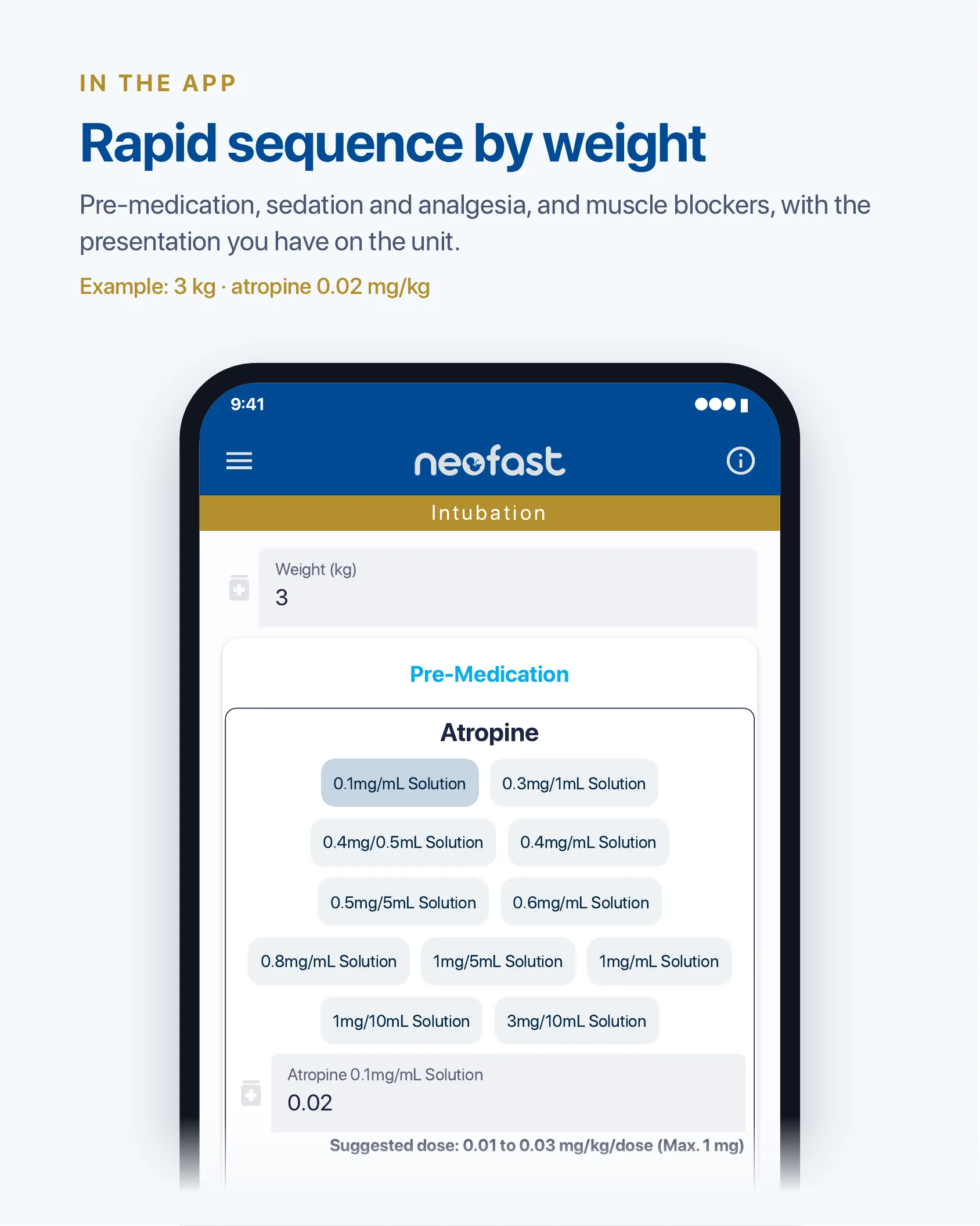
Rapid sequence by weight
Pre-medication, sedation and analgesia, and muscle blockers, with the presentation you have on the unit.
Example: 3 kg · atropine 0.02 mg/kg
App screen: Intubation
- Weight (kg): 3
Pre-Medication
Atropine
- 0.1mg/mL Solution
- 0.3mg/1mL Solution
- 0.4mg/0.5mL Solution
- 0.4mg/mL Solution
- 0.5mg/5mL Solution
- 0.6mg/mL Solution
- 0.8mg/mL Solution
- 1mg/5mL Solution
- 1mg/mL Solution
- 1mg/10mL Solution
- 3mg/10mL Solution
Atropine 0.1mg/mL Solution: 0.02
Suggested dose: 0.01 to 0.03 mg/kg/dose (Max. 1 mg)
In the app: Dilution and volume, ready to draw
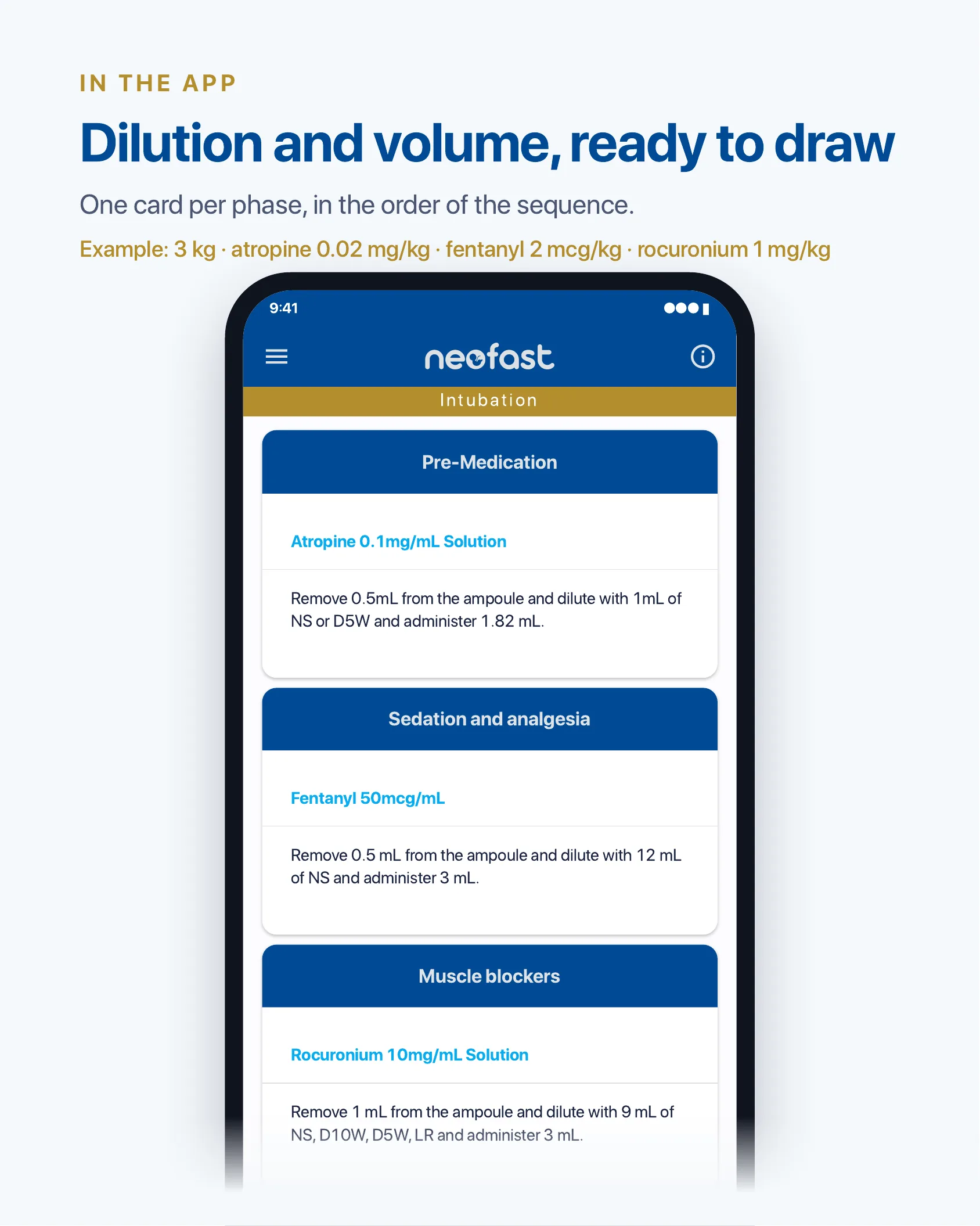
Dilution and volume, ready to draw
One card per phase, in the order of the sequence.
Example: 3 kg · atropine 0.02 mg/kg · fentanyl 2 mcg/kg · rocuronium 1 mg/kg
App screen: Intubation
Pre-Medication
Atropine 0.1mg/mL Solution
Remove 0.5mL from the ampoule and dilute with 1mL of NS or D5W and administer 1.82 mL.
Sedation and analgesia
Fentanyl 50mcg/mL
Remove 0.5 mL from the ampoule and dilute with 12 mL of NS and administer 3 mL.
Muscle blockers
Rocuronium 10mg/mL Solution
Remove 1 mL from the ampoule and dilute with 9 mL of NS, D10W, D5W, LR and administer 3 mL.
After the tube: Monitor what the ventilator is doing
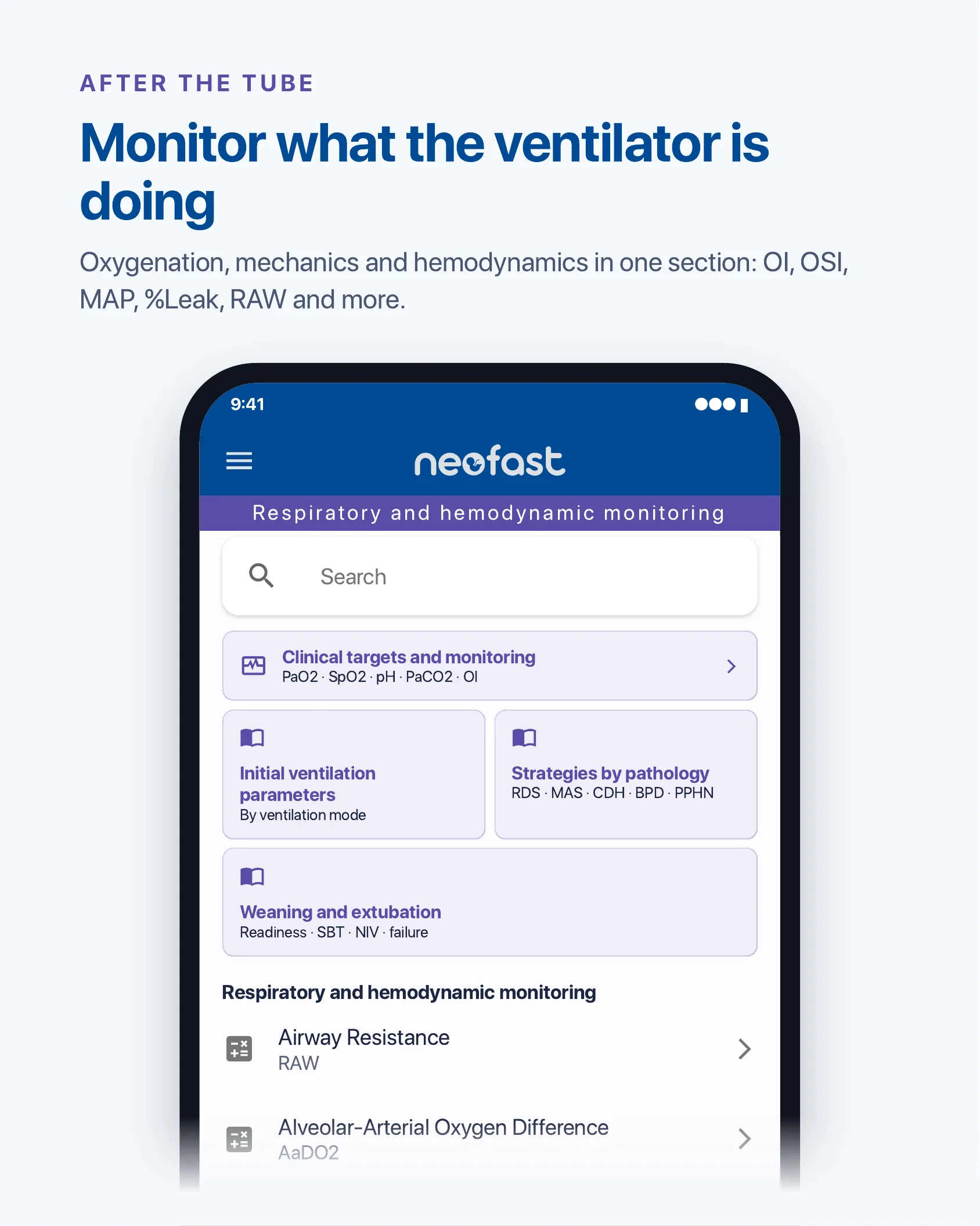
Monitor what the ventilator is doing
Oxygenation, mechanics and hemodynamics in one section: OI, OSI, MAP, %Leak, RAW and more.
App screen: Respiratory and hemodynamic monitoring
- Clinical targets and monitoring — PaO2 · SpO2 · pH · PaCO2 · OI
- Initial ventilation parameters — By ventilation mode
- Strategies by pathology — RDS · MAS · CDH · BPD · PPHN
- Weaning and extubation — Readiness · SBT · NIV · failure
Respiratory and hemodynamic monitoring
- Airway Resistance — RAW
- Alveolar-Arterial Oxygen Difference — AaDO2
Neofast – Neonatal Calculations That Cite Their Sources
neofast
Neonatal calculations that cite their sources
Intubation sequence, respiratory and hemodynamic monitoring, and much more for the NICU.
- App Store · Google Play
The app calculates and cites the source.
The clinical decision belongs to the physician.
Frequently asked questions
What are the absolute indications for intubating a newborn?
The four absolute indications are: no spontaneous breathing after adequate mask ventilation, sudden collapse with apnea and bradycardia, massive pulmonary hemorrhage, and large congenital diaphragmatic hernia.
What blood gas thresholds indicate intubation in a preterm infant under 28 weeks?
Intubate for PaCO2 > 45–55 mmHg (use the lower limit if pH < 7.25) and/or PaO2 < 50–60 mmHg in FiO2 > 0.50; if only oxygenation is poor, nasal CPAP may be tried first.
When should a 28–32 week infant be intubated based on blood gases?
Intubate if PaCO2 > 45–55 mmHg (lower limit if pH < 7.25) and/or PaO2 < 50–60 mmHg in FiO2 > 0.60, and only after CPAP has failed to improve blood gases.
What are the intubation criteria for infants ≥33 weeks gestational age?
Intubate for PaCO2 > 60 mmHg with pH < 7.25 and/or PaO2 < 45 mmHg in FiO2 > 0.80; use a lower threshold if respiratory distress is evident, since CPAP is usually less well tolerated at this age.
Besides blood gas thresholds, what other clinical situations warrant intubation?
Other indications include recurrent apnea (>1–2 episodes per hour needing stimulation) despite CPAP/NIPPV and methylxanthines, severe sepsis, maintaining airway patency, and CO2 control in pulmonary hypertension; in RDS, intubate for PaCO2 > 60 mmHg, PaO2 < 50 mmHg, apnea or decreased respiratory drive, airway patency needs, or planned invasive surfactant.