References
- Toronto Resident’s Handbook of Neonatology
Key takeaways
- Neonatal anemia has three mechanisms: underproduction (anemia of prematurity), blood loss (including iatrogenic — total term blood volume is only ~85 mL/kg), and hemolysis (ABO/Rh/Kell, spherocytosis, G6PD, sepsis, DIC).
- pRBC transfusion thresholds fall with age and depend on respiratory support — with support ~115 g/L (wk1), 100 (wk2), 85 (wk3); without support 100, 85, 75 g/L. Respiratory support = FiO₂ >25% or need for increased airway pressure.
- Products must be irradiated (prevents transfusion-associated GVHD) and CMV-safe (pre-storage leukoreduced and/or CMV-negative); standard dose 10–20 mL/kg given slowly over 3–4 hours.
- Consider holding feeds during transfusion if NEC risk is increased; resume enteral feeds ~4 h after; assess furosemide at ~4 h for volume-overload risk.
Neonatal pRBC Transfusion Protocol
Clinical Thresholds, Product Specifications, and Administration Pathways
Distilled insights from the Toronto Resident’s Handbook of Neonatology
Neonatal Anemia Etiologies and Transfusion Thresholds
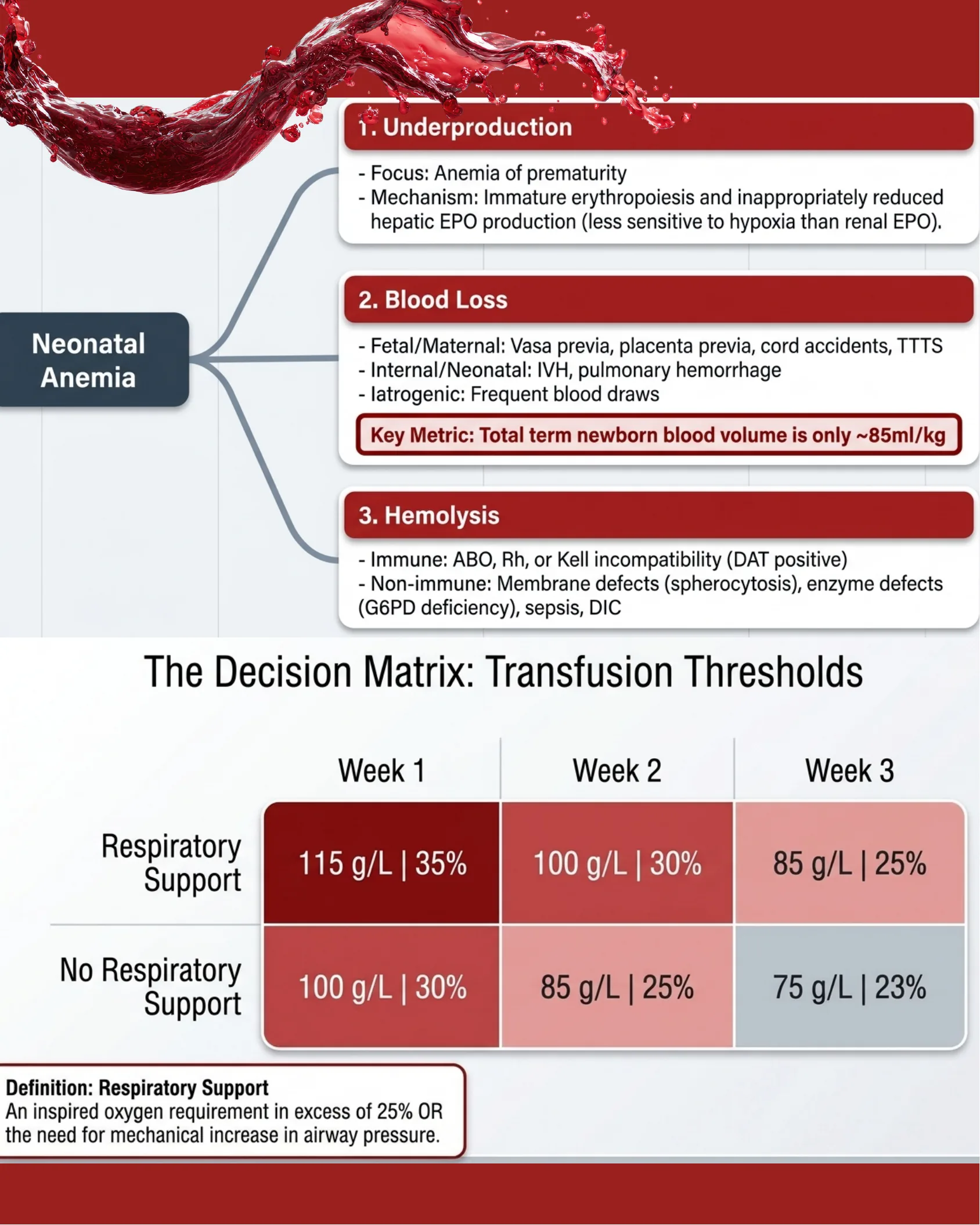
Neonatal Anemia
- 1. Underproduction
- Focus: Anemia of prematurity
- Mechanism: Immature erythropoiesis and inappropriately reduced hepatic EPO production (less sensitive to hypoxia than renal EPO).
- 2. Blood Loss
- Fetal/Maternal: Vasa previa, placenta previa, cord accidents, TTTS
- Internal/Neonatal: IVH, pulmonary hemorrhage
- Iatrogenic: Frequent blood draws
Key Metric: Total term newborn blood volume is only ~85ml/kg
- 3. Hemolysis
- Immune: ABO, Rh, or Kell incompatibility (DAT positive)
- Non-immune: Membrane defects (spherocytosis), enzyme defects (G6PD deficiency), sepsis, DIC
The Decision Matrix: Transfusion Thresholds
| Week 1 | Week 2 | Week 3 | |
|---|---|---|---|
| Respiratory Support | 115 g/L | 35% | 100 g/L | 30% | 85 g/L | 25% |
| No Respiratory Support | 100 g/L | 30% | 85 g/L | 25% | 75 g/L | 23% |
Definition: Respiratory Support
An inspired oxygen requirement in excess of 25% OR the need for mechanical increase in airway pressure.
Blood Product Specifications and Administration Timeline
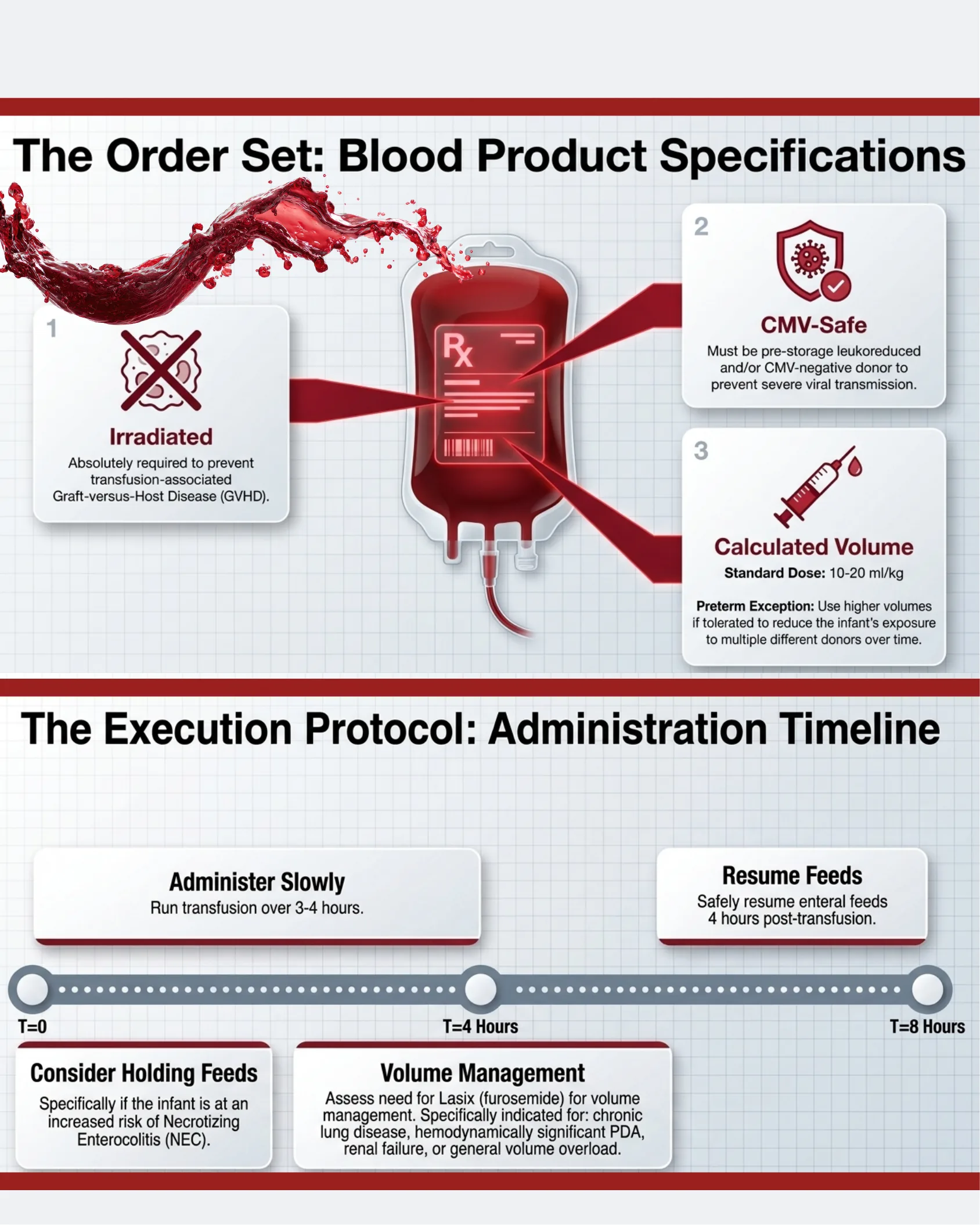
The Order Set: Blood Product Specifications
- 1. Irradiated — Absolutely required to prevent transfusion-associated Graft-versus-Host Disease (GVHD).
- 2. CMV-Safe — Must be pre-storage leukoreduced and/or CMV-negative donor to prevent severe viral transmission.
- 3. Calculated Volume
- Standard Dose: 10-20 ml/kg
- Preterm Exception: Use higher volumes if tolerated to reduce the infant’s exposure to multiple different donors over time.
The Execution Protocol: Administration Timeline
- T=0: Consider Holding Feeds — Specifically if the infant is at an increased risk of Necrotizing Enterocolitis (NEC).
- Administer Slowly — Run transfusion over 3-4 hours.
- T=4 Hours: Volume Management — Assess need for Lasix (furosemide) for volume management. Specifically indicated for: chronic lung disease, hemodynamically significant PDA, renal failure, or general volume overload.
- T=8 Hours: Resume Feeds — Safely resume enteral feeds 4 hours post-transfusion.
Systemic Risk Weighting and Exchange Transfusion
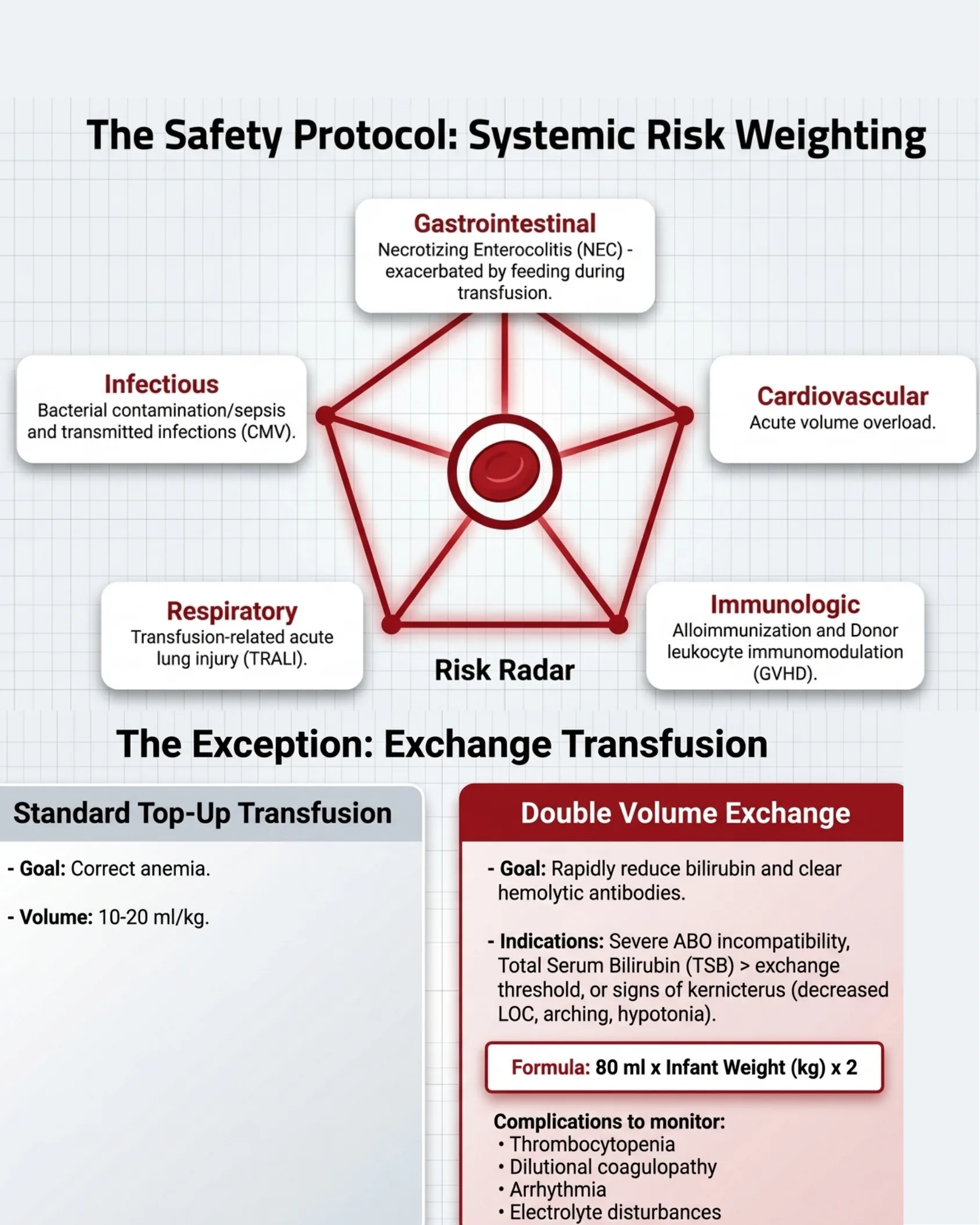
The Safety Protocol: Systemic Risk Weighting
- Gastrointestinal — Necrotizing Enterocolitis (NEC) – exacerbated by feeding during transfusion.
- Cardiovascular — Acute volume overload.
- Immunologic — Alloimmunization and Donor leukocyte immunomodulation (GVHD).
- Respiratory — Transfusion-related acute lung injury (TRALI).
- Infectious — Bacterial contamination/sepsis and transmitted infections (CMV).
The Exception: Exchange Transfusion
| Standard Top-Up Transfusion | Double Volume Exchange |
|---|---|
| Goal: Correct anemia. Volume: 10-20 ml/kg. | Goal: Rapidly reduce bilirubin and clear hemolytic antibodies. Indications: Severe ABO incompatibility, Total Serum Bilirubin (TSB) > exchange threshold, or signs of kernicterus (decreased LOC, arching, hypotonia). |
Formula: 80 ml x Infant Weight (kg) x 2
Complications to monitor:
- Thrombocytopenia
- Dilutional coagulopathy
- Arrhythmia
- Electrolyte disturbances
Pre-Transfusion Safety Checklist
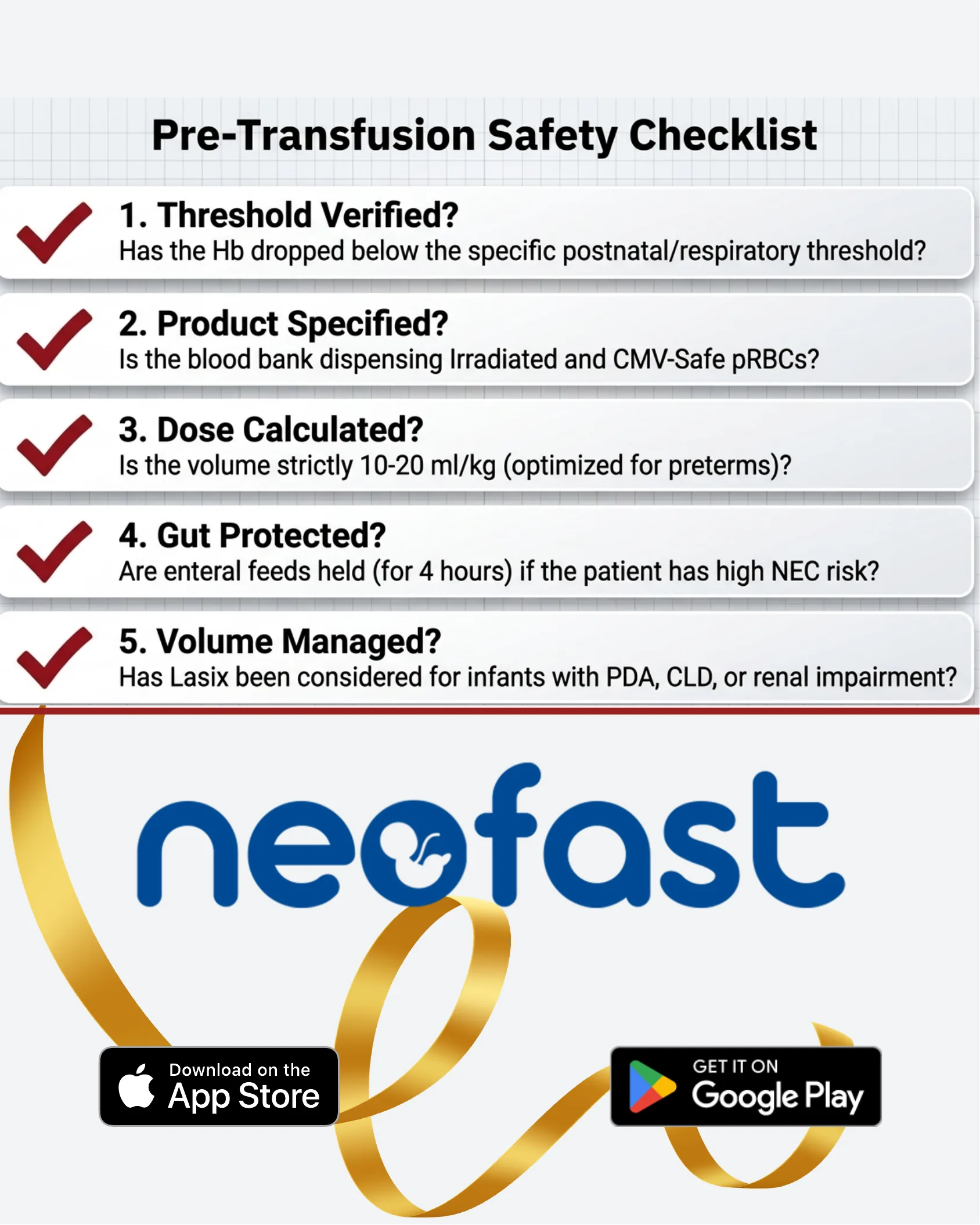
Pre-Transfusion Safety Checklist
- 1. Threshold Verified? Has the Hb dropped below the specific postnatal/respiratory threshold?
- 2. Product Specified? Is the blood bank dispensing Irradiated and CMV-Safe pRBCs?
- 3. Dose Calculated? Is the volume strictly 10-20 ml/kg (optimized for preterms)?
- 4. Gut Protected? Are enteral feeds held (for 4 hours) if the patient has high NEC risk?
- 5. Volume Managed? Has Lasix been considered for infants with PDA, CLD, or renal impairment?
neofast
Download on the App Store · Get it on Google Play
Frequently asked questions
What hemoglobin threshold triggers neonatal red-cell transfusion?
It depends on postnatal age and respiratory support — with support about 115 g/L in week 1, 100 in week 2, 85 in week 3; without support 100, 85, 75 g/L respectively.
Why must neonatal pRBC be irradiated and CMV-safe?
Irradiation prevents transfusion-associated Graft-versus-Host Disease; CMV-safe (pre-storage leukoreduced and/or CMV-negative) prevents severe CMV transmission.
What is the pRBC transfusion volume and rate for neonates?
Standard dose 10–20 mL/kg given slowly over 3–4 hours; preterms may use higher volumes to limit exposure to multiple donors.