Key takeaways
- Recommended glucose infusion rate (GIR) for neonates is 5-7 mg/kg/min, extending to 5-8 mg/kg/min in hypoglycemia, with a maximum of 12 mg/kg/min.
- Total fluid rate on day 1 of life is 60-80 mL/kg/day for full-term newborns, increasing by 10-20 mL/kg daily up to 120-160 mL/kg.
- From the second day of life, sodium is dosed at 2-3 mEq/kg/day and potassium at 1-2 mEq/kg/day once diuresis is well established, while calcium (as GluCa 10%) is given at 2 mEq/kg/day.
- Access type depends on glucose concentration: peripheral or central access is acceptable at or below 12.5%, central access is required above 12.5% and below 20%, and concentrations of 20% or more require central access due to risk of extravasation and phlebitis.
- For potassium concentration, peripheral or central access suffices at or below 40 mEq/L, central access is needed for 40-200 mEq/L, and levels above 200 mEq/L trigger a red alert.
References
- Feld LG, Neuspiel DR, Foster BA, et al. Clinical Practice Guideline: Maintenance Intravenous Fluids in Children. Pediatrics. 2018;142(6):e20183083. doi:10.1542/peds.2018-3083
- Feld LG, et al. Pediatrics. 2018;142(6):e20183083.
Venous Hydration — For Healthcare Professionals
VENOUS HYDRATION · FOR HEALTHCARE PROFESSIONALS
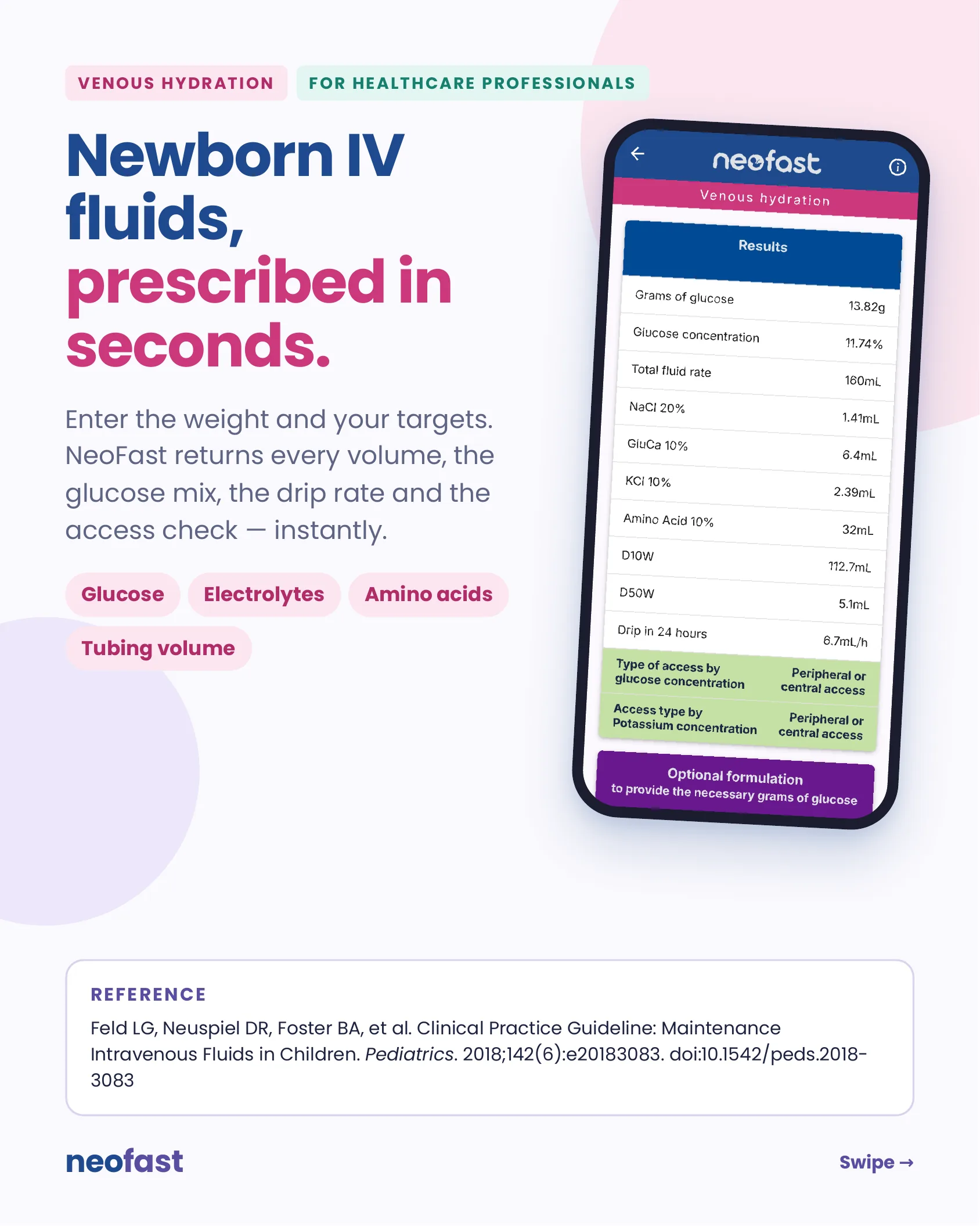
Newborn IV fluids, prescribed in seconds.
Enter the weight and your targets. NeoFast returns every volume, the glucose mix, the drip rate and the access check — instantly.
- Glucose
- Electrolytes
- Amino acids
- Tubing volume
App Results Preview
| Parameter | Value |
|---|---|
| Grams of glucose | 13.82g |
| Glucose concentration | 11.74% |
| Total fluid rate | 160mL |
| NaCl 20% | 1.41mL |
| GluCa 10% | 6.4mL |
| KCl 10% | 2.39mL |
| Amino Acid 10% | 32mL |
| D10W | 112.7mL |
| D50W | 5.1mL |
| Drip in 24 hours | 6.7mL/h |
| Type of access by glucose concentration | Peripheral or central access |
| Access type by Potassium concentration | Peripheral or central access |
Optional formulation to provide the necessary grams of glucose
REFERENCE
Feld LG, Neuspiel DR, Foster BA, et al. Clinical Practice Guideline: Maintenance Intravenous Fluids in Children. Pediatrics. 2018;142(6):e20183083. doi:10.1542/peds.2018-3083
Every Shift, Every Baby
EVERY SHIFT, EVERY BABY
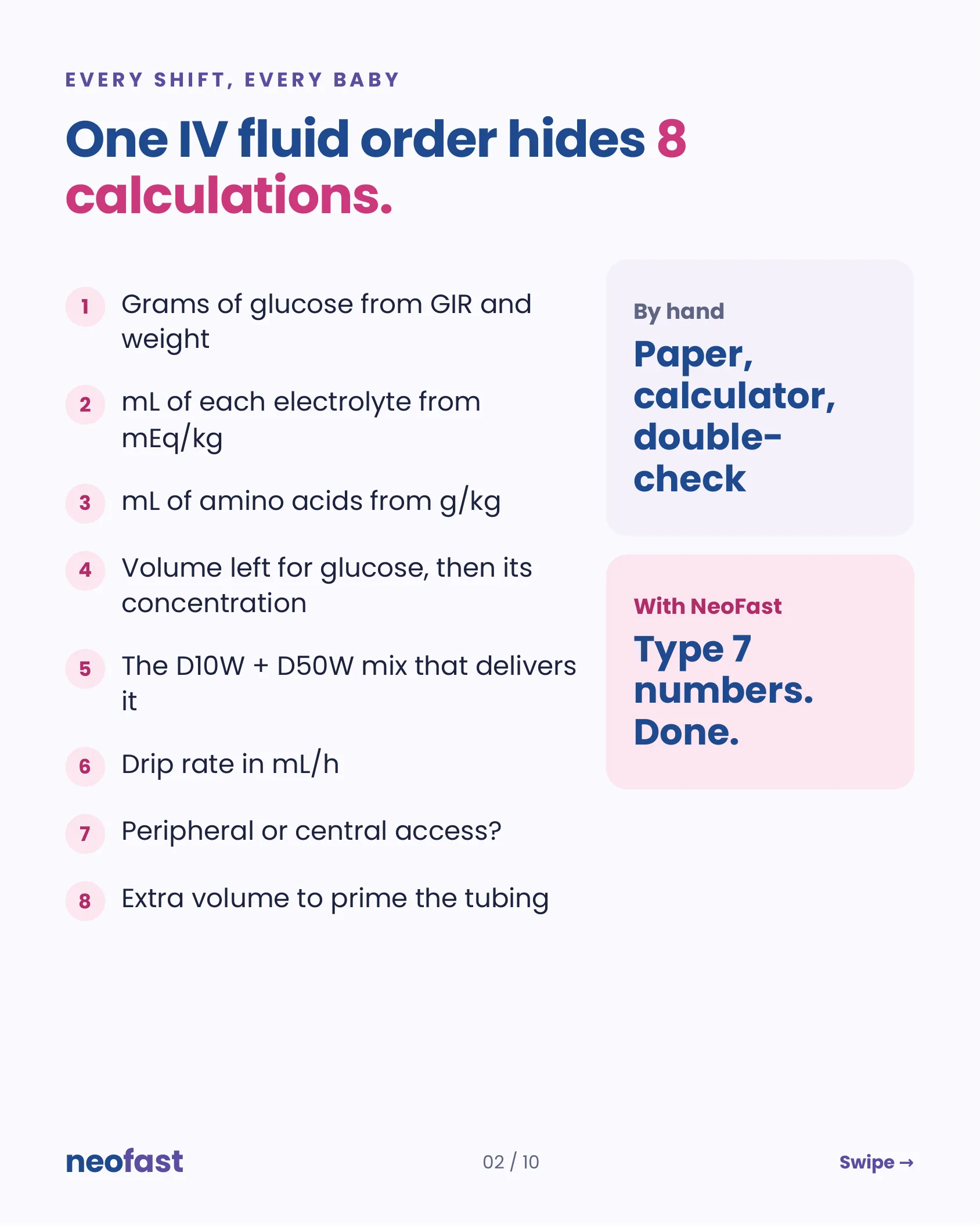
One IV fluid order hides 8 calculations.
- Grams of glucose from GIR and weight
- mL of each electrolyte from mEq/kg
- mL of amino acids from g/kg
- Volume left for glucose, then its concentration
- The D10W + D50W mix that delivers it
- Drip rate in mL/h
- Peripheral or central access?
- Extra volume to prime the tubing
By hand
Paper, calculator, double-check
With NeoFast
Type 7 numbers. Done.
Step 1 · Type
STEP 1 · TYPE
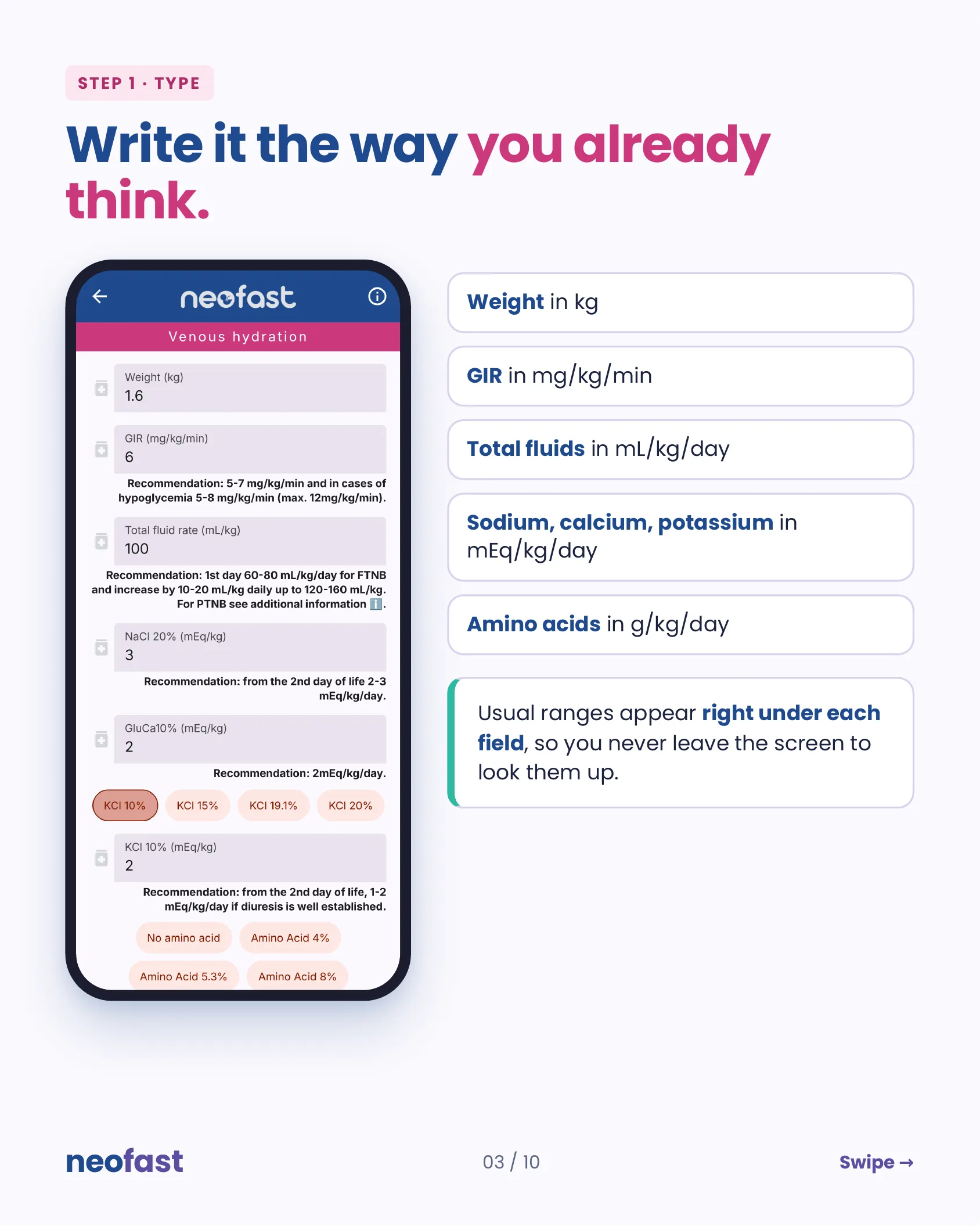
Write it the way you already think.
App Input Fields
| Field | Value | Recommendation |
|---|---|---|
| Weight (kg) | 1.6 | |
| GIR (mg/kg/min) | 6 | 5-7 mg/kg/min and in cases of hypoglycemia 5-8 mg/kg/min (max. 12mg/kg/min). |
| Total fluid rate (mL/kg) | 100 | 1st day 60-80 mL/kg/day for FTNB and increase by 10-20 mL/kg daily up to 120-160 mL/kg. For PTNB see additional information. |
| NaCl 20% (mEq/kg) | 3 | from the 2nd day of life 2-3 mEq/kg/day. |
| GluCa10% (mEq/kg) | 2 | 2mEq/kg/day. |
| KCl 10% (mEq/kg) | 2 | from the 2nd day of life, 1-2 mEq/kg/day if diuresis is well established. |
KCl options: KCl 10% (selected), KCl 15%, KCl 19.1%, KCl 20%
Amino acid options: No amino acid, Amino Acid 4%, Amino Acid 5.3%, Amino Acid 8%
- Weight in kg
- GIR in mg/kg/min
- Total fluids in mL/kg/day
- Sodium, calcium, potassium in mEq/kg/day
- Amino acids in g/kg/day
Usual ranges appear right under each field, so you never leave the screen to look them up.
Step 2 · Read

STEP 2 · READ
The whole order, ready to write.
- Grams and concentration of glucose
- Every additive in mL, already converted from its presentation
- The D10W + D50W mix, or D5W when that fits
- Drip rate for 24 hours
- Access check by glucose and by potassium concentration
Example: 1.6 kg, GIR 6, 100 mL/kg, Na 3, Ca 2, K 2 mEq/kg, amino acids 2 g/kg (10%).
Results
| Parameter | Value |
|---|---|
| Grams of glucose | 13.82g |
| Glucose concentration | 11.74% |
| Total fluid rate | 160mL |
| NaCl 20% | 1.41mL |
| GluCa 10% | 6.4mL |
| KCl 10% | 2.39mL |
| Amino Acid 10% | 32mL |
| D10W | 112.7mL |
| D50W | 5.1mL |
| Drip in 24 hours | 6.7mL/h |
| Type of access by glucose concentration | Peripheral or central access |
| Access type by Potassium concentration | Peripheral or central access |
Optional formulation to provide the necessary grams of glucose
Glucose Dropped? Changed the Plan?
GLUCOSE DROPPED? CHANGED THE PLAN?
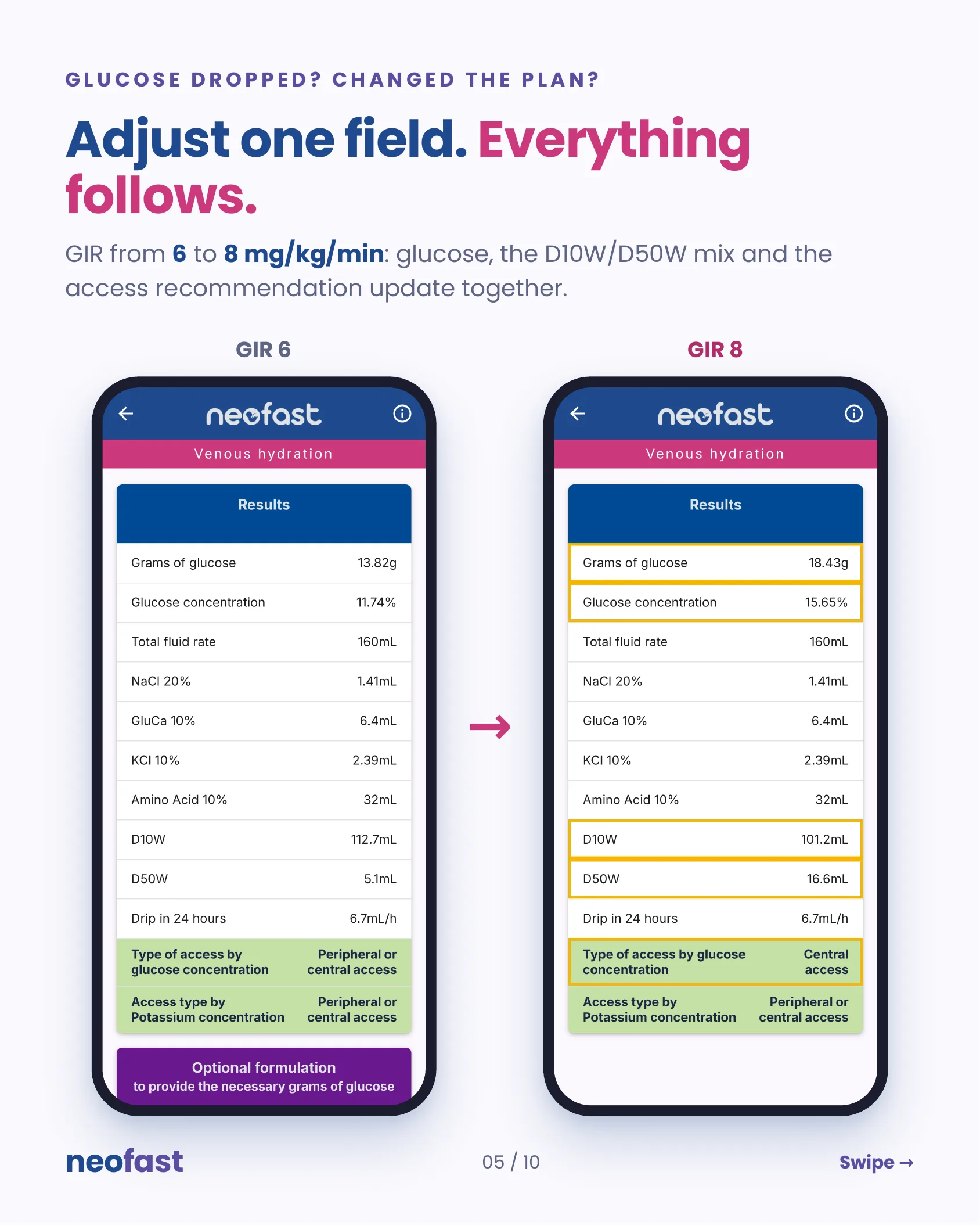
Adjust one field. Everything follows.
GIR from 6 to 8 mg/kg/min: glucose, the D10W/D50W mix and the access recommendation update together.
GIR 6
| Parameter | Value |
|---|---|
| Grams of glucose | 13.82g |
| Glucose concentration | 11.74% |
| Total fluid rate | 160mL |
| NaCl 20% | 1.41mL |
| GluCa 10% | 6.4mL |
| KCl 10% | 2.39mL |
| Amino Acid 10% | 32mL |
| D10W | 112.7mL |
| D50W | 5.1mL |
| Drip in 24 hours | 6.7mL/h |
| Type of access by glucose concentration | Peripheral or central access |
| Access type by Potassium concentration | Peripheral or central access |
GIR 8
| Parameter | Value |
|---|---|
| Grams of glucose | 18.43g |
| Glucose concentration | 15.65% |
| Total fluid rate | 160mL |
| NaCl 20% | 1.41mL |
| GluCa 10% | 6.4mL |
| KCl 10% | 2.39mL |
| Amino Acid 10% | 32mL |
| D10W | 101.2mL |
| D50W | 16.6mL |
| Drip in 24 hours | 6.7mL/h |
| Type of access by glucose concentration | Central access |
| Access type by Potassium concentration | Peripheral or central access |
Built-In Access Check
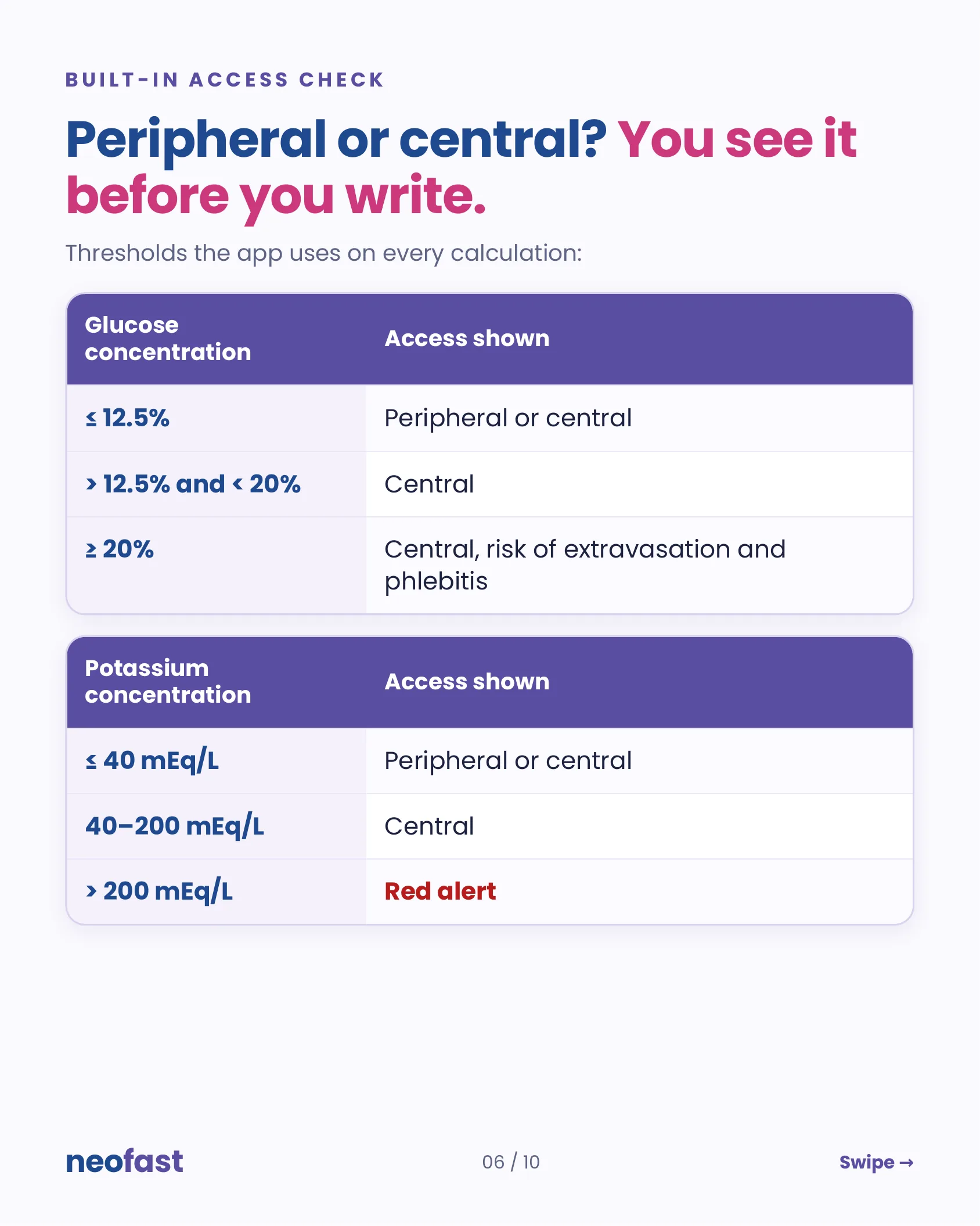
BUILT-IN ACCESS CHECK
Peripheral or central? You see it before you write.
Thresholds the app uses on every calculation:
| Glucose concentration | Access shown |
|---|---|
| ≤ 12.5% | Peripheral or central |
| > 12.5% and < 20% | Central |
| ≥ 20% | Central, risk of extravasation and phlebitis |
| Potassium concentration | Access shown |
|---|---|
| ≤ 40 mEq/L | Peripheral or central |
| 40-200 mEq/L | Central |
| > 200 mEq/L | Red alert |
Amino Acids
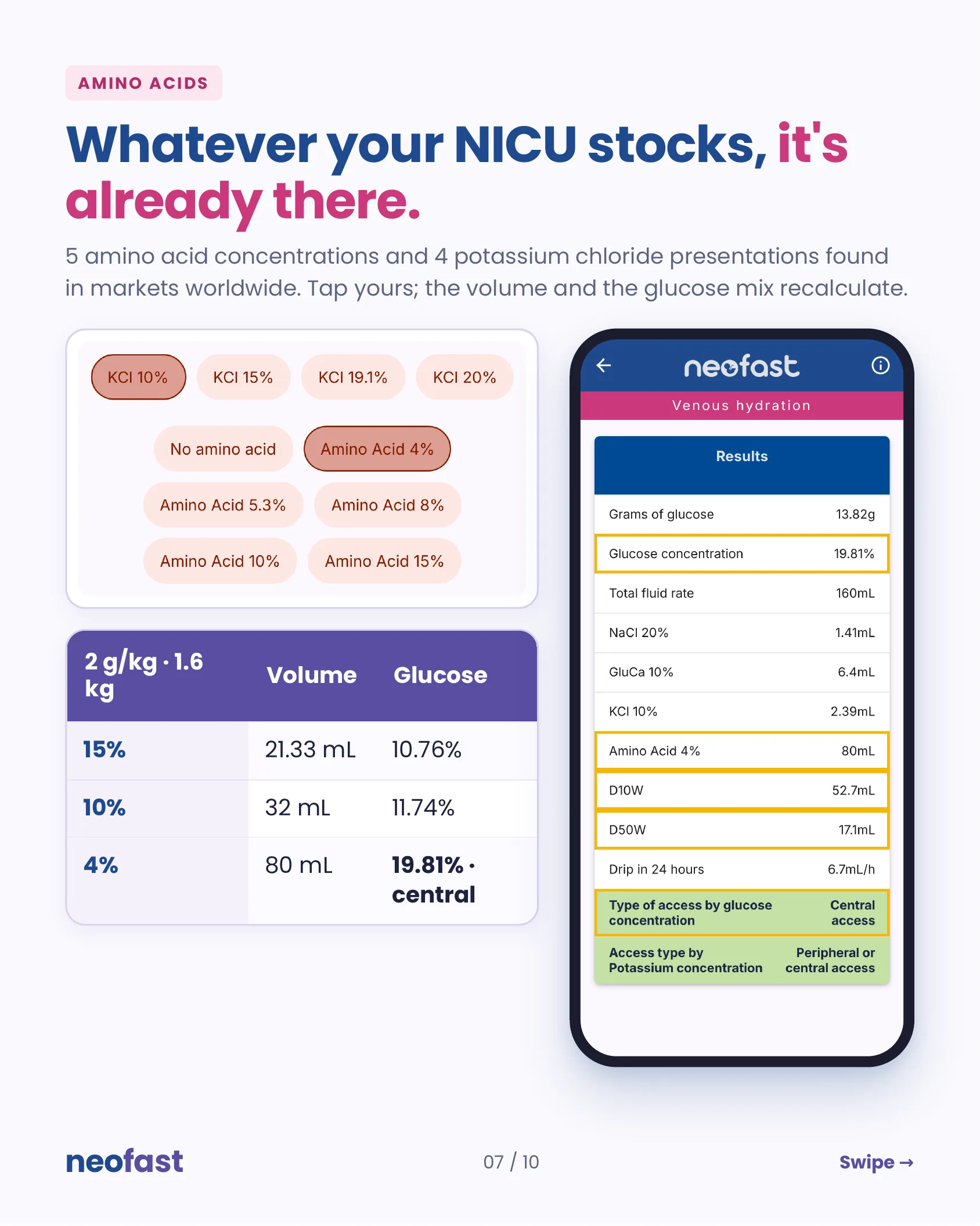
AMINO ACIDS
Whatever your NICU stocks, it’s already there.
5 amino acid concentrations and 4 potassium chloride presentations found in markets worldwide. Tap yours; the volume and the glucose mix recalculate.
KCl options: KCl 10% (selected), KCl 15%, KCl 19.1%, KCl 20%
Amino acid options: No amino acid, Amino Acid 4% (selected), Amino Acid 5.3%, Amino Acid 8%, Amino Acid 10%, Amino Acid 15%
2 g/kg · 1.6 kg
| Concentration | Volume | Glucose |
|---|---|---|
| 15% | 21.33 mL | 10.76% |
| 10% | 32 mL | 11.74% |
| 4% | 80 mL | 19.81% · central |
Results (Amino Acid 4% selected)
| Parameter | Value |
|---|---|
| Grams of glucose | 13.82g |
| Glucose concentration | 19.81% |
| Total fluid rate | 160mL |
| NaCl 20% | 1.41mL |
| GluCa 10% | 6.4mL |
| KCl 10% | 2.39mL |
| Amino Acid 4% | 80mL |
| D10W | 52.7mL |
| D50W | 17.1mL |
| Drip in 24 hours | 6.7mL/h |
| Type of access by glucose concentration | Central access |
| Access type by Potassium concentration | Peripheral or central access |
Made for the Real NICU
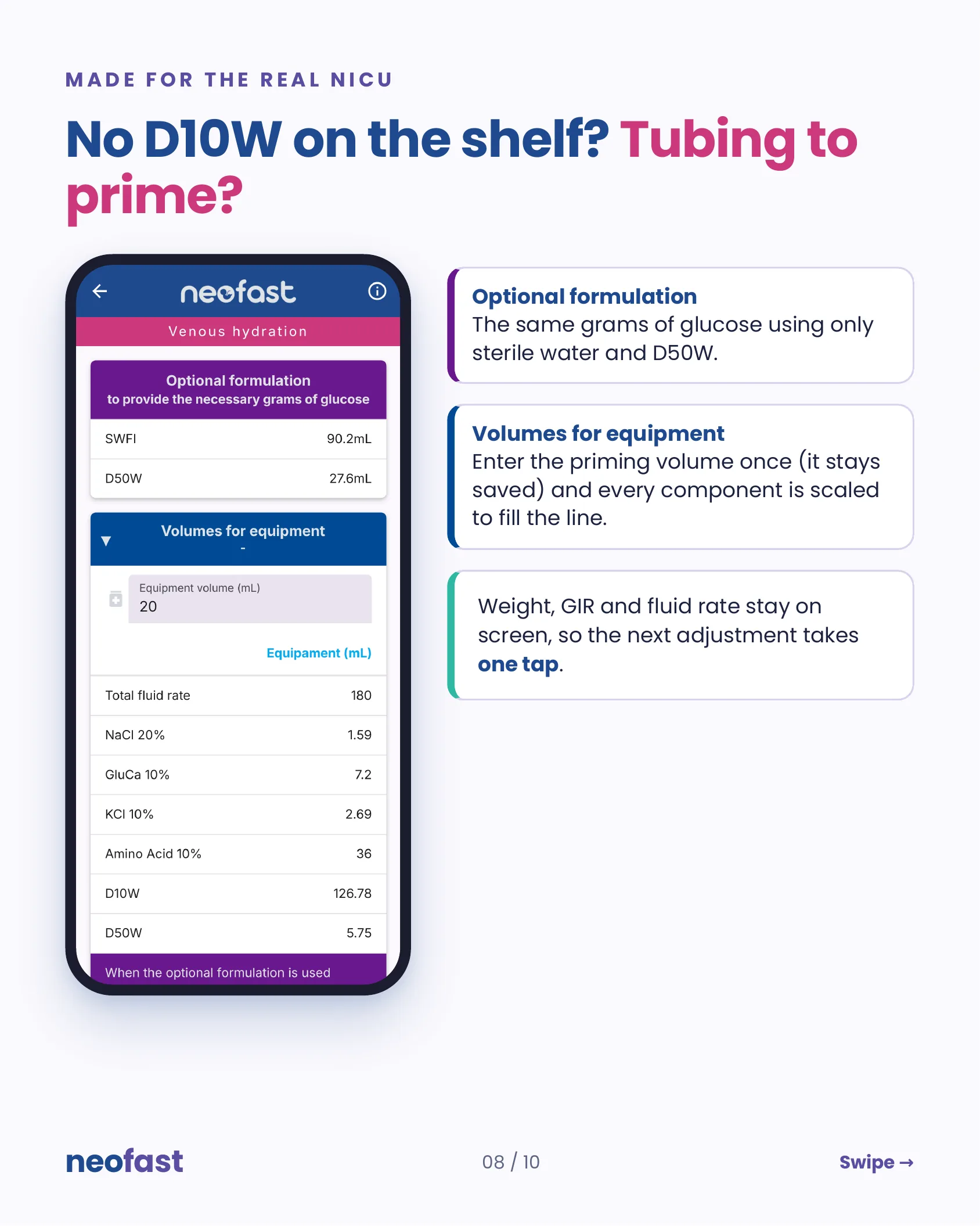
MADE FOR THE REAL NICU
No D10W on the shelf? Tubing to prime?
Optional Formulation
| Component | Value |
|---|---|
| SWFI | 90.2mL |
| D50W | 27.6mL |
Optional formulation: The same grams of glucose using only sterile water and D50W.
Volumes for Equipment
Equipment volume (mL): 20
| Parameter | Equipment (mL) |
|---|---|
| Total fluid rate | 180 |
| NaCl 20% | 1.59 |
| GluCa 10% | 7.2 |
| KCl 10% | 2.69 |
| Amino Acid 10% | 36 |
| D10W | 126.78 |
| D50W | 5.75 |
When the optional formulation is used
Volumes for equipment: Enter the priming volume once (it stays saved) and every component is scaled to fill the line.
Weight, GIR and fluid rate stay on screen, so the next adjustment takes one tap.
Your whole shift, in one app.

AND THAT’S ONE MODULE
Your whole shift, in one app.
- Venous hydration · fluids, glucose, electrolytes, amino acids
- Continuous medication
- Medicines
- Intubation
- Respiratory and hemodynamic monitoring
- Growth and development, procedures, other calculations and scores
Your next IV fluid order takes seconds.
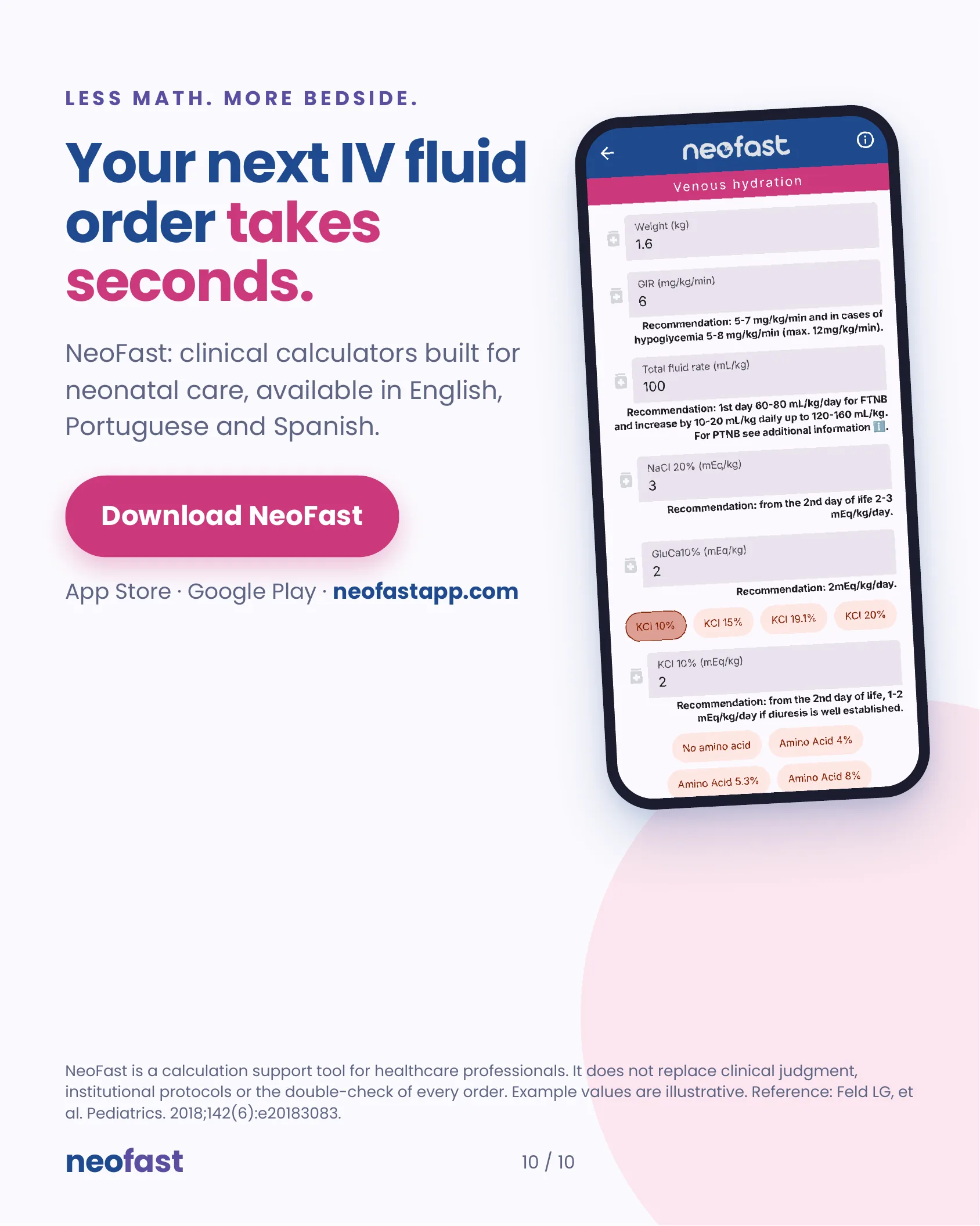
LESS MATH. MORE BEDSIDE.
Your next IV fluid order takes seconds.
NeoFast: clinical calculators built for neonatal care, available in English, Portuguese and Spanish.
Download NeoFast
App Store · Google Play · neofastapp.com
Venous hydration
- Weight (kg): 1.6
- GIR (mg/kg/min): 6 — Recommendation: 5-7 mg/kg/min and in cases of hypoglycemia 5-8 mg/kg/min (max. 12mg/kg/min).
- Total fluid rate (mL/kg): 100 — Recommendation: 1st day 60-80 mL/kg/day for FTNB and increase by 10-20 mL/kg daily up to 120-160 mL/kg. For PTNB see additional information ⓘ.
- NaCl 20% (mEq/kg): 3 — Recommendation: from the 2nd day of life 2-3 mEq/kg/day.
- GluCa10% (mEq/kg): 2 — Recommendation: 2mEq/kg/day.
- KCl options: KCl 10%, KCl 15%, KCl 19.1%, KCl 20%
- KCl 10% (mEq/kg): 2 — Recommendation: from the 2nd day of life, 1-2 mEq/kg/day if diuresis is well established.
- Amino acid options: No amino acid, Amino Acid 4%, Amino Acid 5.3%, Amino Acid 8%
NeoFast is a calculation support tool for healthcare professionals. It does not replace clinical judgment, institutional protocols or the double-check of every order. Example values are illustrative. Reference: Feld LG, et al. Pediatrics. 2018;142(6):e20183083.
Frequently asked questions
What GIR should be used for a neonate with hypoglycemia?
In cases of hypoglycemia, the glucose infusion rate should be 5-8 mg/kg/min, with a maximum of 12 mg/kg/min; the standard recommended range otherwise is 5-7 mg/kg/min.
What total fluid rate is recommended for a full-term newborn on day 1 of life?
On the first day of life, full-term newborns should receive 60-80 mL/kg/day, increasing by 10-20 mL/kg daily up to a range of 120-160 mL/kg/day.
When should sodium and potassium be started in neonatal IV fluids, and at what dose?
From the second day of life, sodium (NaCl 20%) is given at 2-3 mEq/kg/day, and potassium (KCl 10%) is given at 1-2 mEq/kg/day, provided diuresis is well established.
At what glucose concentration does a neonate need central access instead of peripheral?
Glucose concentrations of 12.5% or below allow peripheral or central access; concentrations above 12.5% and below 20% require central access; concentrations of 20% or more require central access due to risk of extravasation and phlebitis.
What potassium concentration triggers a red alert for access type?
A potassium concentration greater than 200 mEq/L triggers a red alert; 40-200 mEq/L requires central access, and 40 mEq/L or below allows peripheral or central access.