Key takeaways
- Term newborns typically lose 5–10% of birth weight in the first week, while preterm infants may lose 10–15% due to greater body water and skin losses, and fluid therapy should allow this physiological contraction rather than fight it.
- Start IV fluids at 60–80 mL/kg/day on day 1 in term newborns, advancing by 10–20 mL/kg/day to a target of 120–160 mL/kg/day, individualized by gestational age.
- No routine sodium should be given until postnatal diuresis starts (usually day 2), since early hyponatremia usually reflects excess water rather than sodium deficiency; term maintenance sodium is 2–3 mEq/kg/day from day 2, while preterm infants after the first week may need 3–5 mEq/kg/day (AAP) or up to 3–8 mEq/kg/day (ESPGHAN 2022).
- In the Neofluid multicenter study of term newborns, hyponatremia occurred in 7.9% of infants on hypotonic maintenance fluids versus only 1.2% on isotonic fluids, supporting isotonic fluids as the safer choice in term infants.
- Potassium should be started at 1–2 mEq/kg/day from day 2 only once diuresis is established, alongside calcium gluconate 10% at around 2 mEq/kg/day and a glucose infusion rate of 5–7 mg/kg/min (5–8 mg/kg/min in hypoglycemia, max 12 mg/kg/min).
References
- Weaver LJ, Travers CP, Ambalavanan N, Askenazi D. Neonatal fluid overload—ignorance is no longer bliss. Pediatr Nephrol. 2023;38(1):47–60. doi:10.1007/s00467-022-05514-4
- Selewski DT, Barhight MF, Bjornstad EC, et al. Fluid assessment, fluid balance, and fluid overload in sick children: a report from the Pediatric ADQI conference. Pediatr Nephrol. 2024. doi:10.1007/s00467-023-06156-w
- Ozkan H, Duman N, Tuzun F, et al. Isotonic and hypotonic fluids in IV maintenance therapy in term newborns: the multicenter “Neofluid” study. Front Nutr. 2024;11:1410571
- Kosmeri C, Baltogianni M, Dermitzaki N, Tsiogka CM, Giapros V. The changing landscape of sodium needs in the preterm neonate. Nutrients. 2026;18(2):186
- Diller N, Osborn DA, Birch P. Higher versus lower sodium intake for preterm infants. Cochrane Database Syst Rev. 2023. CD012642.pub2
- Embleton ND, Moltu SJ, Lapillonne A, et al. Enteral nutrition in preterm infants (2022): ESPGHAN position paper. J Pediatr Gastroenterol Nutr. 2023;76:248–268
Fluid & electrolyte management in the newborn
NEONATOLOGY · EVIDENCE UPDATE
Fluid & electrolyte management in the newborn
What recent international literature (2022–2026) says and how to calculate it at the bedside with NeoFast.
References
- Weaver LJ, Travers CP, Ambalavanan N, Askenazi D. Neonatal fluid overload—ignorance is no longer bliss. Pediatr Nephrol. 2023;38(1):47–60. doi:10.1007/s00467-022-05514-4
- Selewski DT, Barhight MF, Bjornstad EC, et al. Fluid assessment, fluid balance, and fluid overload in sick children: a report from the Pediatric ADQI conference. Pediatr Nephrol. 2024. doi:10.1007/s00467-023-06156-w
- Ozkan H, Duman N, Tuzun F, et al. Isotonic and hypotonic fluids in IV maintenance therapy in term newborns: the multicenter “Neofluid” study. Front Nutr. 2024;11:1410571
- Kosmeri C, Baltogianni M, Dermitzaki N, Tsiogka CM, Giapros V. The changing landscape of sodium needs in the preterm neonate. Nutrients. 2026;18(2):186
- Diller N, Osborn DA, Birch P. Higher versus lower sodium intake for preterm infants. Cochrane Database Syst Rev. 2023. CD012642.pub2
- Embleton ND, Moltu SJ, Lapillonne A, et al. Enteral nutrition in preterm infants (2022): ESPGHAN position paper. J Pediatr Gastroenterol Nutr. 2023;76:248–268
neofast · neofastapp.com
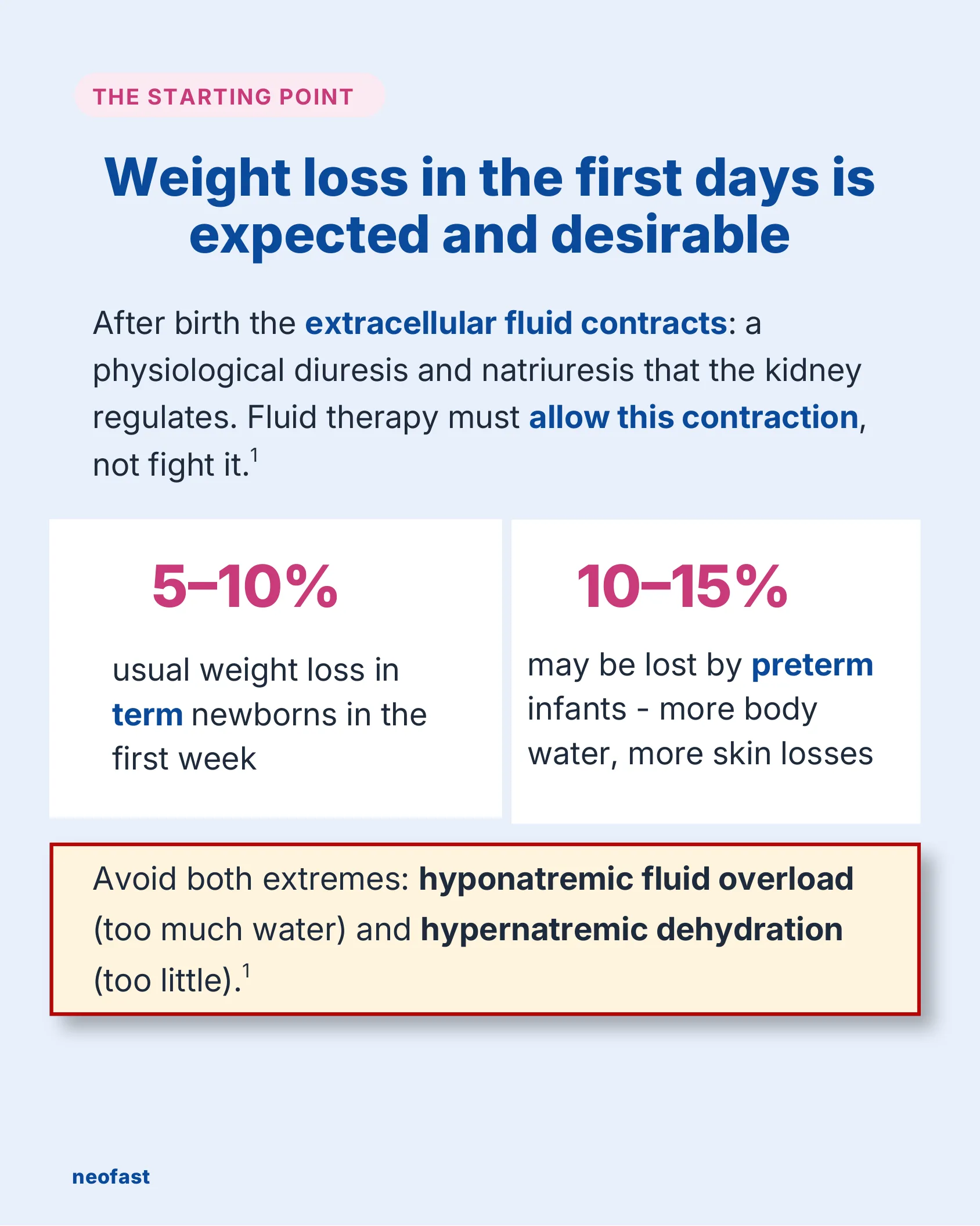
The starting point: weight loss in the first days
Weight loss in the first days is expected and desirable
After birth the extracellular fluid contracts: a physiological diuresis and natriuresis that the kidney regulates. Fluid therapy must allow this contraction, not fight it.1
- 5–10%: usual weight loss in term newborns in the first week
- 10–15%: may be lost by preterm infants – more body water, more skin losses
Avoid both extremes: hyponatremic fluid overload (too much water) and hypernatremic dehydration (too little).1
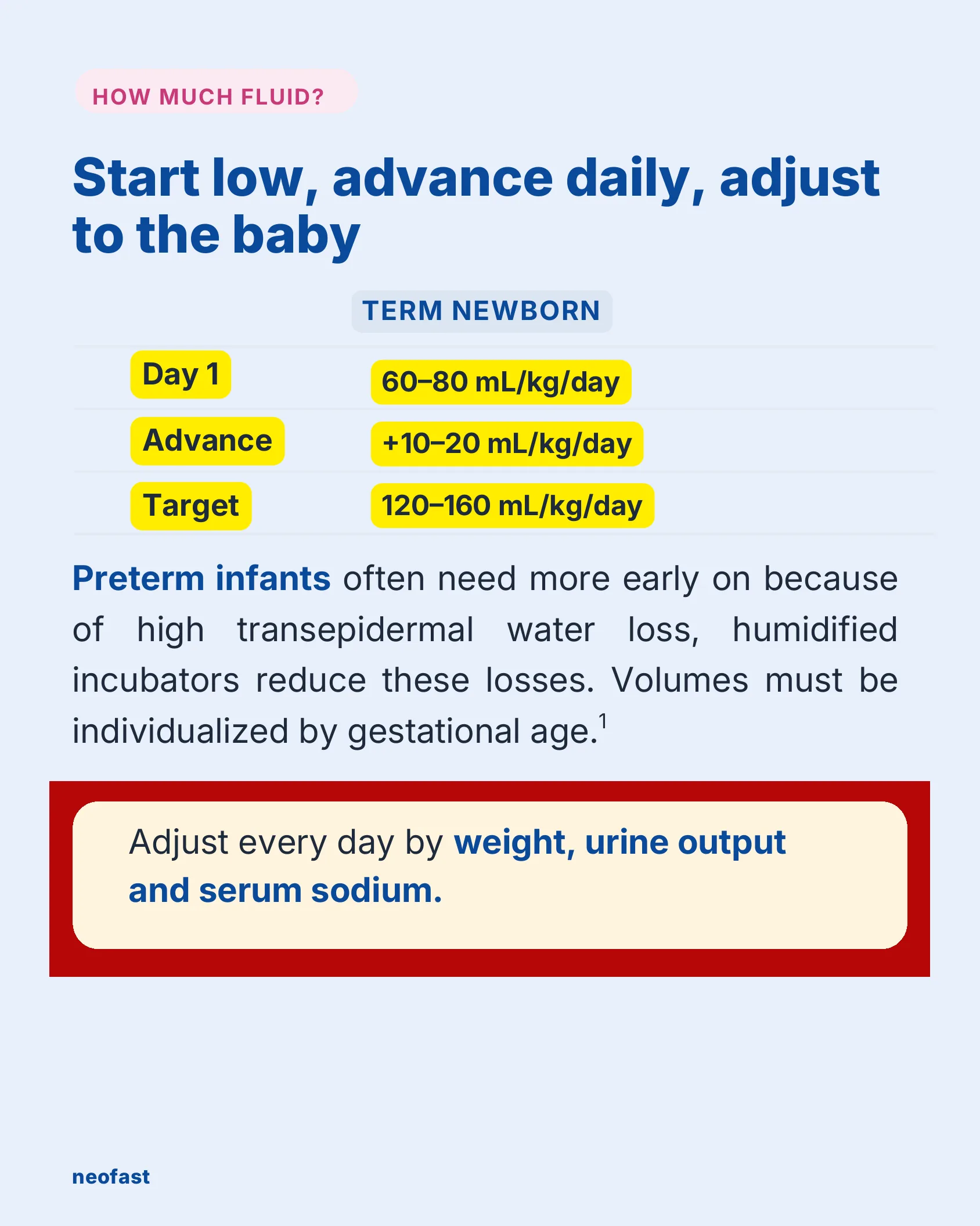
How much fluid? Start low, advance daily
Start low, advance daily, adjust to the baby
| Term newborn | |
|---|---|
| Day 1 | 60–80 mL/kg/day |
| Advance | +10–20 mL/kg/day |
| Target | 120–160 mL/kg/day |
Preterm infants often need more early on because of high transepidermal water loss, humidified incubators reduce these losses. Volumes must be individualized by gestational age.1
Adjust every day by weight, urine output and serum sodium.
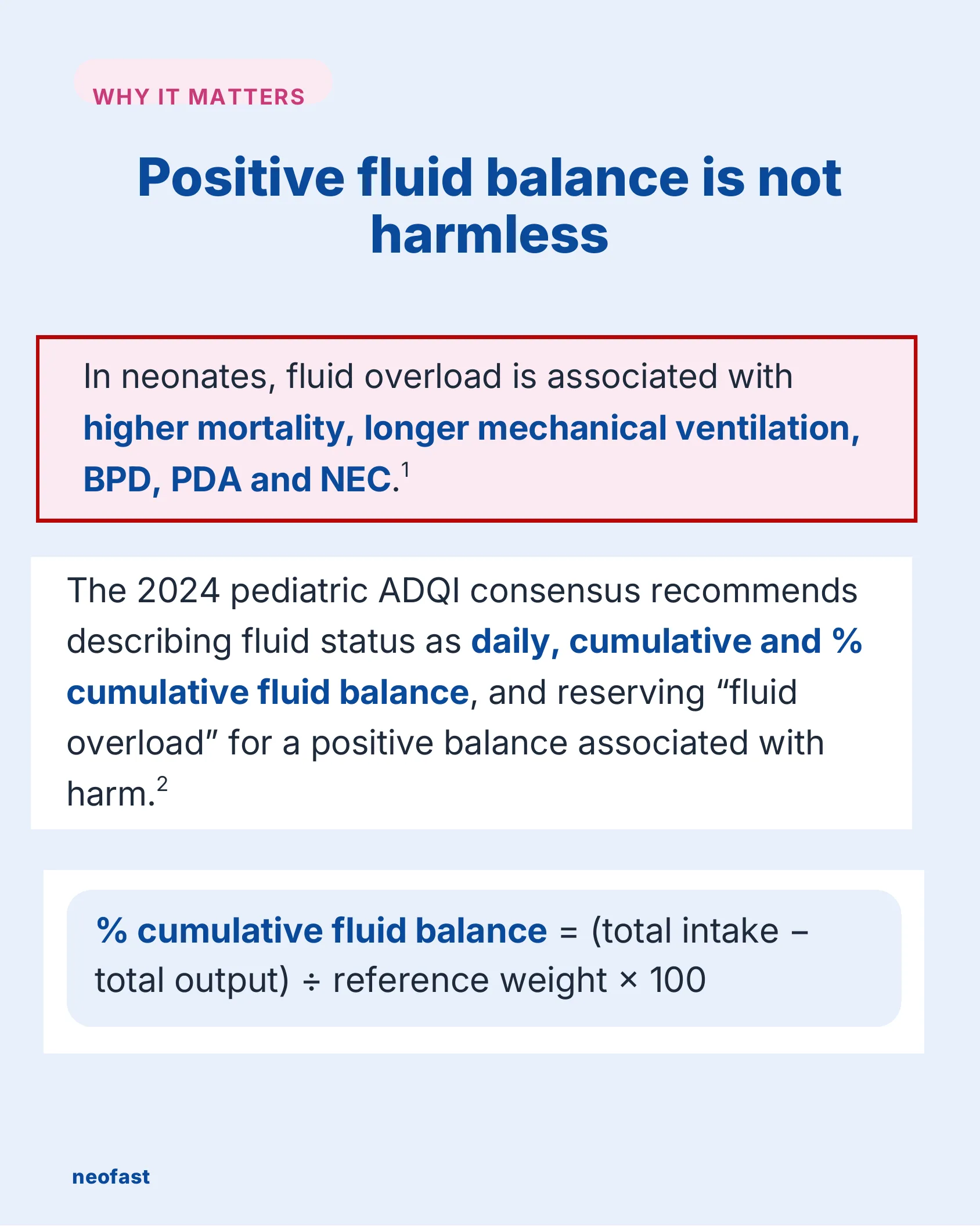
Why it matters: positive fluid balance is not harmless
Positive fluid balance is not harmless
In neonates, fluid overload is associated with higher mortality, longer mechanical ventilation, BPD, PDA and NEC.1
The 2024 pediatric ADQI consensus recommends describing fluid status as daily, cumulative and % cumulative fluid balance, and reserving “fluid overload” for a positive balance associated with harm.2
% cumulative fluid balance = (total intake – total output) ÷ reference weight × 100
Sodium: timing matters as much as dose
Timing matters as much as dose
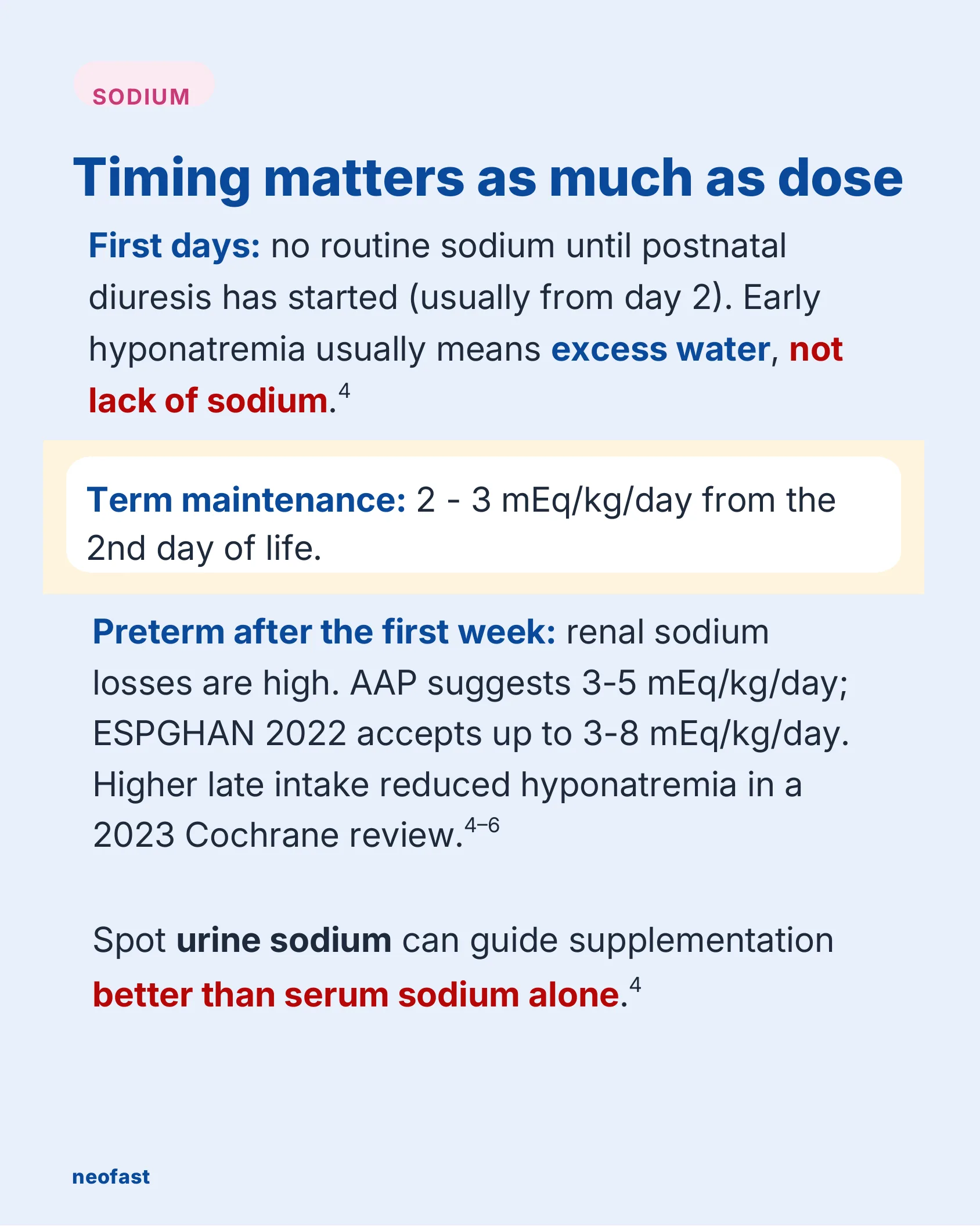
First days: no routine sodium until postnatal diuresis has started (usually from day 2). Early hyponatremia usually means excess water, not lack of sodium.4
Term maintenance: 2 – 3 mEq/kg/day from the 2nd day of life.
Preterm after the first week: renal sodium losses are high. AAP suggests 3-5 mEq/kg/day; ESPGHAN 2022 accepts up to 3-8 mEq/kg/day. Higher late intake reduced hyponatremia in a 2023 Cochrane review.4–6
Spot urine sodium can guide supplementation better than serum sodium alone.4
Tonicity: isotonic vs hypotonic maintenance fluids
Isotonic vs hypotonic maintenance fluids
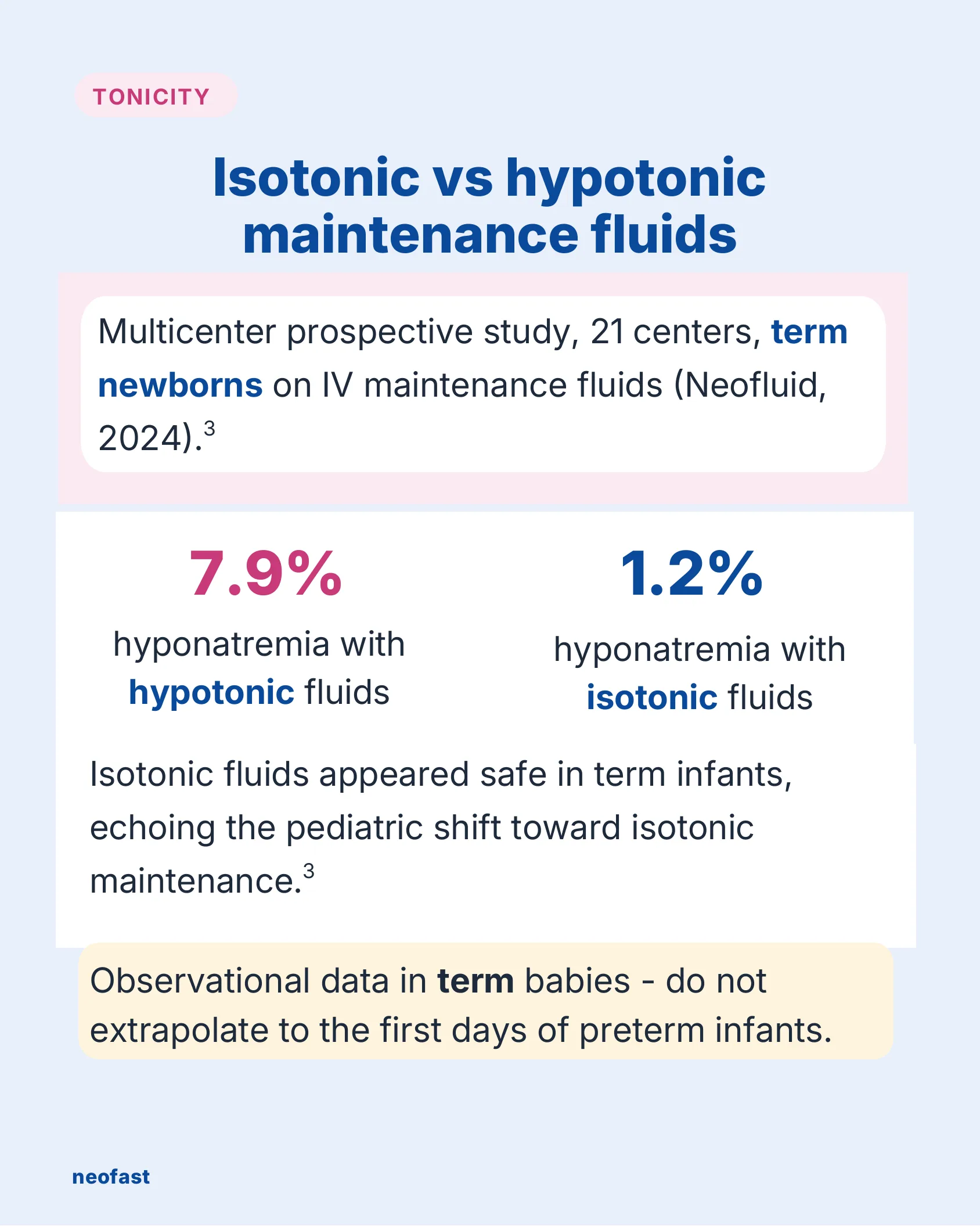
Multicenter prospective study, 21 centers, term newborns on IV maintenance fluids (Neofluid, 2024).3
- 7.9% hyponatremia with hypotonic fluids
- 1.2% hyponatremia with isotonic fluids
Isotonic fluids appeared safe in term infants, echoing the pediatric shift toward isotonic maintenance.3
Observational data in term babies – do not extrapolate to the first days of preterm infants.
At the bedside: glucose, potassium & monitoring
Glucose, potassium & what to monitor
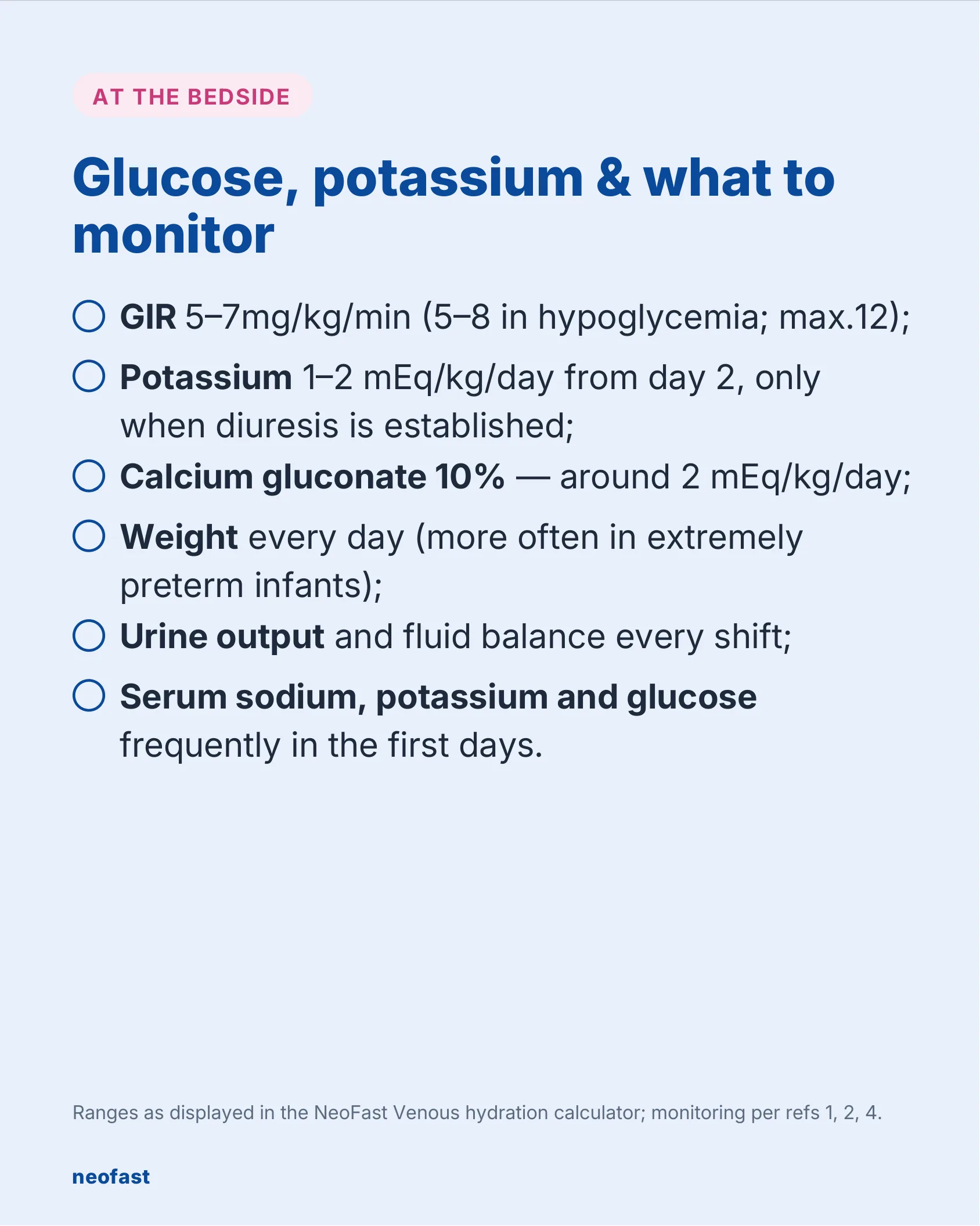
- GIR 5–7mg/kg/min (5–8 in hypoglycemia; max.12)
- Potassium 1–2 mEq/kg/day from day 2, only when diuresis is established
- Calcium gluconate 10% — around 2 mEq/kg/day
- Weight every day (more often in extremely preterm infants)
- Urine output and fluid balance every shift
- Serum sodium, potassium and glucose frequently in the first days.
Ranges as displayed in the NeoFast Venous hydration calculator; monitoring per refs 1, 2, 4.
In the app: venous hydration prescription example
Venous hydration: enter the prescription
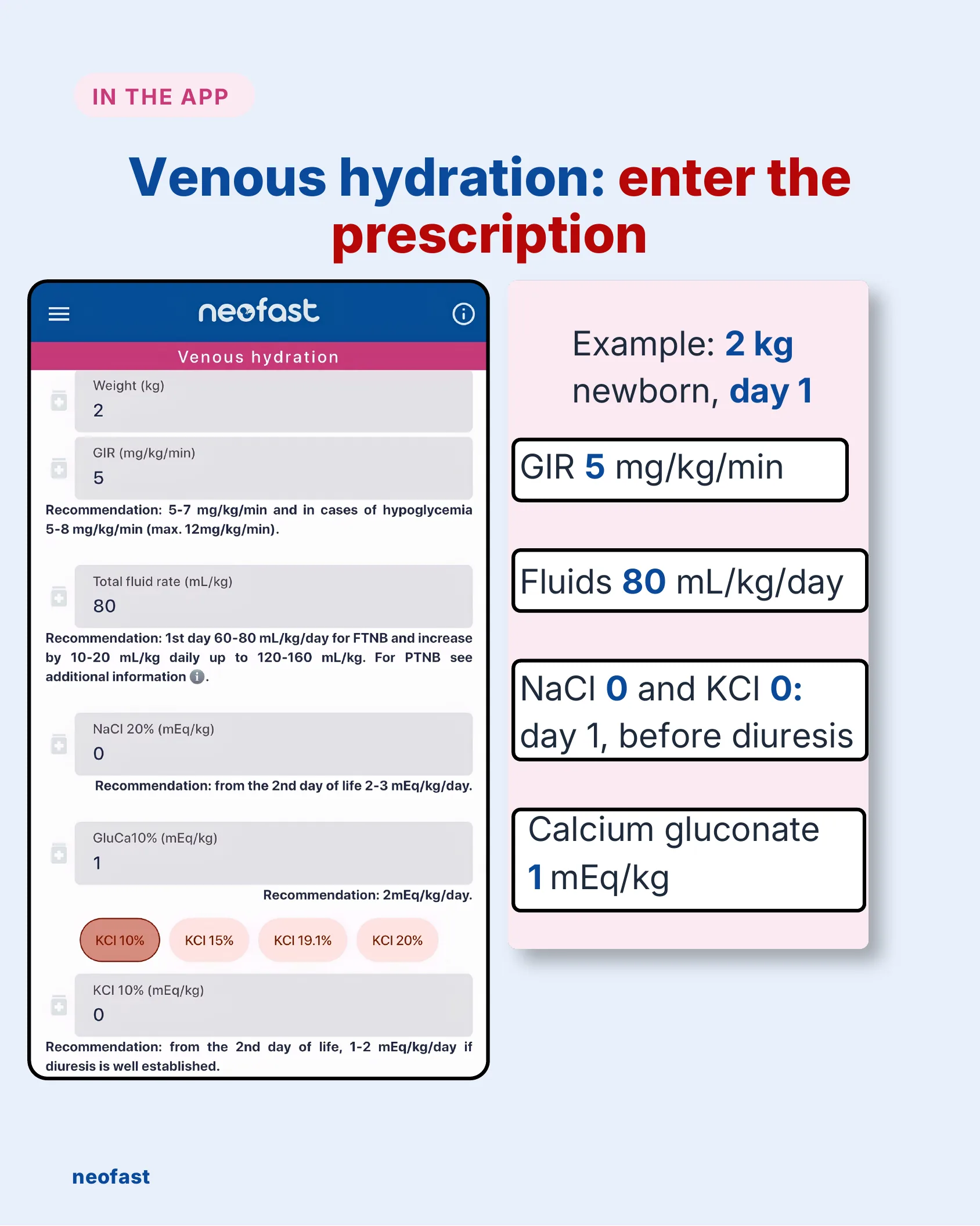
App fields and recommendations shown:
- Weight (kg): 2
- GIR (mg/kg/min): 5 — Recommendation: 5-7 mg/kg/min and in cases of hypoglycemia 5-8 mg/kg/min (max. 12mg/kg/min).
- Total fluid rate (mL/kg): 80 — Recommendation: 1st day 60-80 mL/kg/day for FTNB and increase by 10-20 mL/kg daily up to 120-160 mL/kg. For PTNB see additional information.
- NaCl 20% (mEq/kg): 0 — Recommendation: from the 2nd day of life 2-3 mEq/kg/day.
- GluCa10% (mEq/kg): 1 — Recommendation: 2mEq/kg/day.
- KCl options: KCl 10%, KCl 15%, KCl 19.1%, KCl 20%
- KCl 10% (mEq/kg): 0 — Recommendation: from the 2nd day of life, 1-2 mEq/kg/day if diuresis is well established.
Example: 2 kg newborn, day 1
- GIR 5 mg/kg/min
- Fluids 80 mL/kg/day
- NaCl 0 and KCl 0: day 1, before diuresis
- Calcium gluconate 1 mEq/kg
Ready-to-prescribe volumes in seconds
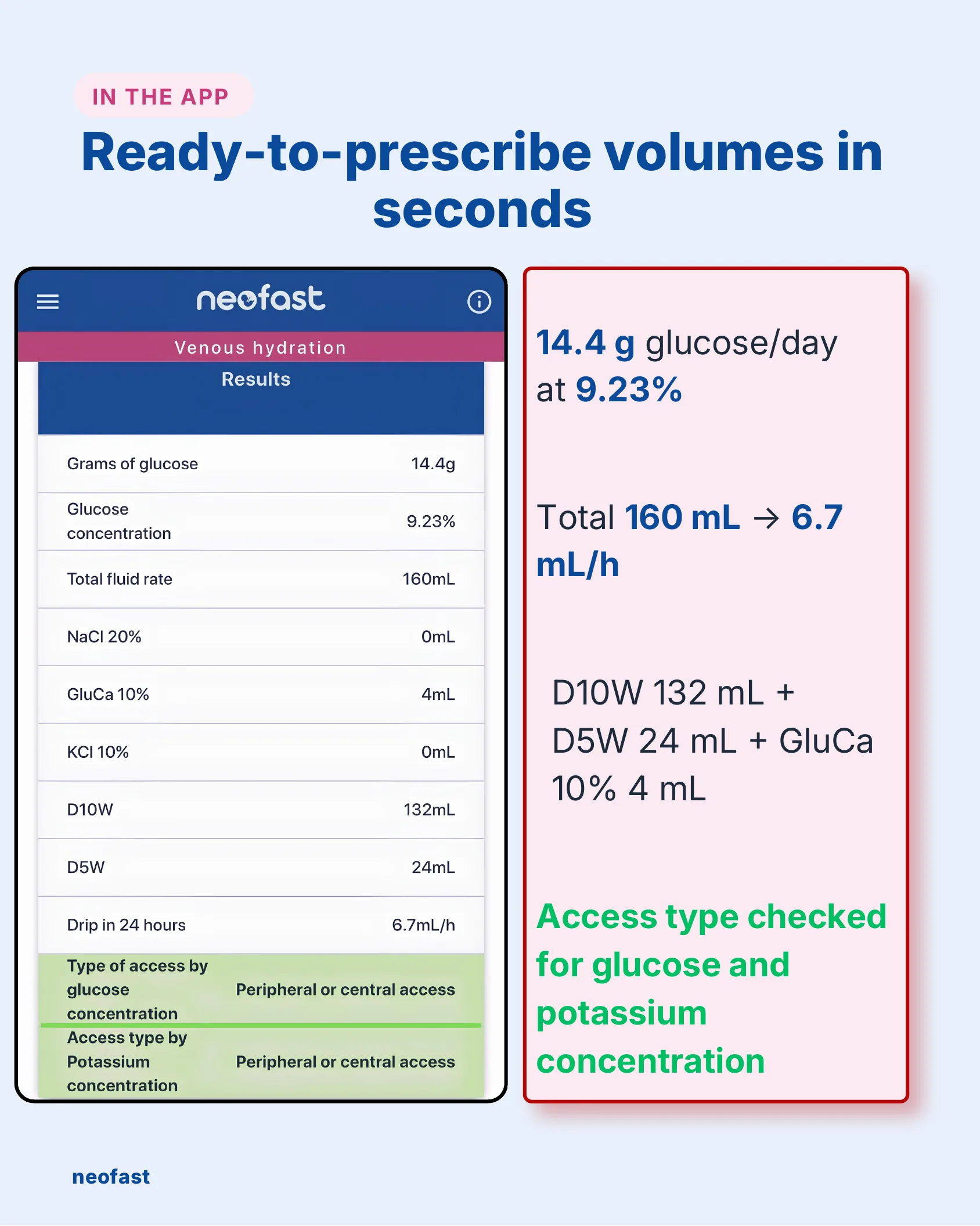
Ready-to-prescribe volumes in seconds
Venous hydration — Results (app screenshot)
| Grams of glucose | 14.4g |
| Glucose concentration | 9.23% |
| Total fluid rate | 160mL |
| NaCl 20% | 0mL |
| GluCa 10% | 4mL |
| KCl 10% | 0mL |
| D10W | 132mL |
| D5W | 24mL |
| Drip in 24 hours | 6.7mL/h |
| Type of access by glucose concentration | Peripheral or central access |
| Access type by Potassium concentration | Peripheral or central access |
Summary
- 14.4 g glucose/day at 9.23%
- Total 160 mL → 6.7 mL/h
- D10W 132 mL + D5W 24 mL + GluCa 10% 4 mL
- Access type checked for glucose and potassium concentration
Individualize, monitor, recalculate
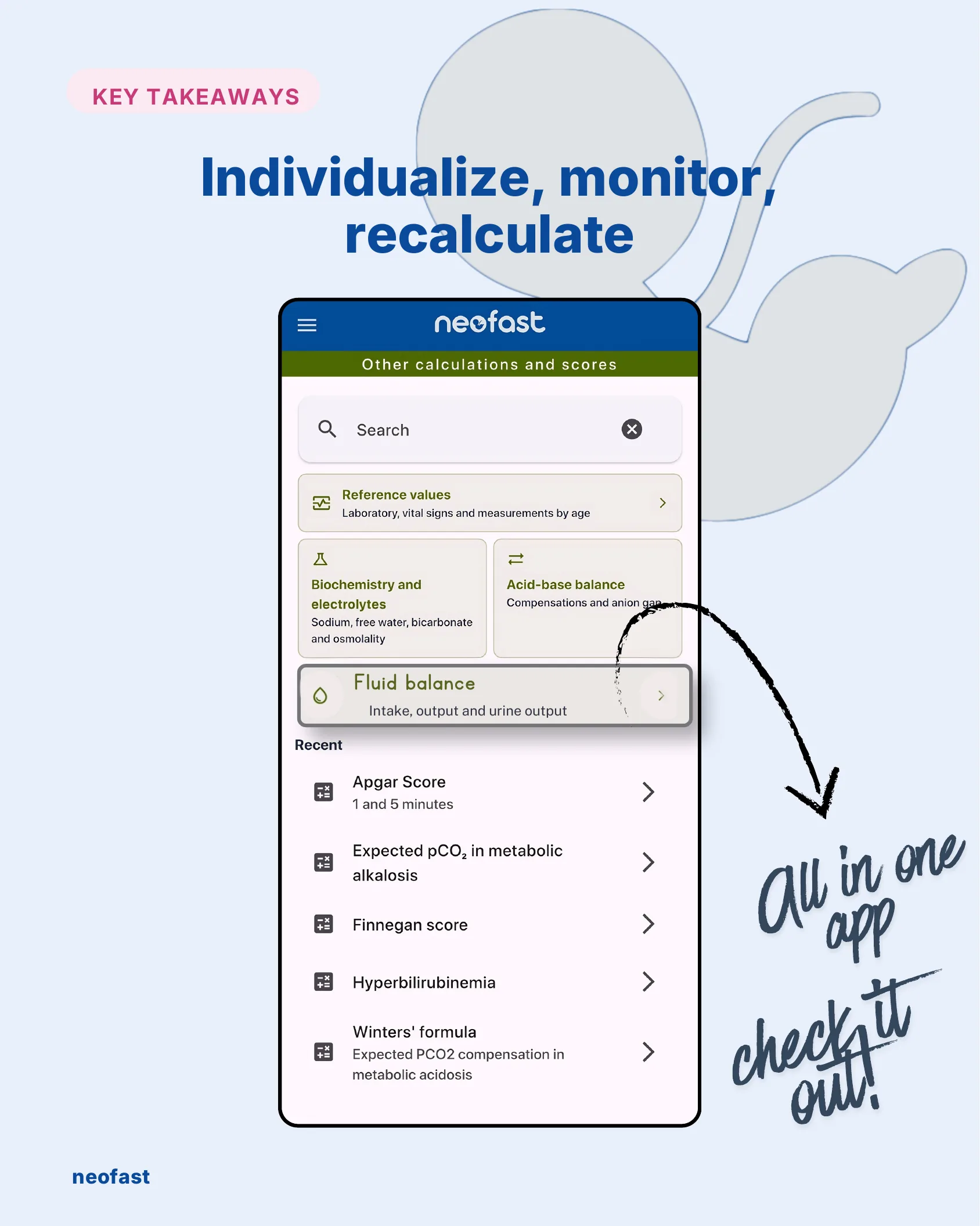
Individualize, monitor, recalculate
Other calculations and scores (app screenshot)
- Reference values — Laboratory, vital signs and measurements by age
- Biochemistry and electrolytes — Sodium, free water, bicarbonate and osmolality
- Acid-base balance — Compensations and anion gap
- Fluid balance — Intake, output and urine output
Recent
- Apgar Score — 1 and 5 minutes
- Expected pCO₂ in metabolic alkalosis
- Finnegan score
- Hyperbilirubinemia
- Winters’ formula — Expected PCO2 compensation in metabolic acidosis
All in one app — check it out!
Individualize, monitor, recalculate
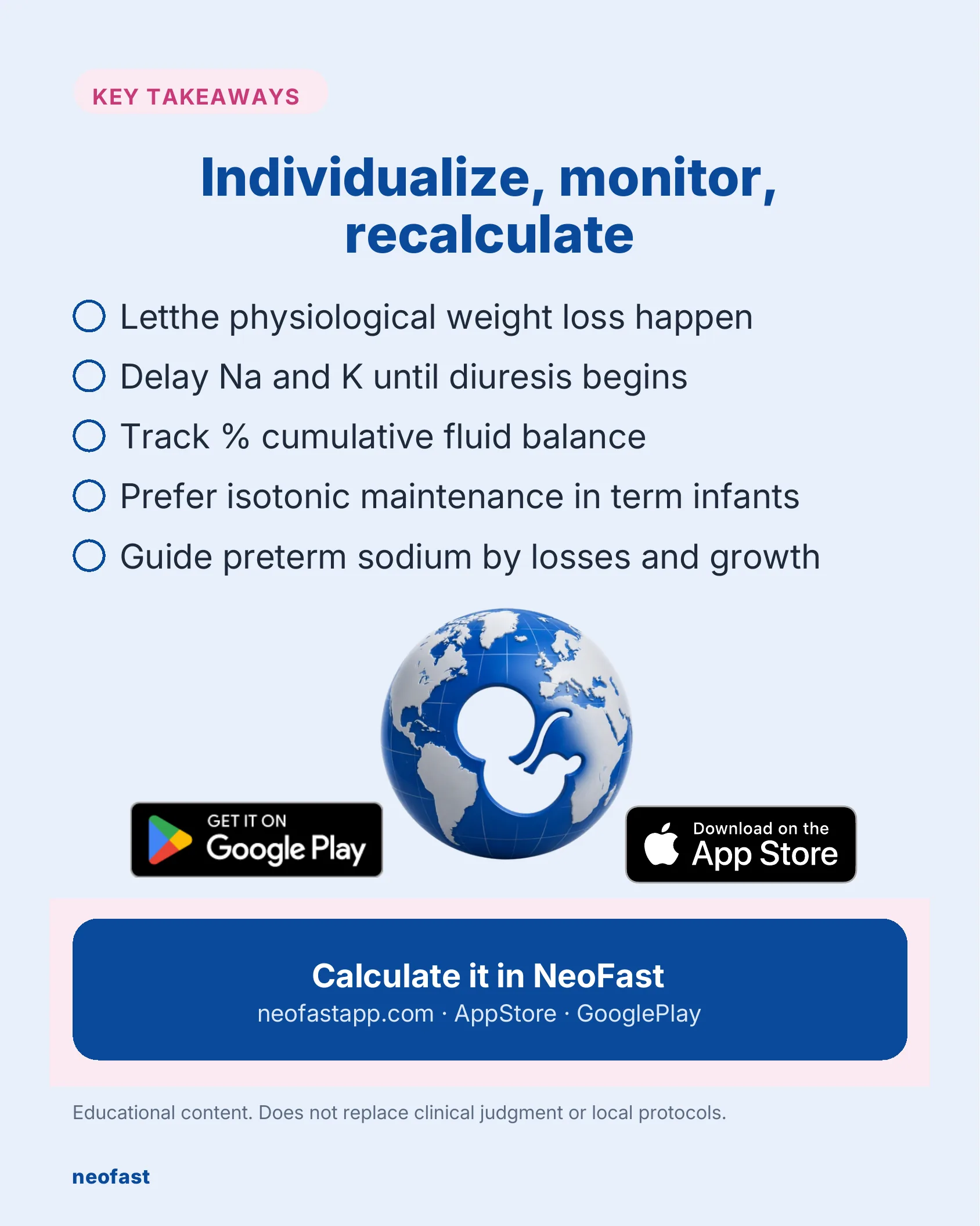
Individualize, monitor, recalculate
- Let the physiological weight loss happen
- Delay Na and K until diuresis begins
- Track % cumulative fluid balance
- Prefer isotonic maintenance in term infants
- Guide preterm sodium by losses and growth
Calculate it in NeoFast
neofastapp.com · AppStore · GooglePlay
Educational content. Does not replace clinical judgment or local protocols.
Frequently asked questions
How much weight loss is normal in newborns in the first week?
Term newborns typically lose 5–10% of birth weight in the first week; preterm infants may lose 10–15% due to higher body water content and greater skin losses. This weight loss is physiological and fluid therapy should allow it rather than prevent it.
What is the recommended starting fluid rate for term newborns?
Start at 60–80 mL/kg/day on day 1, advancing by 10–20 mL/kg/day, with a target of 120–160 mL/kg/day, adjusted daily based on weight, urine output and serum sodium.
When should sodium supplementation be started in newborns?
No routine sodium should be given until postnatal diuresis has started, usually from day 2, since early hyponatremia is usually due to excess water rather than sodium deficiency. Term maintenance sodium is 2–3 mEq/kg/day from day 2; preterm infants after the first week may need 3–5 mEq/kg/day (AAP) or up to 3–8 mEq/kg/day (ESPGHAN 2022).
Are isotonic or hypotonic fluids safer for IV maintenance in term newborns?
The 2024 multicenter Neofluid study found hyponatremia in 7.9% of term newborns on hypotonic fluids versus 1.2% on isotonic fluids, suggesting isotonic fluids are safer in term infants; this is observational data in term babies and should not be extrapolated to preterm infants in the first days.
When should potassium be started in newborns and at what dose?
Potassium should be started at 1–2 mEq/kg/day from day 2, only once diuresis is well established.