Key takeaways
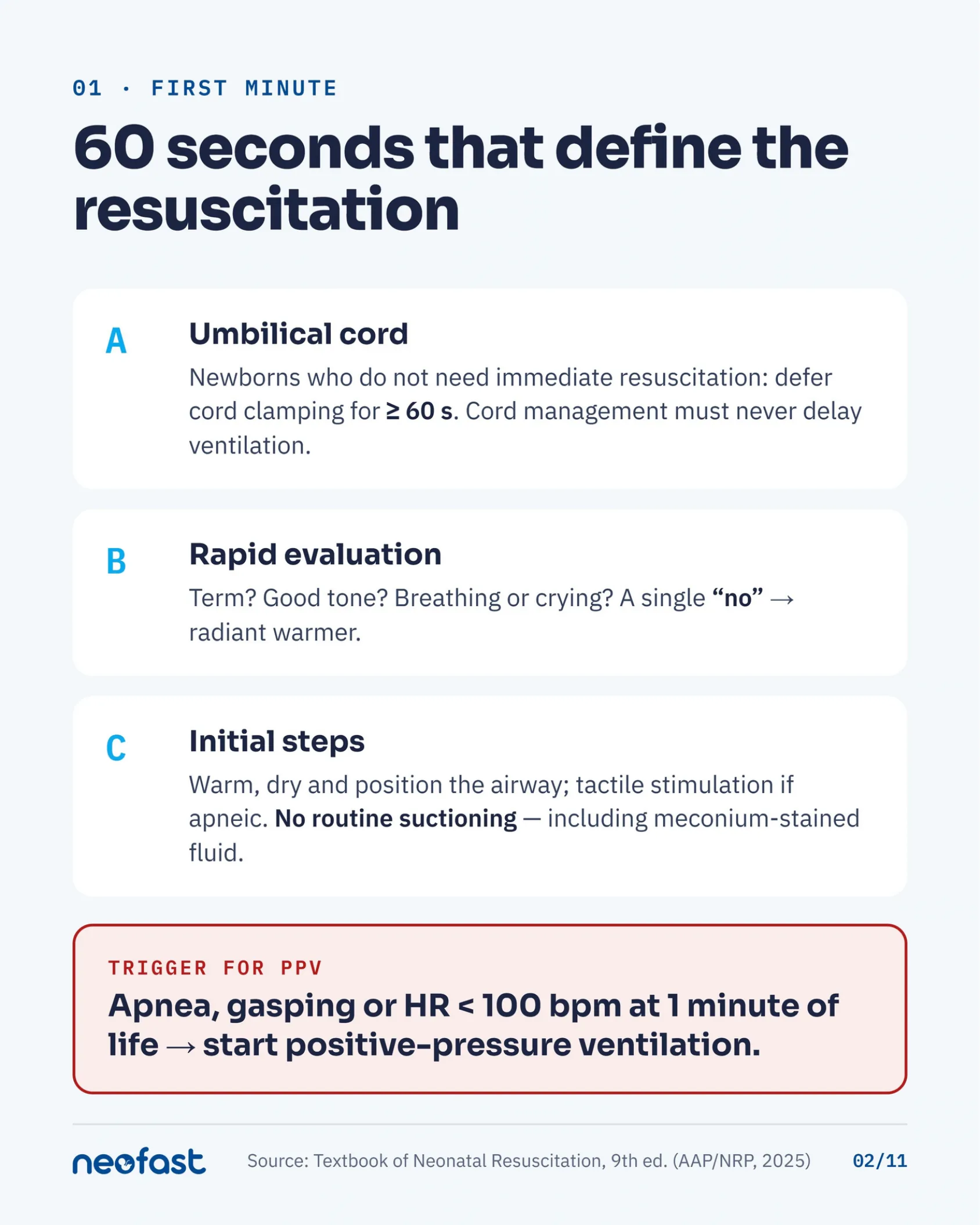
- The trigger to start positive-pressure ventilation is apnea, gasping, or heart rate < 100 bpm at 1 minute of life.
- IV/IO epinephrine dose is 0.02 mg/kg (0.2 mL/kg of 0.1 mg/mL concentration), range 0.01–0.03 mg/kg, repeated every 3–5 minutes, followed by a 3-mL saline flush.
- Chest compressions are indicated only when HR remains < 60 bpm despite ≥ 30 seconds of effective ventilation, delivered at a 3:1 ratio (90 compressions + 30 breaths/min) with 100% FiO2.
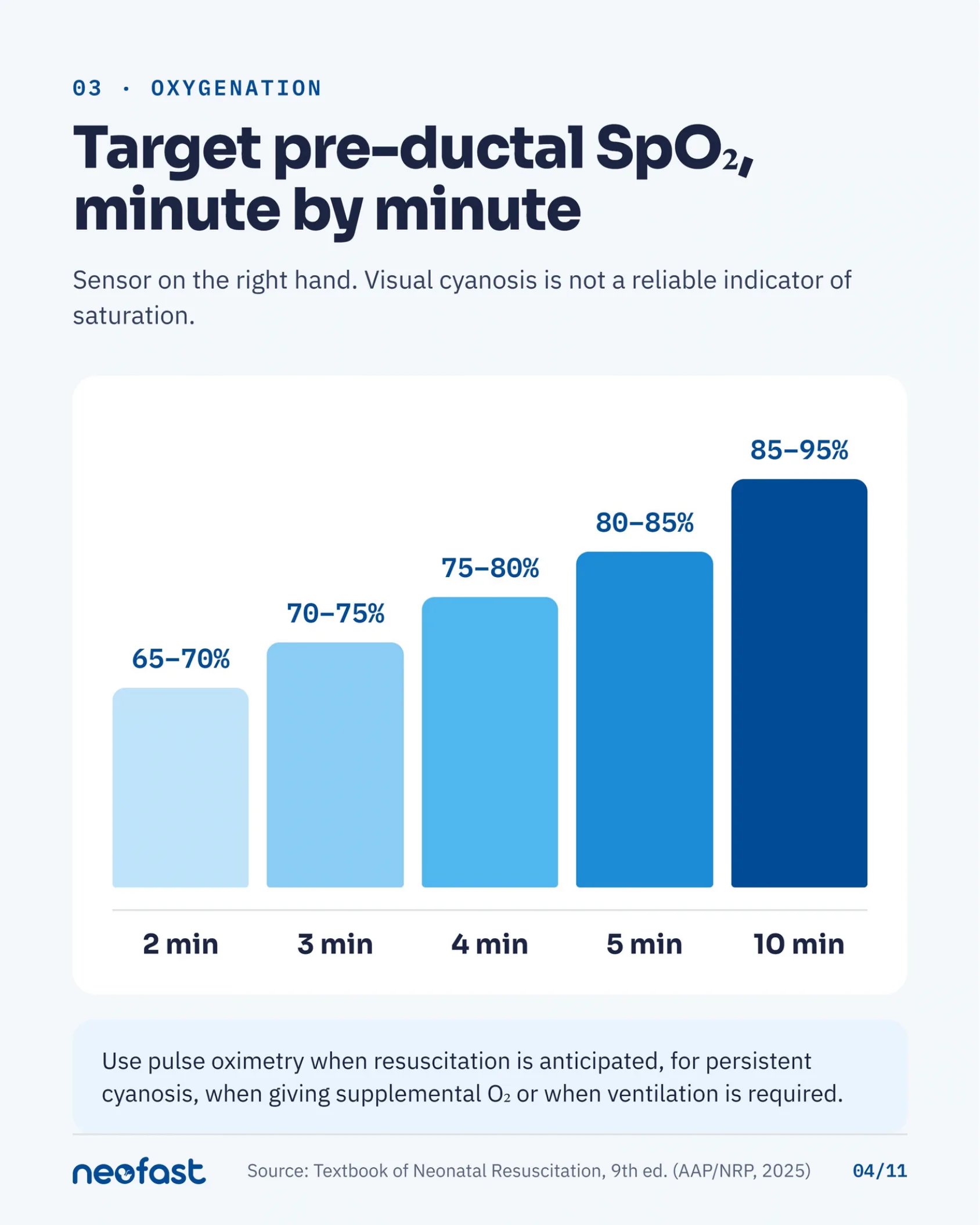
- Target pre-ductal SpO2 rises progressively from 65–75% at 2–3 minutes to 85–95% by 10 minutes of life.
- If HR stays < 60 bpm after epinephrine, consider hypovolemia and pneumothorax, and give volume expansion at 10 mL/kg over 5–10 minutes.
References
- Textbook of Neonatal Resuscitation, 9th ed. (AAP/NRP, 2025)
- Neonatal Resuscitation Program® (NRP) · American Academy of Pediatrics, 2025 · Ed. Gary M. Weiner
Essential Steps
Neonatal Resuscitation
From the first minute to epinephrine: the numbers you need at the tip of your tongue — and in the palm of your hand.
Sole source of this content
Textbook of Neonatal Resuscitation, 9th Edition
Neonatal Resuscitation Program® (NRP) · American Academy of Pediatrics, 2025 · Ed. Gary M. Weiner
Technical content for neonatologists
60 seconds that define the resuscitation
01 · First Minute
60 seconds that define the resuscitation
- A — Umbilical cord: Newborns who do not need immediate resuscitation: defer cord clamping for ≥ 60 s. Cord management must never delay ventilation.
- B — Rapid evaluation: Term? Good tone? Breathing or crying? A single “no” → radiant warmer.
- C — Initial steps: Warm, dry and position the airway; tactile stimulation if apneic. No routine suctioning — including meconium-stained fluid.
Trigger for PPV: Apnea, gasping or HR < 100 bpm at 1 minute of life → start positive-pressure ventilation.
PPV: the single most important and effective step
02 · Ventilation
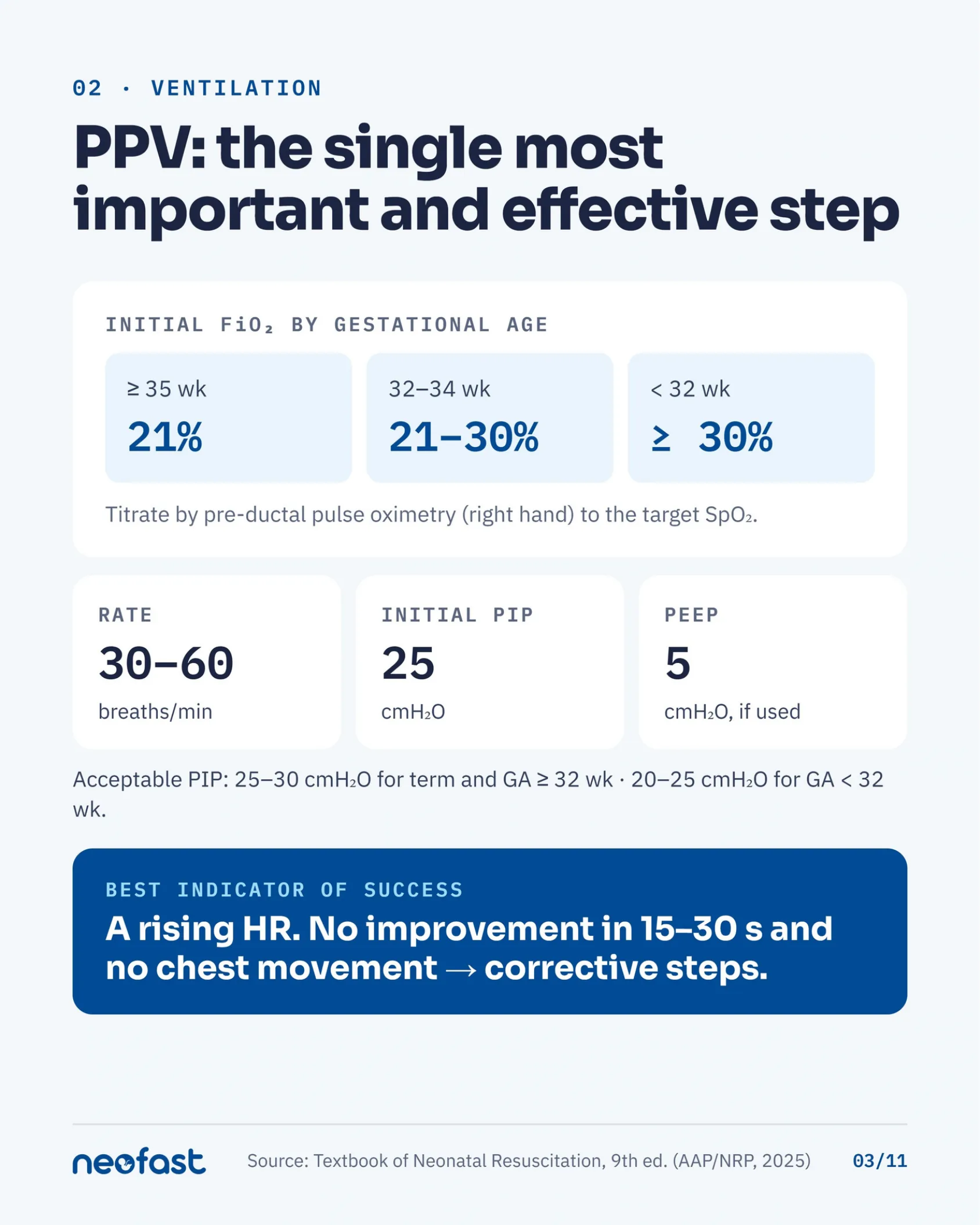
PPV: the single most important and effective step
| Gestational Age | Initial FiO₂ |
|---|---|
| ≥ 35 wk | 21% |
| 32–34 wk | 21–30% |
| < 32 wk | ≥ 30% |
Titrate by pre-ductal pulse oximetry (right hand) to the target SpO₂.
- Rate: 30–60 breaths/min
- Initial PIP: 25 cmH₂O
- PEEP: 5 cmH₂O, if used
Acceptable PIP: 25–30 cmH₂O for term and GA ≥ 32 wk · 20–25 cmH₂O for GA < 32 wk.
Best indicator of success: A rising HR. No improvement in 15–30 s and no chest movement → corrective steps.
Target pre-ductal SpO₂, minute by minute
03 · Oxygenation
Target pre-ductal SpO₂, minute by minute
Sensor on the right hand. Visual cyanosis is not a reliable indicator of saturation.
| Time | Target SpO₂ |
|---|---|
| 2 min | 65–70% |
| 3 min | 70–75% |
| 4 min | 75–80% |
| 5 min | 80–85% |
| 10 min | 85–95% |
Use pulse oximetry when resuscitation is anticipated, for persistent cyanosis, when giving supplemental O₂ or when ventilation is required.
Chest not moving? MR SOPA
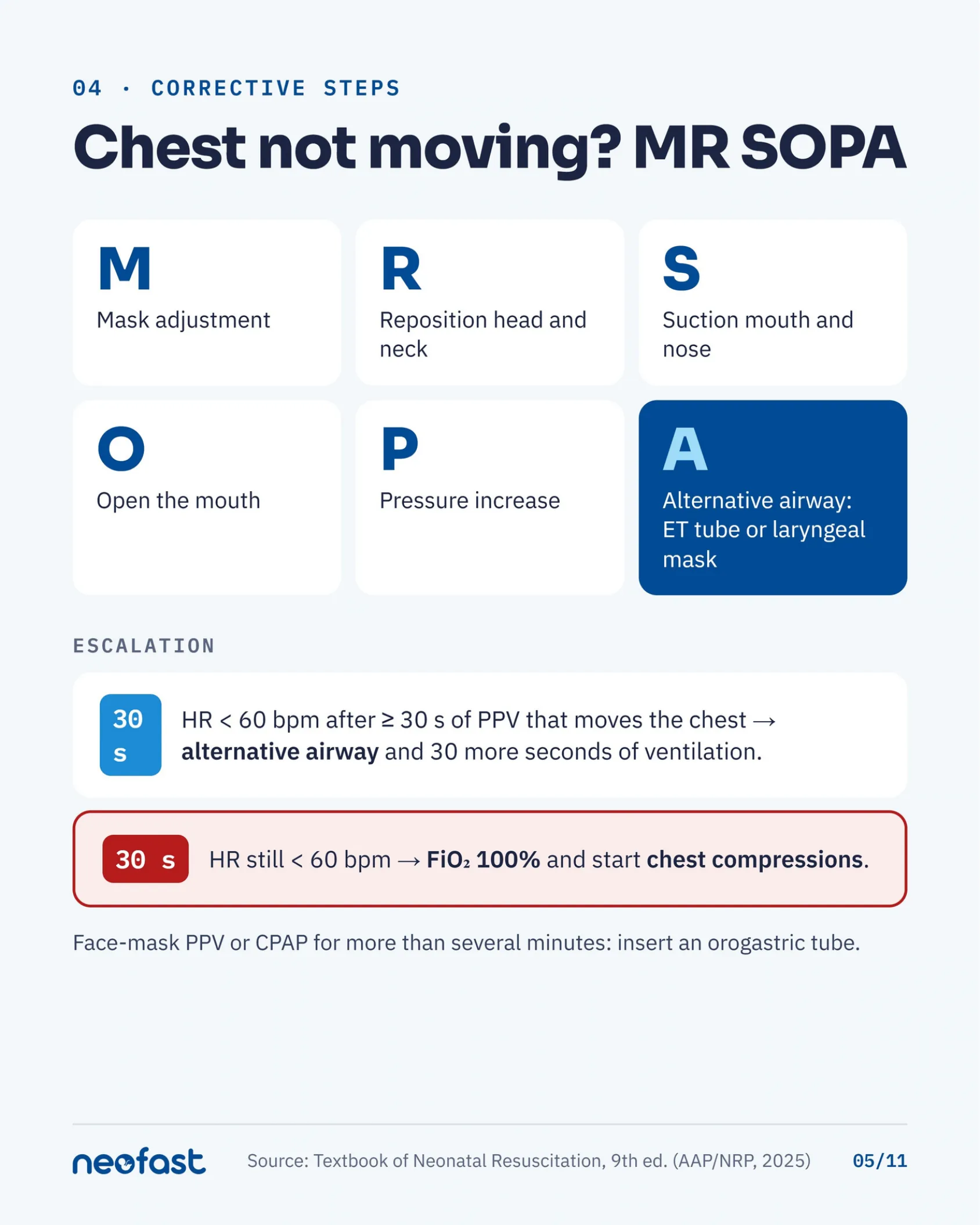
04 · Corrective Steps
Chest not moving? MR SOPA
- M — Mask adjustment
- R — Reposition head and neck
- S — Suction mouth and nose
- O — Open the mouth
- P — Pressure increase
- A — Alternative airway: ET tube or laryngeal mask
Escalation
- 30 s: HR < 60 bpm after ≥ 30 s of PPV that moves the chest → alternative airway and 30 more seconds of ventilation.
- 30 s: HR still < 60 bpm → FiO₂ 100% and start chest compressions.
Face-mask PPV or CPAP for more than several minutes: insert an orogastric tube.
The right tube, in about 30 seconds
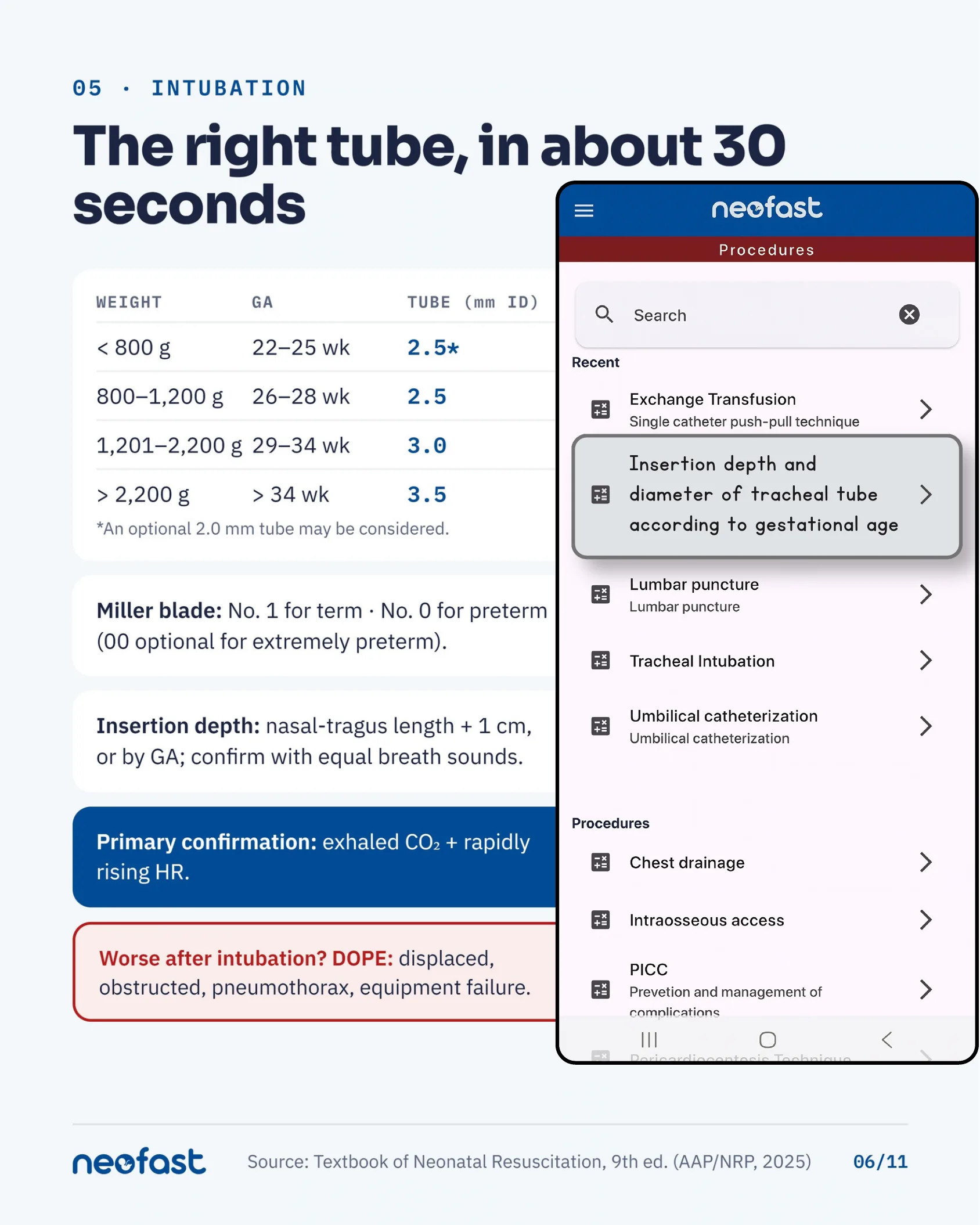
05 · Intubation
The right tube, in about 30 seconds
| Weight | GA | Tube (mm ID) |
|---|---|---|
| < 800 g | 22–25 wk | 2.5* |
| 800–1,200 g | 26–28 wk | 2.5 |
| 1,201–2,200 g | 29–34 wk | 3.0 |
| > 2,200 g | > 34 wk | 3.5 |
*An optional 2.0 mm tube may be considered.
Miller blade: No. 1 for term · No. 0 for preterm (00 optional for extremely preterm).
Insertion depth: nasal-tragus length + 1 cm, or by GA; confirm with equal breath sounds.
Primary confirmation: exhaled CO₂ + rapidly rising HR.
Worse after intubation? DOPE: displaced, obstructed, pneumothorax, equipment failure.
Only after ventilation that moves the chest
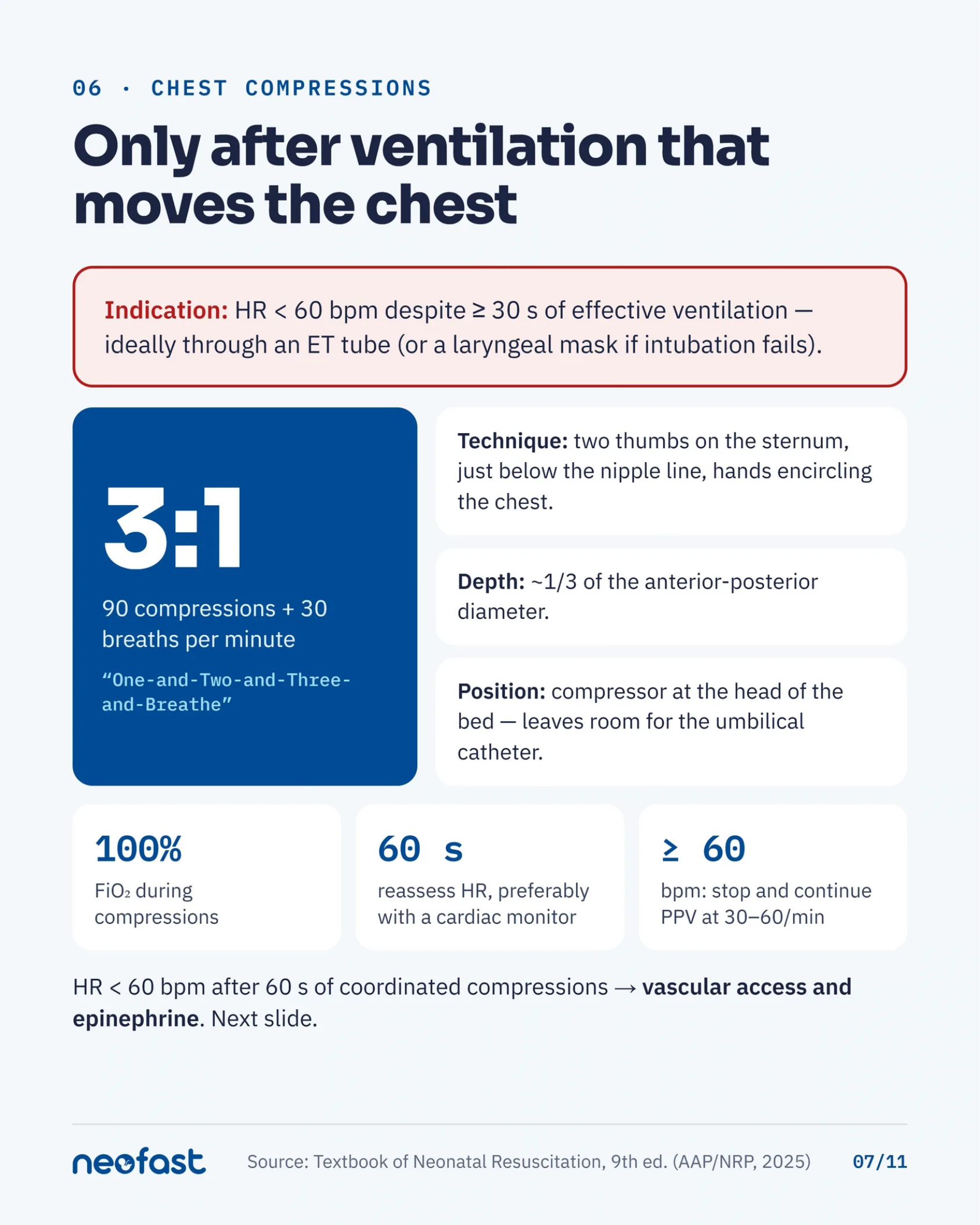
06 · Chest Compressions
Only after ventilation that moves the chest
Indication: HR < 60 bpm despite ≥ 30 s of effective ventilation — ideally through an ET tube (or a laryngeal mask if intubation fails).
3:1 — 90 compressions + 30 breaths per minute
“One-and-Two-and-Three-and-Breathe”
- Technique: two thumbs on the sternum, just below the nipple line, hands encircling the chest.
- Depth: ~1/3 of the anterior-posterior diameter.
- Position: compressor at the head of the bed — leaves room for the umbilical catheter.
- 100% FiO₂ during compressions
- 60 s: reassess HR, preferably with a cardiac monitor
- ≥ 60 bpm: stop and continue PPV at 30–60/min
HR < 60 bpm after 60 s of coordinated compressions → vascular access and epinephrine. Next slide.
Epinephrine: the math you can’t get wrong
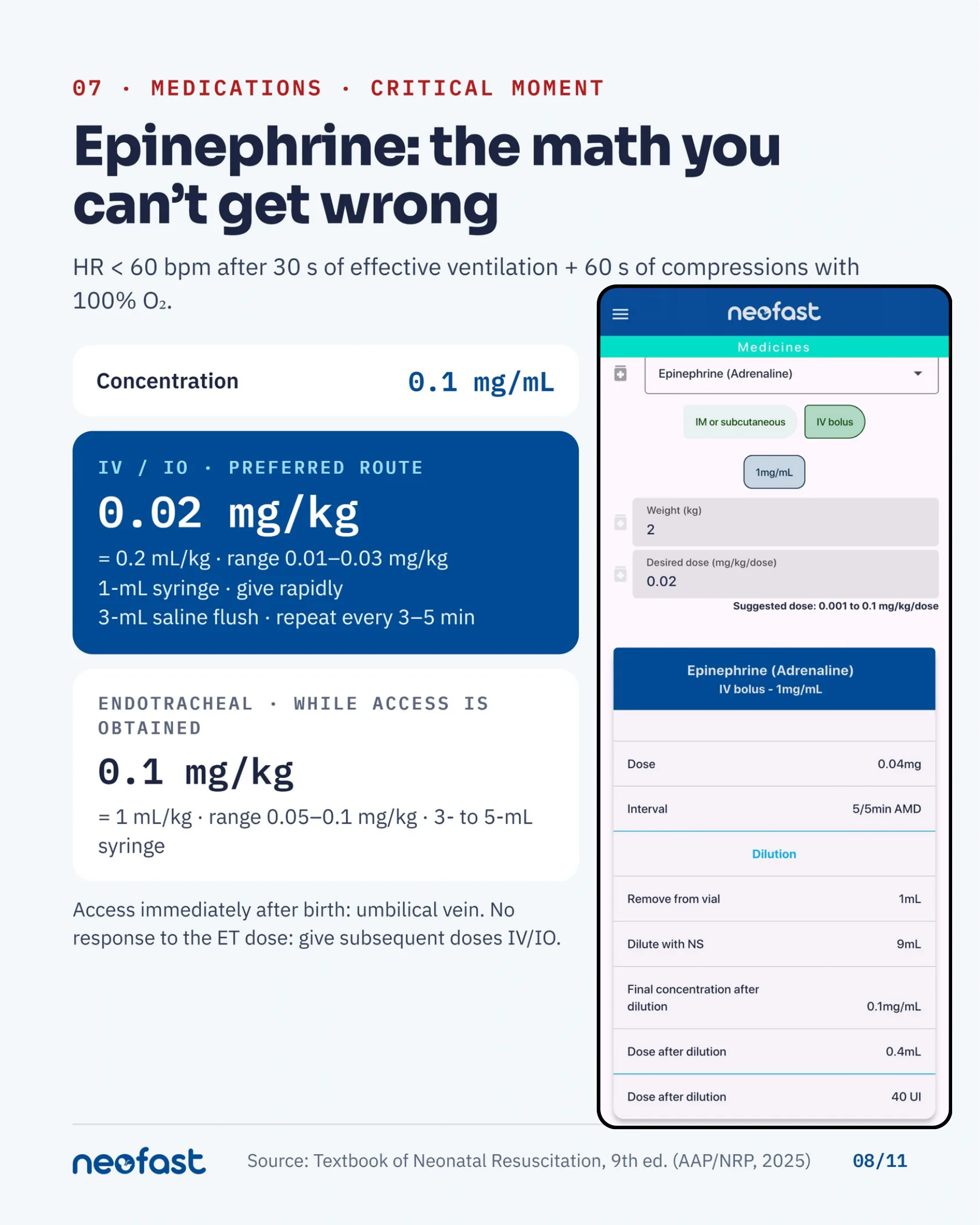
07 · Medications · Critical Moment
Epinephrine: the math you can’t get wrong
HR < 60 bpm after 30 s of effective ventilation + 60 s of compressions with 100% O₂.
Concentration: 0.1 mg/mL
IV / IO · Preferred route
- 0.02 mg/kg = 0.2 mL/kg · range 0.01–0.03 mg/kg
- 1-mL syringe · give rapidly
- 3-mL saline flush · repeat every 3–5 min
Endotracheal · while access is obtained
- 0.1 mg/kg = 1 mL/kg · range 0.05–0.1 mg/kg · 3- to 5-mL syringe
Access immediately after birth: umbilical vein. No response to the ET dose: give subsequent doses IV/IO.
HR still < 60 bpm after epinephrine?
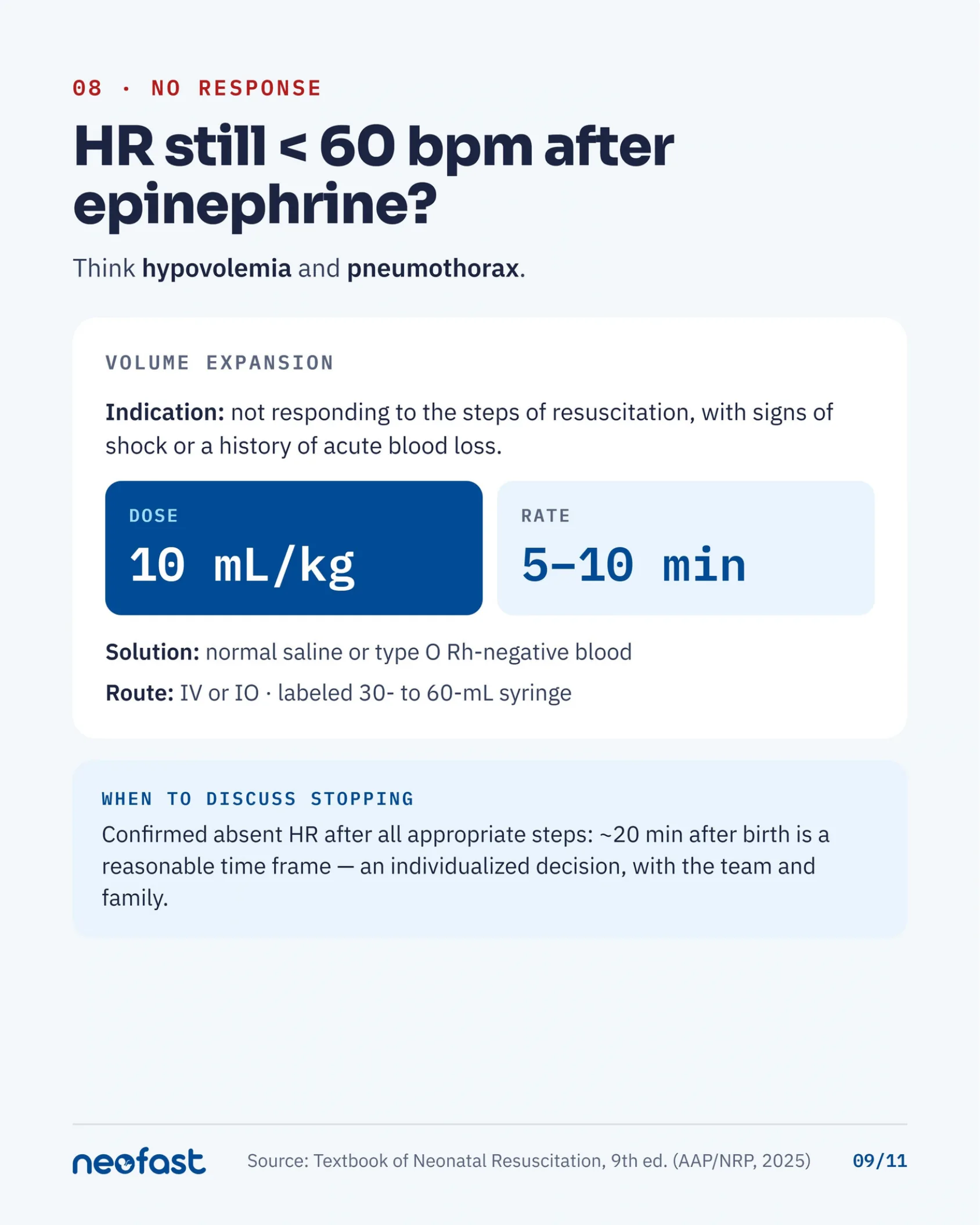
08 · NO RESPONSE
Think hypovolemia and pneumothorax.
Volume Expansion
Indication: not responding to the steps of resuscitation, with signs of shock or a history of acute blood loss.
| Dose | Rate |
|---|---|
| 10 mL/kg | 5–10 min |
Solution: normal saline or type O Rh-negative blood
Route: IV or IO · labeled 30- to 60-mL syringe
When to Discuss Stopping
Confirmed absent HR after all appropriate steps: ~20 min after birth is a reasonable time frame — an individualized decision, with the team and family.
Intubated. Now, how do you ventilate?
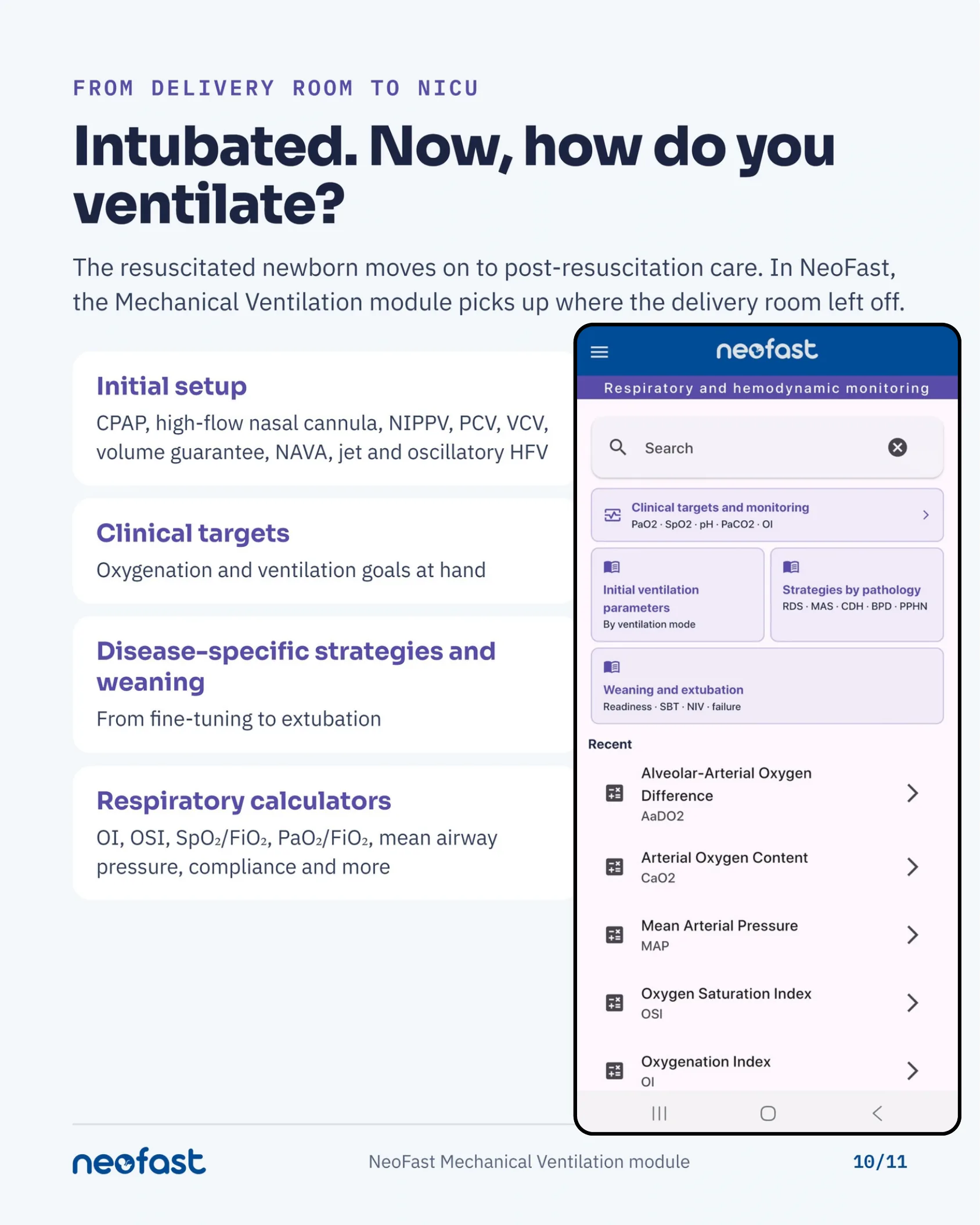
FROM DELIVERY ROOM TO NICU
The resuscitated newborn moves on to post-resuscitation care. In NeoFast, the Mechanical Ventilation module picks up where the delivery room left off.
Initial setup
CPAP, high-flow nasal cannula, NIPPV, PCV, VCV, volume guarantee, NAVA, jet and oscillatory HFV
Clinical targets
Oxygenation and ventilation goals at hand
Disease-specific strategies and weaning
From fine-tuning to extubation
Respiratory calculators
OI, OSI, SpO2/FiO2, PaO2/FiO2, mean airway pressure, compliance and more
- Clinical targets and monitoring — PaO2 · SpO2 · pH · PaCO2 · OI
- Initial ventilation parameters — By ventilation mode
- Strategies by pathology — RDS · MAS · CDH · BPD · PPHN
- Weaning and extubation — Readiness · SBT · NIV · failure
Recent
- Alveolar-Arterial Oxygen Difference (AaDO2)
- Arterial Oxygen Content (CaO2)
- Mean Arterial Pressure (MAP)
- Oxygen Saturation Index (OSI)
- Oxygenation Index (OI)
At every moment. Especially the critical ones.
At every moment. Especially the critical ones.
When every second counts, the math is already done: weight-based doses, intubation and mechanical ventilation in your pocket.
- Medications with calculated dose and volume
- Intubation: tube, blade and rapid sequence
- Mechanical ventilation from setup to weaning
SAVE AND SHARE
Take it to your next shift
SUBSCRIBE TO NEOFAST
Link in bio ·
Content based exclusively on the Textbook of Neonatal Resuscitation, 9th ed. (AAP/NRP, 2025). Does not replace clinical judgment or NRP training.
Frequently asked questions
What heart rate and signs trigger starting PPV in neonatal resuscitation?
Apnea, gasping, or HR < 100 bpm at 1 minute of life triggers starting positive-pressure ventilation.
What is the correct IV/IO epinephrine dose in neonatal resuscitation?
0.02 mg/kg (= 0.2 mL/kg using the 0.1 mg/mL concentration), range 0.01–0.03 mg/kg, given rapidly via a 1-mL syringe, followed by a 3-mL saline flush, repeated every 3–5 minutes.
What is the endotracheal epinephrine dose while awaiting vascular access?
0.1 mg/kg (= 1 mL/kg), range 0.05–0.1 mg/kg, given with a 3- to 5-mL syringe; if there is no response to the ET dose, give subsequent doses IV/IO.
When should chest compressions start and in what ratio?
Compressions start when HR < 60 bpm despite ≥ 30 seconds of effective ventilation that moves the chest, delivered at a 3:1 ratio (90 compressions + 30 breaths per minute) with 100% FiO2, reassessing HR after 60 seconds.
What does MR SOPA stand for in corrective ventilation steps?
Mask adjustment, Reposition head and neck, Suction mouth and nose, Open the mouth, Pressure increase, Alternative airway (ET tube or laryngeal mask) — used when the chest is not moving during PPV.