Key takeaways
- An insulin-glucose ratio exceeding 0.4 in a sample drawn at the moment of hypoglycemia confirms hyperinsulinism.
- A glucose infusion rate greater than 15 mg/kg/min needed to sustain euglycemia, with hypoglycemia recurring on every weaning attempt, is a red flag against simple perinatal asphyxia.
- The combination of hypoglycemia, anabolism (weight gain of +54 g/day on continuous glucose infusion), and negative ketonuria (absent fasting ketosis) points to excessive insulin secretion rather than HIE.
- The final diagnosis was Congenital Hyperinsulinism (Persistent Hyperinsulinemic Hypoglycemia of Infancy, diffuse variant), treated with near-total pancreatectomy on day 34 of life, after which neurodevelopment was entirely normal at age three.
- General GIR recommendations are 5-7 mg/kg/min normally and 5-8 mg/kg/min in hypoglycemia, with a maximum of 12 mg/kg/min.
References
- Challenging Cases in Neonatology (AAP)
Refractory seizures and hypotonia: HIE or a more concealed condition?
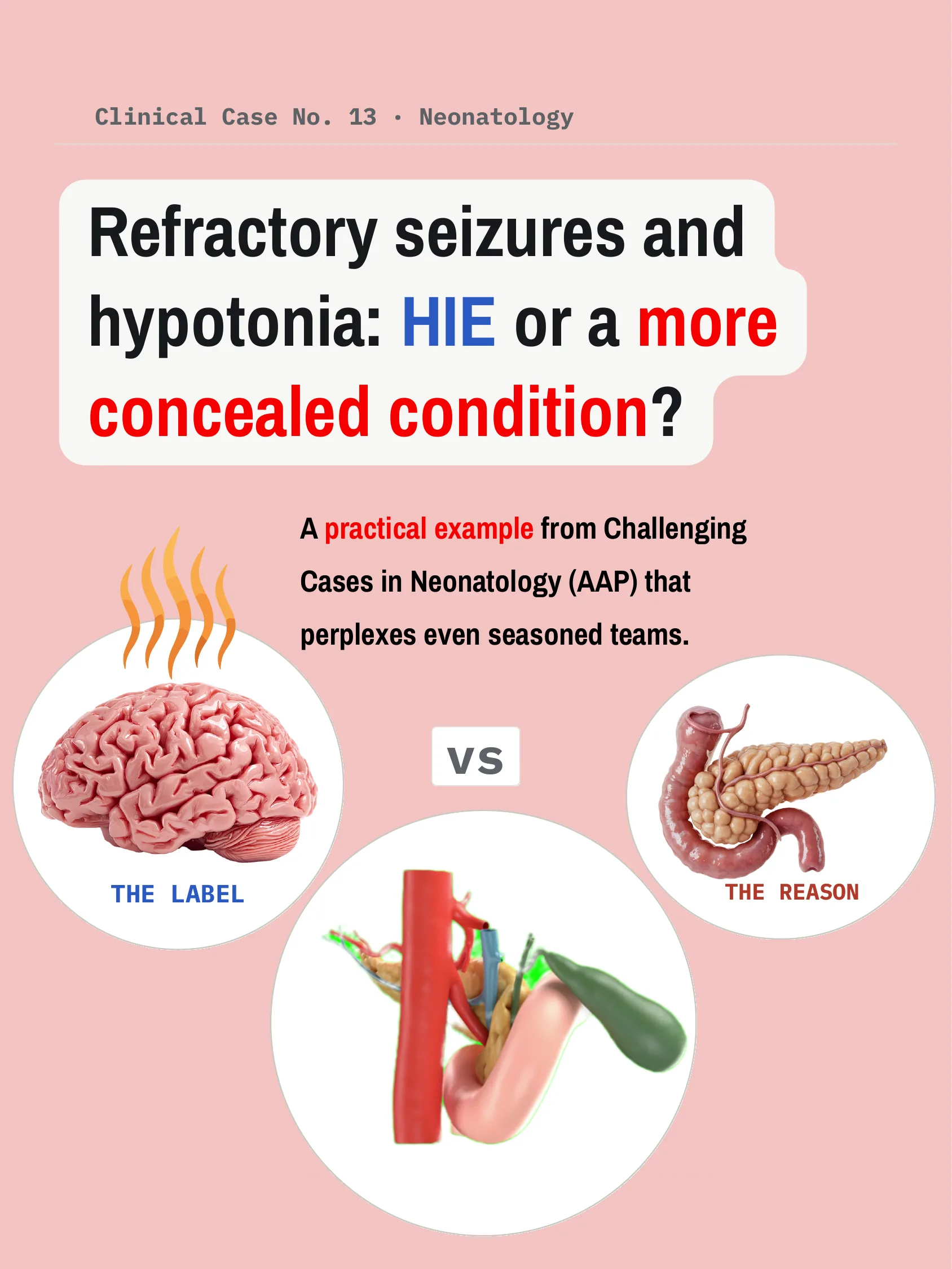
Clinical Case No. 13 · Neonatology
Refractory seizures and hypotonia: HIE or a more concealed condition?
A practical example from Challenging Cases in Neonatology (AAP) that perplexes even seasoned teams.
- THE LABEL — Brain (representing HIE)
- VS
- THE REASON — Pancreas and vascular anatomy
The Presentation
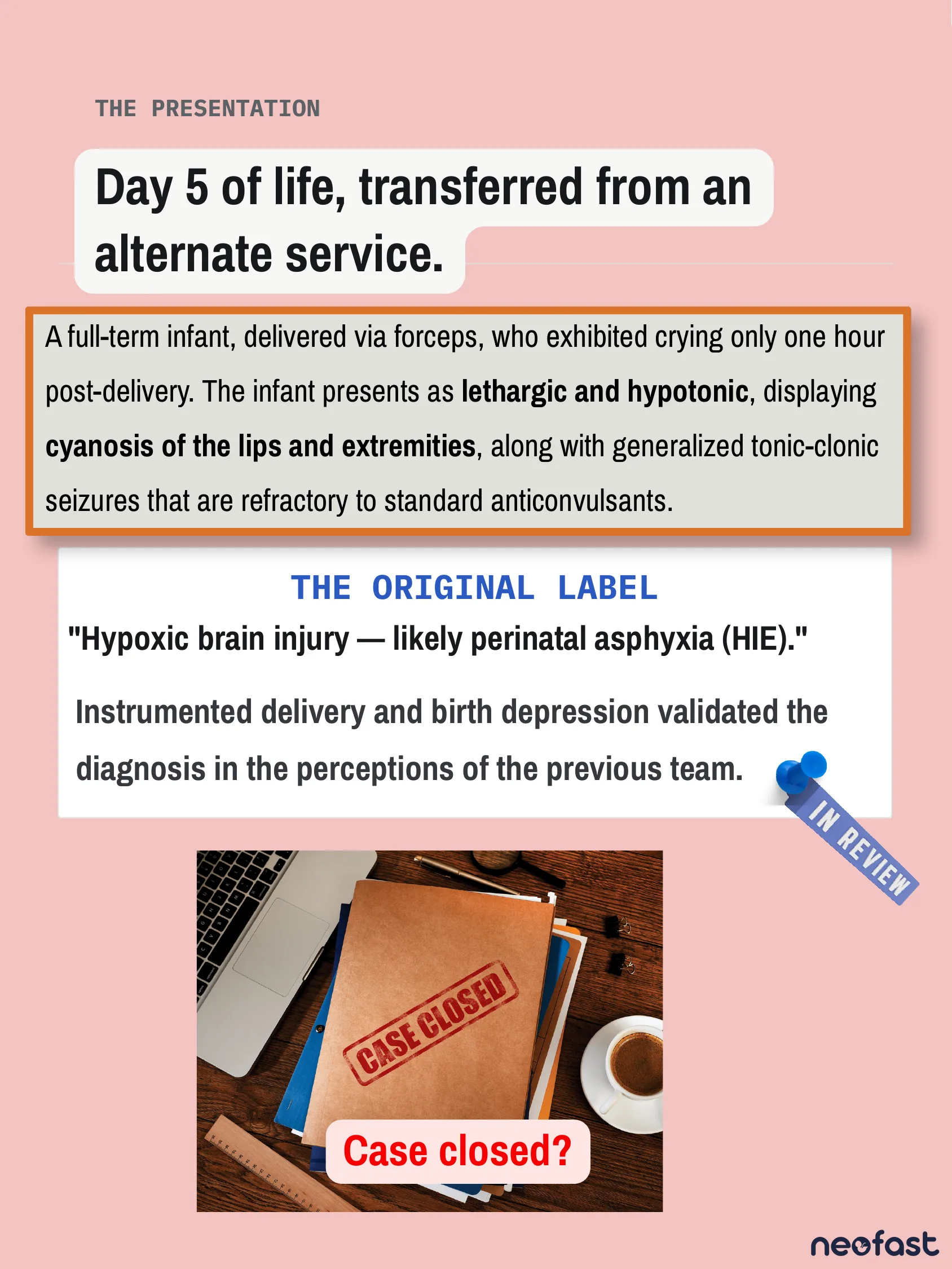
THE PRESENTATION
Day 5 of life, transferred from an alternate service.
A full-term infant, delivered via forceps, who exhibited crying only one hour post-delivery. The infant presents as lethargic and hypotonic, displaying cyanosis of the lips and extremities, along with generalized tonic-clonic seizures that are refractory to standard anticonvulsants.
THE ORIGINAL LABEL
“Hypoxic brain injury — likely perinatal asphyxia (HIE).”
Instrumented delivery and birth depression validated the diagnosis in the perceptions of the previous team.
Case closed?
Concealed Indicators
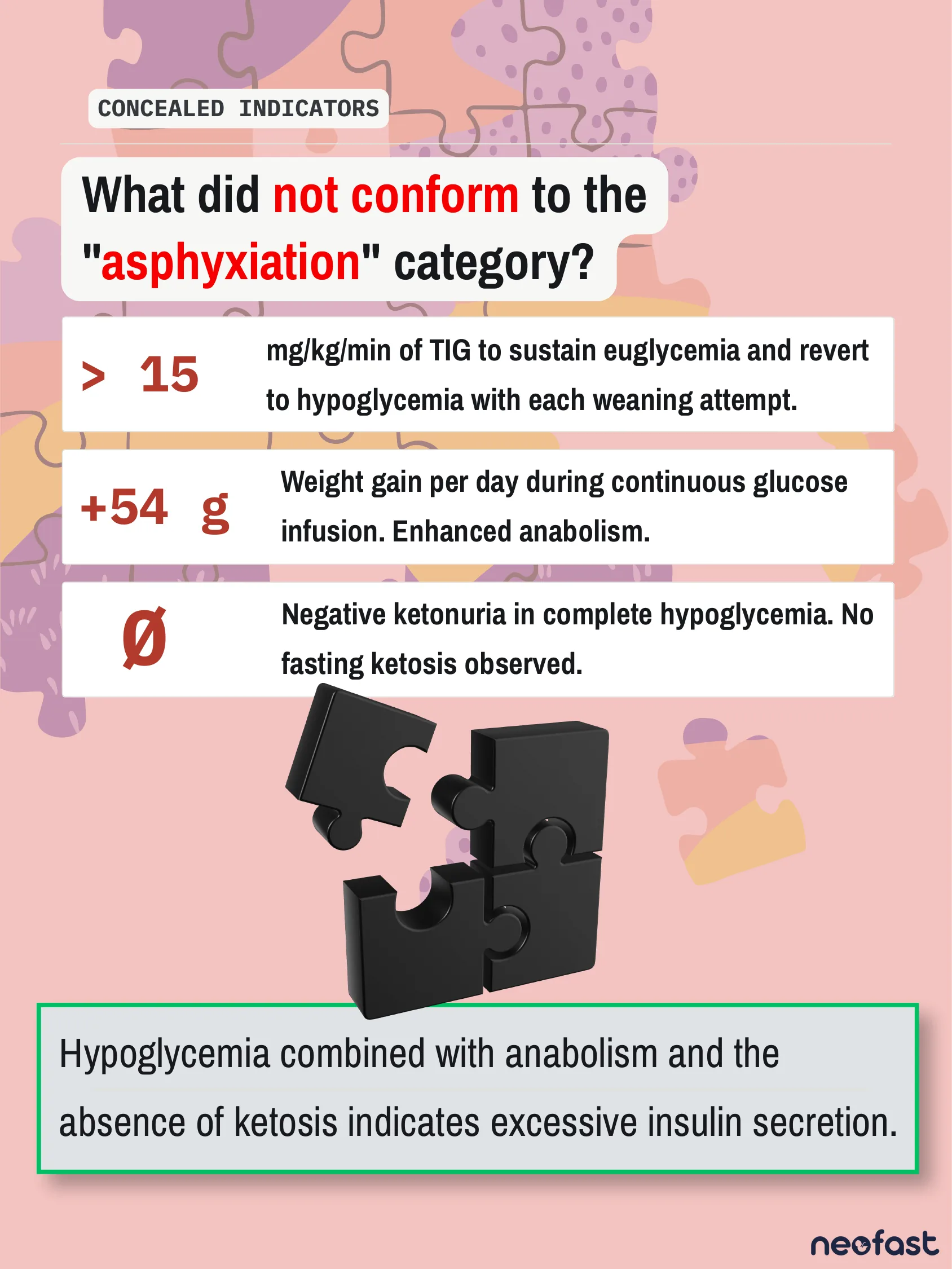
CONCEALED INDICATORS
What did not conform to the “asphyxiation” category?
- > 15 mg/kg/min of TIG to sustain euglycemia and revert to hypoglycemia with each weaning attempt.
- +54 g Weight gain per day during continuous glucose infusion. Enhanced anabolism.
- Ø Negative ketonuria in complete hypoglycemia. No fasting ketosis observed.
Hypoglycemia combined with anabolism and the absence of ketosis indicates excessive insulin secretion.
The Diagnosis
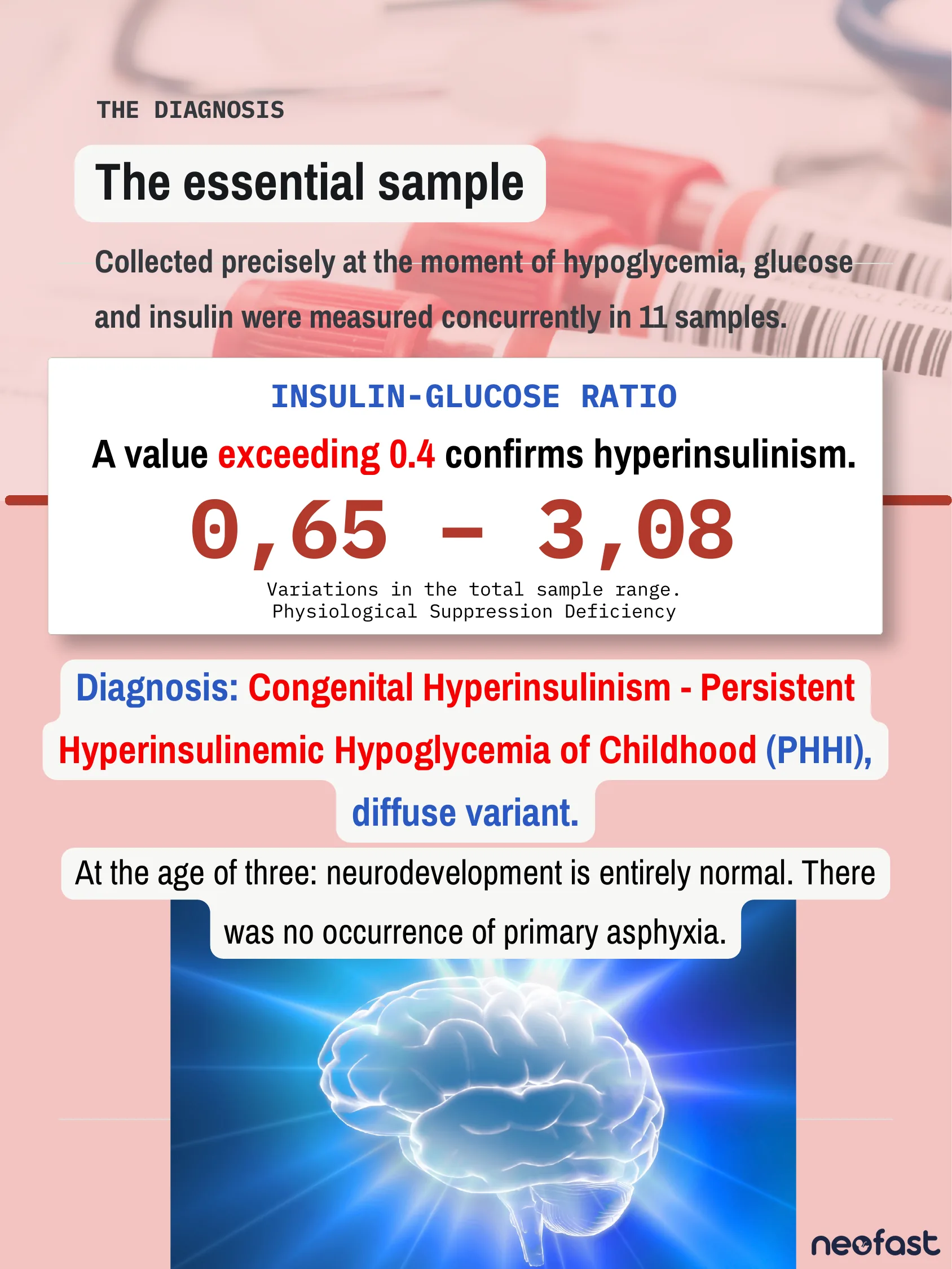
THE DIAGNOSIS
The essential sample
Collected precisely at the moment of hypoglycemia, glucose and insulin were measured concurrently in 11 samples.
INSULIN-GLUCOSE RATIO
A value exceeding 0.4 confirms hyperinsulinism.
0.65 – 3.08
Variations in the total sample range. Physiological Suppression Deficiency
Diagnosis: Congenital Hyperinsulinism – Persistent Hyperinsulinemic Hypoglycemia of Childhood (PHHI), diffuse variant.
At the age of three: neurodevelopment is entirely normal. There was no occurrence of primary asphyxia.
NeoFast in Operation
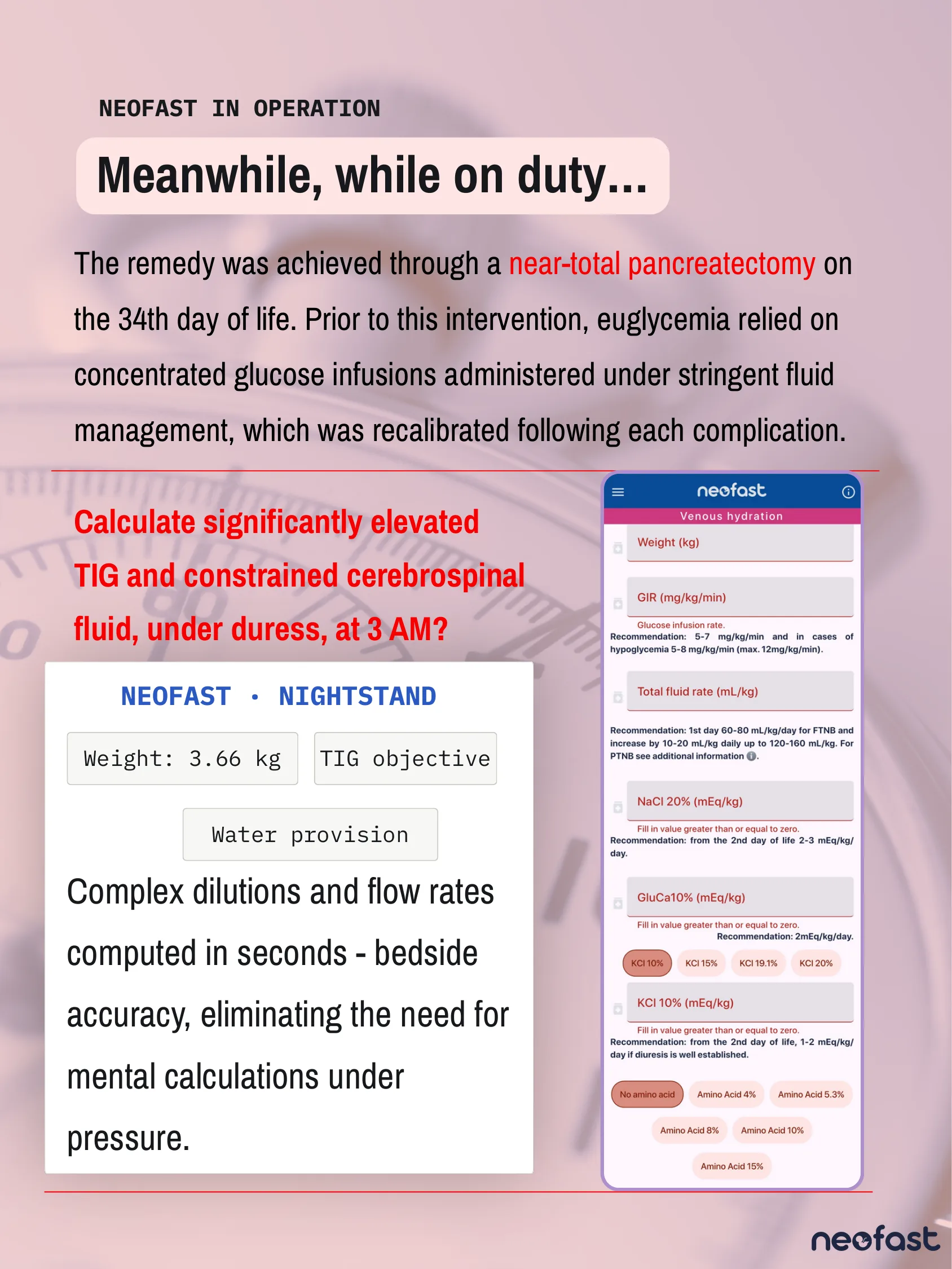
NEOFAST IN OPERATION
Meanwhile, while on duty…
The remedy was achieved through a near-total pancreatectomy on the 34th day of life. Prior to this intervention, euglycemia relied on concentrated glucose infusions administered under stringent fluid management, which was recalibrated following each complication.
Calculate significantly elevated TIG and constrained cerebrospinal fluid, under duress, at 3 AM?
NEOFAST · NIGHTSTAND
- Weight: 3.66 kg
- TIG objective
- Water provision
Complex dilutions and flow rates computed in seconds – bedside accuracy, eliminating the need for mental calculations under pressure.
Venous hydration (app fields)
- Weight (kg)
- GIR (mg/kg/min) — Glucose infusion rate. Recommendation: 5-7 mg/kg/min and in cases of hypoglycemia 5-8 mg/kg/min (max. 12mg/kg/min).
- Total fluid rate (mL/kg) — Recommendation: 1st day 60-80 mL/kg/day for FTNB and increase by 10-20 mL/kg daily up to 120-160 mL/kg. For PTNB see additional information.
- NaCl 20% (mEq/kg) — Fill in value greater than or equal to zero. Recommendation: from the 2nd day of life 2-3 mEq/kg/day.
- GluCa10% (mEq/kg) — Fill in value greater than or equal to zero. Recommendation: 2mEq/kg/day.
- KCl 10%, KCl 15%, KCl 19.1%, KCl 20% options
- KCl 10% (mEq/kg) — Fill in value greater than or equal to zero. Recommendation: from the 2nd day of life, 1-2 mEq/kg/day if diuresis is well established.
- No amino acid, Amino Acid 4%, Amino Acid 5.3%, Amino Acid 8%, Amino Acid 10%, Amino Acid 15% options
Time is a Neural Entity
Time is a neural entity.
In cases of neonatal hypoglycemia, precision and promptness in calculations are crucial to avert permanent and irreversible brain damage.
neofast
Neonatal Tool
- Download on the App Store
- Get it on Google Play
Frequently asked questions
What insulin-glucose ratio confirms congenital hyperinsulinism?
A ratio exceeding 0.4, measured in a sample collected precisely at the moment of hypoglycemia, confirms hyperinsulinism; in this case the ratio ranged 0.65–3.08 across 11 samples.
What clinical clues suggested hyperinsulinism instead of HIE in this refractory seizure case?
The infant required over 15 mg/kg/min of glucose infusion (TIG) to maintain euglycemia and relapsed into hypoglycemia with every weaning attempt, gained +54 g/day on continuous glucose infusion (excess anabolism), and had negative ketonuria despite hypoglycemia — all indicating excessive insulin secretion rather than perinatal asphyxia.
How was the congenital hyperinsulinism case eventually treated?
The infant underwent a near-total pancreatectomy on day 34 of life after prior management with concentrated glucose infusions and strict fluid control; at three years of age, neurodevelopment was entirely normal.
What is the recommended glucose infusion rate (GIR) for neonates?
The general recommendation is 5-7 mg/kg/min, and in cases of hypoglycemia 5-8 mg/kg/min, with a maximum of 12 mg/kg/min.
What are the standard fluid recommendations for a full-term newborn?
For full-term neonates, start at 60-80 mL/kg/day on day 1 and increase by 10-20 mL/kg daily up to 120-160 mL/kg/day; preterm neonates require additional considerations.