Key takeaways
- NeoFast’s Reference Values screen covers 132 parameters across 11 groups, selecting the applicable published range based on sex, gestational age at birth (22-42 weeks), and chronological days of life (0-1095 days).
- For a male infant on day 5 of life, total T4 differs sharply by gestational age: 6.29 mcg/dL (SD 2.10) at 28-30 weeks versus 12.67 mcg/dL (SD 2.87) at >37 weeks, both at day 7 per Williams 2004.
- Coagulation values also diverge by maturity on day 5: aPTT is 50.5 s (26.9-74.1) in preterm infants versus 42.60 s (SD 8.62) in full-term infants, per Andrew 1987 and 1988.
- The app uses chronological age, not corrected age, with prematurity entered separately via gestational age at birth, matching how the source tables are structured.
- If a published reference range does not exist for the entered age, the app explicitly states this rather than substituting a neighboring age band; 10 such parameters (e.g., chloride, CRP, folate) are listed individually in one example screen.
References
- AAP. Soghier LM, Fratantoni K, Reyes C, eds. Reference Range Values for Pediatric Care. 2nd ed. American Academy of Pediatrics; 2019.
- AAP chemistry bibliography. The 16 titles the AAP lists for its chemistry tables, among them Adeli 2015, Bailey 2013 and Colantonio 2012 (CALIPER). The book does not say which entry produced which analyte.
- Newborn chemistry. Dollberg S, Bauer R, Lubetzky R, Mimouni FB. A reappraisal of neonatal blood chemistry reference ranges using the Nova M electrodes. Am J Perinatol. 2001;18(8):433-440.
- Postnatal blood count. Soldin SJ, Wong EC, Brugnara C, Soldin OP, eds. Pediatric Reference Intervals. 7th ed. AACC Press; 2011.
- Neonatal thyroid. Williams FL, Simpson J, Delahunty C, et al. Developmental trends in cord and postpartum serum thyroid hormones in preterm infants. J Clin Endocrinol Metab. 2004;89(11):5314-5320.
- Preterm coagulation. Andrew M, Paes B, Milner R, et al. Development of the human coagulation system in the healthy premature infant. Blood. 1988;72(5):1651-1657.
- Term coagulation. Andrew M, Paes B, Milner R, et al. Development of the human coagulation system in the full-term infant. Blood. 1987;70(1):165-172.
- Blood pressure in the first month. Pejovic B, Peco-Antic A, Marinkovic-Eric J. Blood pressure in non-critically ill preterm and full-term neonates. Pediatr Nephrol. 2007;22(2):249-257.
- Resting heart and respiratory rate. Monaghan A. Detecting and managing deterioration in children. Paediatr Nurs. 2005;17(1):32-35. Reproduced by the AAP within PEWS.
- Baylor. Baylor College of Medicine. Guidelines for Acute Care of the Neonate. 31st ed. 2023-2024. Where the Pejovic table is reproduced.
- Harriet Lane. The Harriet Lane Handbook. 24th ed. Elsevier; 2027. Ch. 29 (Blood Chemistry and Body Fluids), ch. 14 (Hematology), ch. 3 (Toxicology) and inside cover.
- Nelson. Kliegman RM, St Geme JW, eds. Nelson Textbook of Pediatrics. 22nd ed. Elsevier; 2024. Ch. 770 (Reference Intervals for Laboratory Tests and Procedures).
Neonatal Laboratory Values
Neonatal Laboratory Values
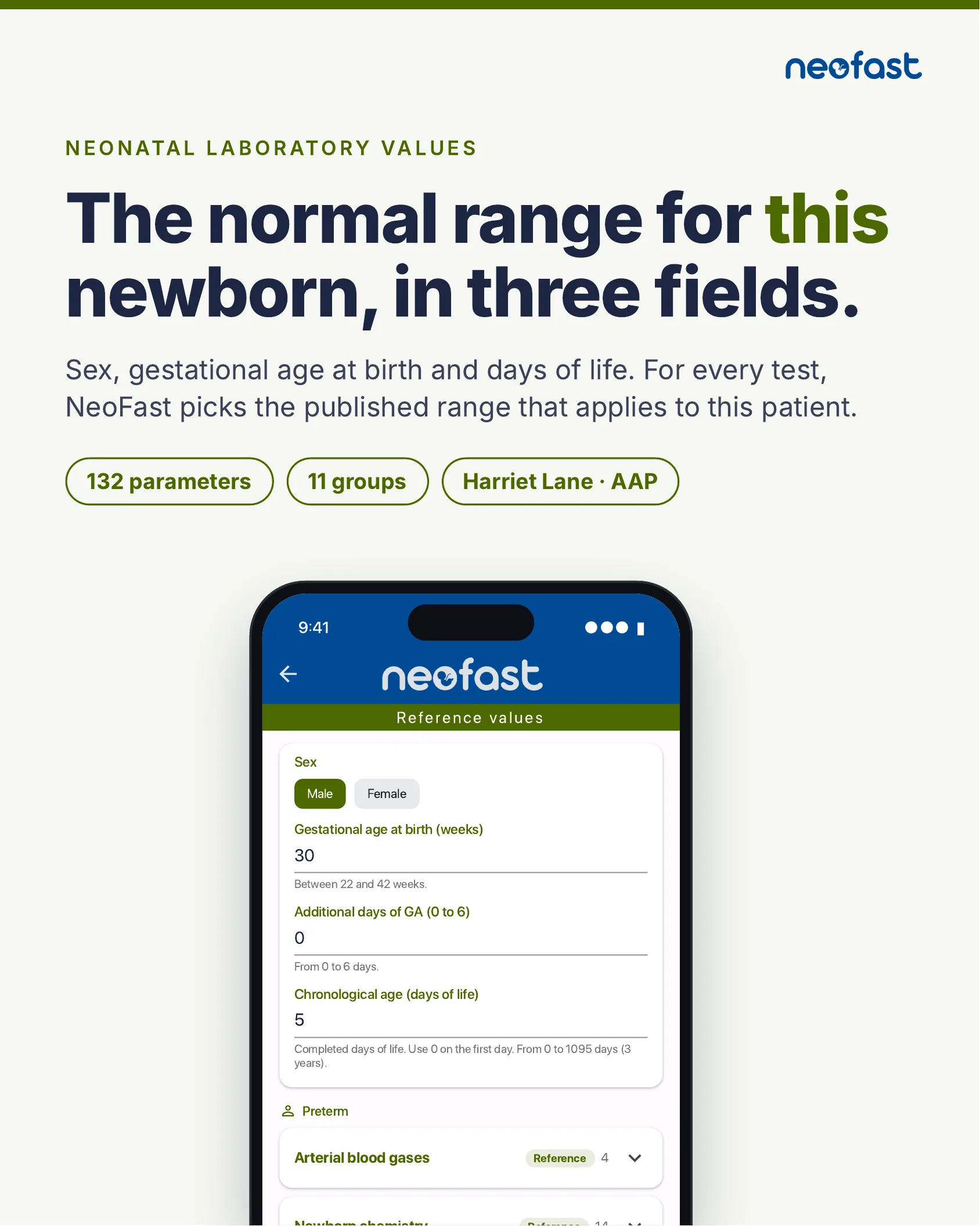
The normal range for this newborn, in three fields.
Sex, gestational age at birth and days of life. For every test, NeoFast picks the published range that applies to this patient.
- 132 parameters
- 11 groups
- Harriet Lane · AAP
App screen: Reference values
- Sex: Male / Female (Male selected)
- Gestational age at birth (weeks): 30 — Between 22 and 42 weeks.
- Additional days of GA (0 to 6): 0 — From 0 to 6 days.
- Chronological age (days of life): 5 — Completed days of life. Use 0 on the first day. From 0 to 1095 days (3 years).
Preterm
- Arterial blood gases — Reference — 4
- Newborn chemistry — Reference — 14
Why It Matters
Why it matters
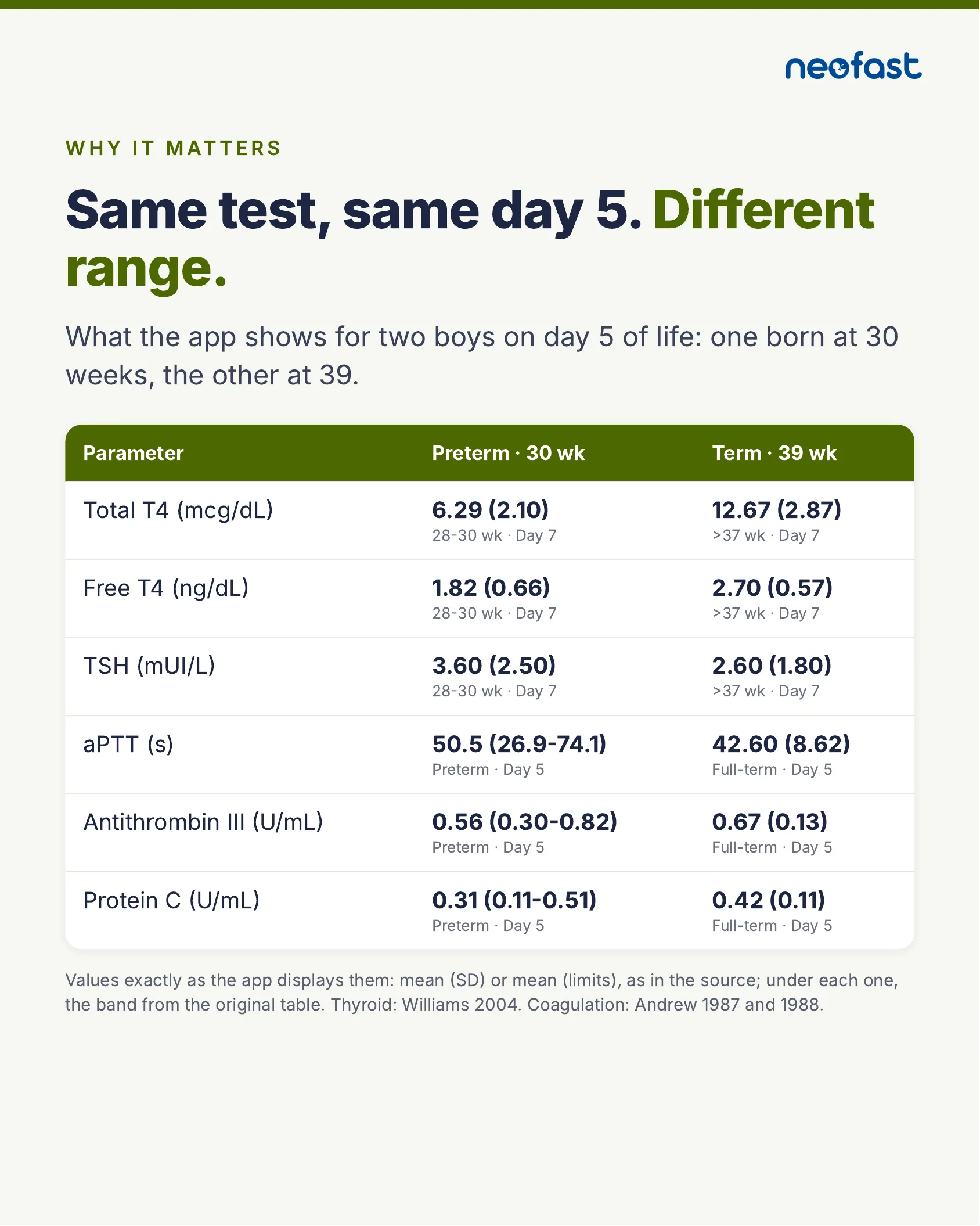
Same test, same day 5. Different range.
What the app shows for two boys on day 5 of life: one born at 30 weeks, the other at 39.
| Parameter | Preterm · 30 wk | Term · 39 wk |
|---|---|---|
| Total T4 (mcg/dL) | 6.29 (2.10) 28-30 wk · Day 7 | 12.67 (2.87) >37 wk · Day 7 |
| Free T4 (ng/dL) | 1.82 (0.66) 28-30 wk · Day 7 | 2.70 (0.57) >37 wk · Day 7 |
| TSH (mUI/L) | 3.60 (2.50) 28-30 wk · Day 7 | 2.60 (1.80) >37 wk · Day 7 |
| aPTT (s) | 50.5 (26.9-74.1) Preterm · Day 5 | 42.60 (8.62) Full-term · Day 5 |
| Antithrombin III (U/mL) | 0.56 (0.30-0.82) Preterm · Day 5 | 0.67 (0.13) Full-term · Day 5 |
| Protein C (U/mL) | 0.31 (0.11-0.51) Preterm · Day 5 | 0.42 (0.11) Full-term · Day 5 |
Values exactly as the app displays them: mean (SD) or mean (limits), as in the source; under each one, the band from the original table. Thyroid: Williams 2004. Coagulation: Andrew 1987 and 1988.
How It Works

How it works
Three fields. No guessing.
- 1. Sex
Male or female. Required, like the others. - 2. Gestational age at birth
22 to 42 weeks, plus 0 to 6 days. - 3. Chronological age
Completed days of life, 0 to 1,095 (3 years).
- Age is chronological, not corrected. Prematurity comes in through gestational age, the way the tables themselves do it.
- Every value carries the source’s band label: “4-7 d”, “Preterm · Day 5”.
- If the source does not cover that age, the app says so. It never offers the neighbouring band.
App screen: Reference values
- Sex: Male / Female (Male selected)
- Gestational age at birth (weeks): 30 — Between 22 and 42 weeks.
- Additional days of GA (0 to 6): 0 — From 0 to 6 days.
- Chronological age (days of life): 5 — Completed days of life. Use 0 on the first day. From 0 to 1095 days (3 years).
Preterm
- Arterial blood gases — Reference — 4
- Newborn chemistry — Reference — 14
- Chemistry — 37
- Cerebrospinal fluid — Reference — 13
- Thyroid — 3
Example · 30-week newborn, Day 5

Example · 30-week newborn, Day 5
This patient’s blood count, already filtered.
- 8 parameters
Haemoglobin, haematocrit, MCV, MCHC, reticulocytes, white cells, platelets and red cells. - The right band
For day 5 the app uses the 4-7 d column and shows it under every number. - Shortcut
On white cells, one tap opens the Rodwell score.
App screen: Blood count (8)
| Parameter | Range |
|---|---|
| Hemoglobin (g/dL) — 4-7 d | 12.5-16.3 |
| Hematocrit (%) — 4-7 d | 35.9-46.6 |
| MCV (fL) — 4-7 d | 87.1-96.5 |
| MCHC (g/dL) — 4-7 d | 30.9-33.4 |
| Reticulocytes (%) — 4-7 d | 0.4-2.7 |
| White blood cells (×10³/µL) — 4-7 d — ↗ Rodwell score | 6.54-12.32 |
| Platelets (×10³/µL) — 4-7 d | 129-271 |
| Red blood cells (×10¹²/L) — 4-7 d | 3.98-5.08 |
Other groups shown below: Coagulation (25), Blood pressure — Reference (3), Vital signs (2), Vital signs – Harriet Lane — Reference (3).
Coagulation
Coagulation
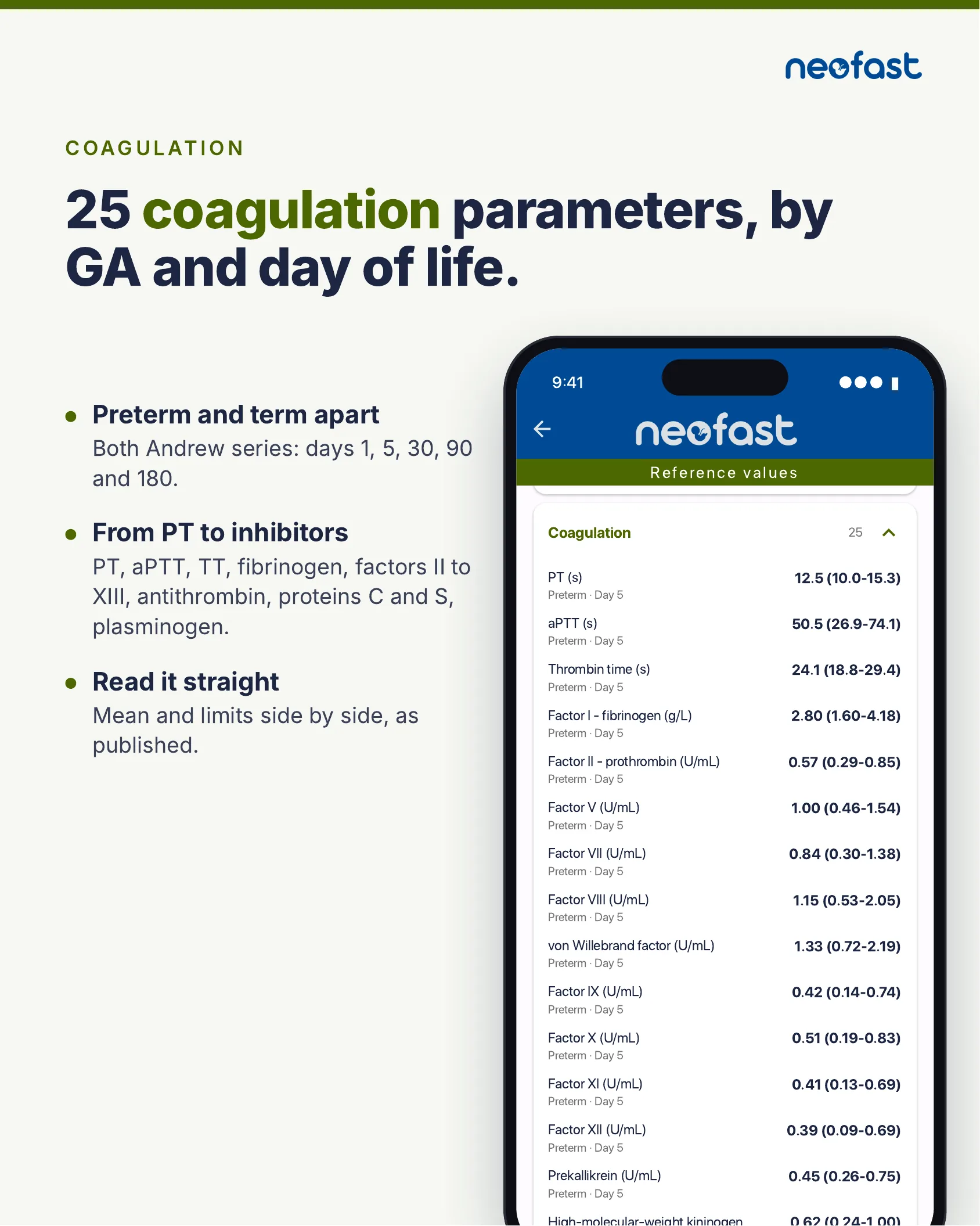
25 coagulation parameters, by GA and day of life.
- Preterm and term apart
Both Andrew series: days 1, 5, 30, 90 and 180. - From PT to inhibitors
PT, aPTT, TT, fibrinogen, factors II to XIII, antithrombin, proteins C and S, plasminogen. - Read it straight
Mean and limits side by side, as published.
App screen: Coagulation (25)
| Parameter | Value (mean, limits) — Preterm · Day 5 |
|---|---|
| PT (s) | 12.5 (10.0-15.3) |
| aPTT (s) | 50.5 (26.9-74.1) |
| Thrombin time (s) | 24.1 (18.8-29.4) |
| Factor I – fibrinogen (g/L) | 2.80 (1.60-4.18) |
| Factor II – prothrombin (U/mL) | 0.57 (0.29-0.85) |
| Factor V (U/mL) | 1.00 (0.46-1.54) |
| Factor VII (U/mL) | 0.84 (0.30-1.38) |
| Factor VIII (U/mL) | 1.15 (0.53-2.05) |
| von Willebrand factor (U/mL) | 1.33 (0.72-2.19) |
| Factor IX (U/mL) | 0.42 (0.14-0.74) |
| Factor X (U/mL) | 0.51 (0.19-0.83) |
| Factor XI (U/mL) | 0.41 (0.13-0.69) |
| Factor XII (U/mL) | 0.39 (0.09-0.69) |
| Prekallikrein (U/mL) | 0.45 (0.26-0.75) |
| High-molecular-weight kininogen | 0.62 (0.24-1.00) |
Reference Tables
Reference tables
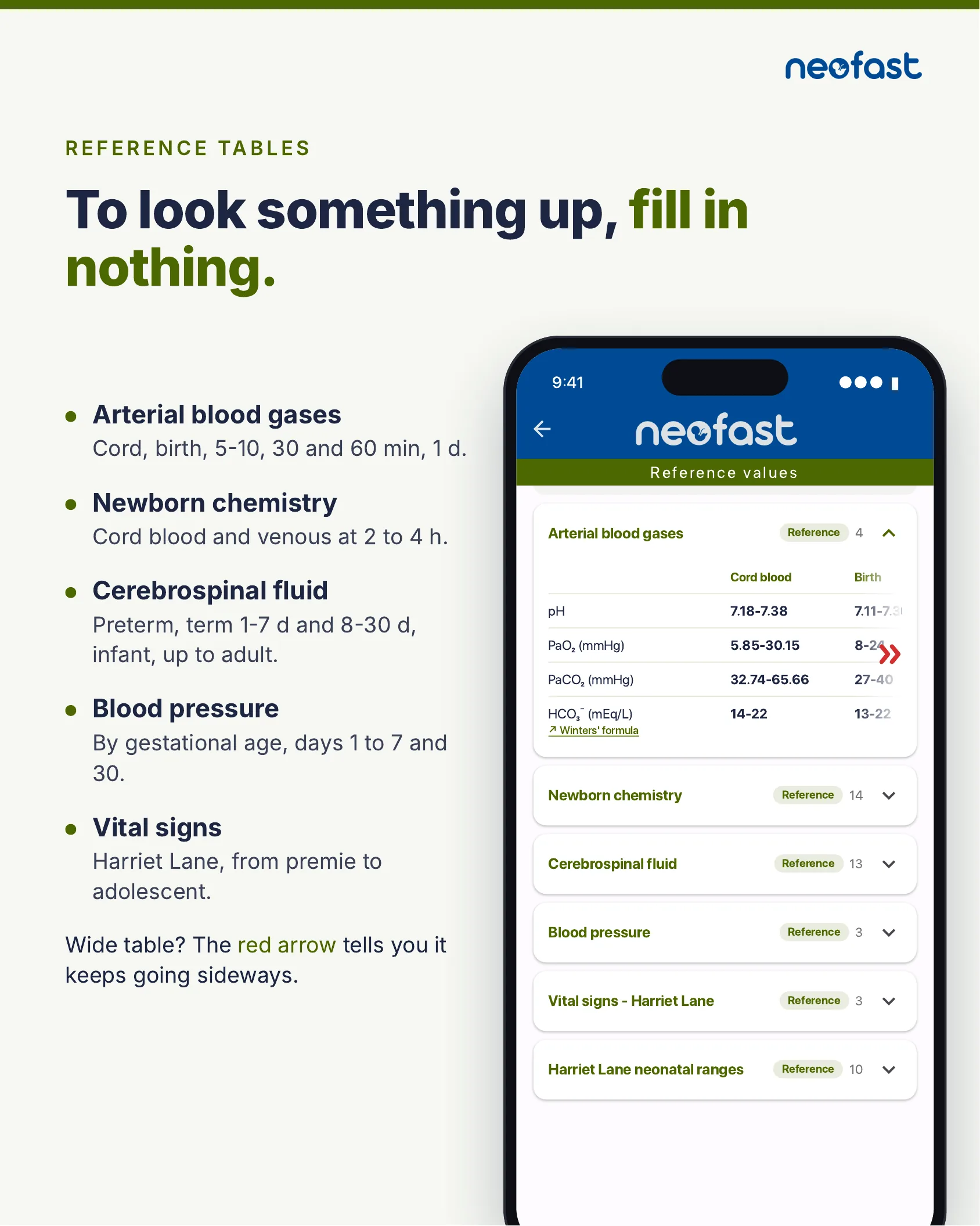
To look something up, fill in nothing.
- Arterial blood gases
Cord, birth, 5-10, 30 and 60 min, 1 d. - Newborn chemistry
Cord blood and venous at 2 to 4 h. - Cerebrospinal fluid
Preterm, term 1-7 d and 8-30 d, infant, up to adult. - Blood pressure
By gestational age, days 1 to 7 and 30. - Vital signs
Harriet Lane, from premie to adolescent.
Wide table? The red arrow tells you it keeps going sideways.
App screen: Arterial blood gases (4) — Reference
| Cord blood | Birth | |
|---|---|---|
| pH | 7.18-7.38 | 7.11-7.3… |
| PaO₂ (mmHg) | 5.85-30.15 | 8-24… |
| PaCO₂ (mmHg) | 32.74-65.66 | 27-40 |
| HCO₃⁻ (mEq/L) — ↗ Winters’ formula | 14-22 | 13-22 |
Other groups: Newborn chemistry — Reference (14), Cerebrospinal fluid — Reference (13), Blood pressure — Reference (3), Vital signs – Harriet Lane — Reference (3), Harriet Lane neonatal ranges — Reference (10).
Shortcuts and Transparency
Shortcuts and transparency
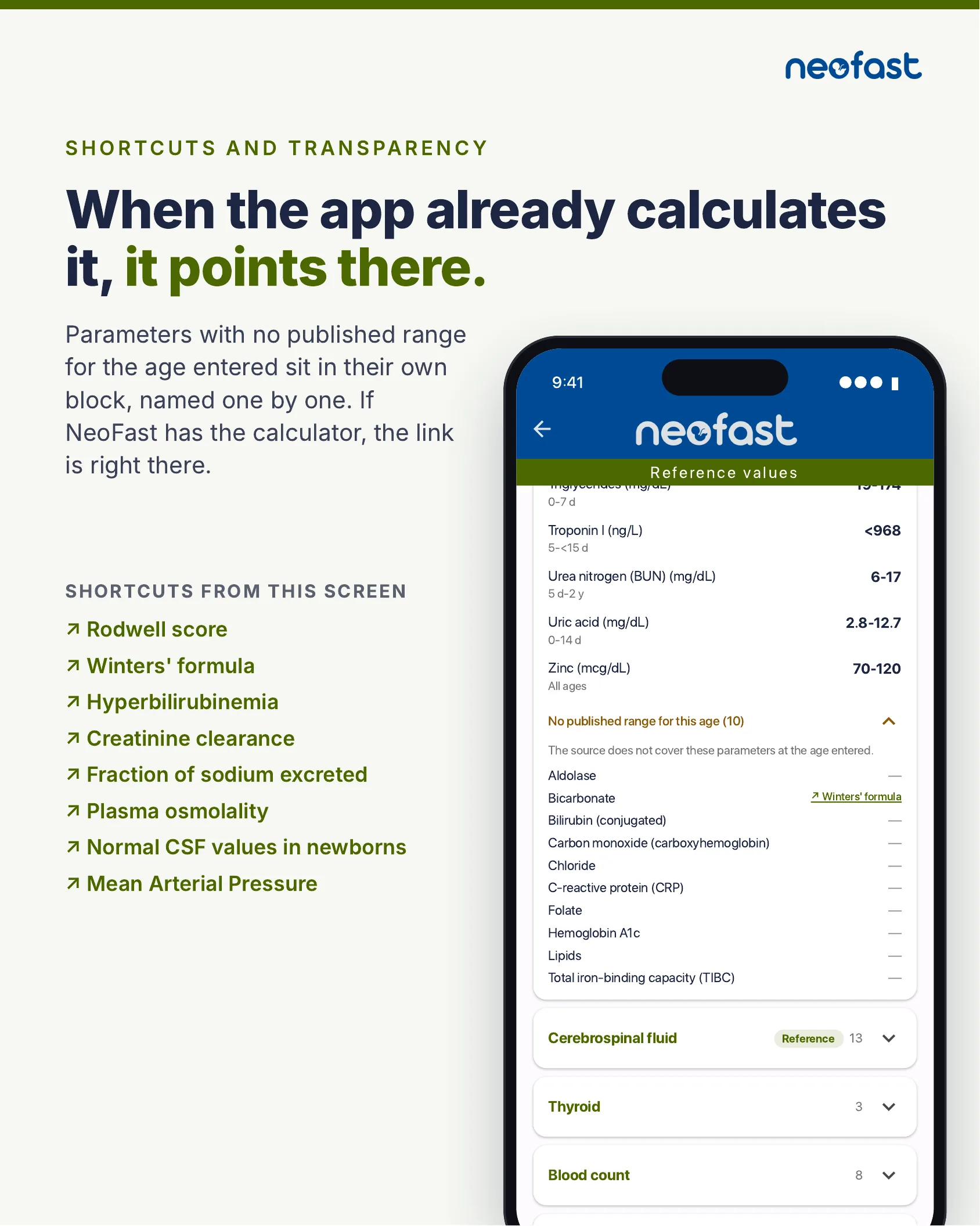
When the app already calculates it, it points there.
Parameters with no published range for the age entered sit in their own block, named one by one. If NeoFast has the calculator, the link is right there.
Shortcuts from this screen
- ↗ Rodwell score
- ↗ Winters’ formula
- ↗ Hyperbilirubinemia
- ↗ Creatinine clearance
- ↗ Fraction of sodium excreted
- ↗ Plasma osmolality
- ↗ Normal CSF values in newborns
- ↗ Mean Arterial Pressure
App screen
| Parameter | Value |
|---|---|
| Triglycerides (mg/dL) — 0-7 d | 15-174 |
| Troponin I (ng/L) — 5-<15 d | <968 |
| Urea nitrogen (BUN) (mg/dL) — 5 d-2 y | 6-17 |
| Uric acid (mg/dL) — 0-14 d | 2.8-12.7 |
| Zinc (mcg/dL) — All ages | 70-120 |
No published range for this age (10)
The source does not cover these parameters at the age entered.
- Aldolase — —
- Bicarbonate — ↗ Winters’ formula
- Bilirubin (conjugated) — —
- Carbon monoxide (carboxyhemoglobin) — —
- Chloride — —
- C-reactive protein (CRP) — —
- Folate — —
- Hemoglobin A1c — —
- Lipids — —
- Total iron-binding capacity (TIBC) — —
Other groups: Cerebrospinal fluid — Reference (13), Thyroid (3), Blood count (8).
In the App
In the app
Other calculations and scores › Reference values
Get NeoFast
App Store and Google Play · 30 days free on your first purchase.
Reference ranges
Laboratories use different analysers, reagents and methods. Always check the ranges of the laboratory that ran the test before making decisions. A reference range covers 95% of results from healthy people: 1 in every 20 tests ordered falls outside it without the patient being ill. This screen uses CHRONOLOGICAL age, not corrected. Prematurity enters as its own axis, through gestational age.
References
- AAP. Soghier LM, Fratantoni K, Reyes C, eds. Reference Range Values for Pediatric Care. 2nd ed. American Academy of Pediatrics; 2019.
- AAP chemistry bibliography. The 16 titles the AAP lists for its chemistry tables, among them Adeli 2015, Bailey 2013 and Colantonio 2012 (CALIPER). The book does not say which entry produced which analyte.
- Newborn chemistry. Dollberg S, Bauer R, Lubetzky R, Mimouni FB. A reappraisal of neonatal blood chemistry reference ranges using the Nova M electrodes. Am J Perinatol. 2001;18(8):433-440.
- Postnatal blood count. Soldin SJ, Wong EC, Brugnara C, Soldin OP, eds. Pediatric Reference Intervals. 7th ed. AACC Press; 2011.
- Neonatal thyroid. Williams FL, Simpson J, Delahunty C, et al. Developmental trends in cord and postpartum serum thyroid hormones in preterm infants. J Clin Endocrinol Metab. 2004;89(11):5314-5320.
- Preterm coagulation. Andrew M, Paes B, Milner R, et al. Development of the human coagulation system in the healthy premature infant. Blood. 1988;72(5):1651-1657.
- Term coagulation. Andrew M, Paes B, Milner R, et al. Development of the human coagulation system in the full-term infant. Blood. 1987;70(1):165-172.
- Blood pressure in the first month. Pejovic B, Peco-Antic A, Marinkovic-Eric J. Blood pressure in non-critically ill preterm and full-term neonates. Pediatr Nephrol. 2007;22(2):249-257.
- Resting heart and respiratory rate. Monaghan A. Detecting and managing deterioration in children. Paediatr Nurs. 2005;17(1):32-35. Reproduced by the AAP within PEWS.
- Baylor. Baylor College of Medicine. Guidelines for Acute Care of the Neonate. 31st ed. 2023-2024. Where the Pejovic table is reproduced.
- Harriet Lane. The Harriet Lane Handbook. 24th ed. Elsevier; 2027. Ch. 29 (Blood Chemistry and Body Fluids), ch. 14 (Hematology), ch. 3 (Toxicology) and inside cover.
- Nelson. Kliegman RM, St Geme JW, eds. Nelson Textbook of Pediatrics. 22nd ed. Elsevier; 2024. Ch. 770 (Reference Intervals for Laboratory Tests and Procedures).
Frequently asked questions
What inputs does NeoFast use to select neonatal reference ranges?
Three fields: sex (male/female), gestational age at birth (22 to 42 weeks, plus 0 to 6 additional days), and chronological age in completed days of life (0 to 1095 days, i.e., up to 3 years). Age used is chronological, not corrected.
How many lab parameters and groups does the NeoFast reference values feature include?
132 parameters organized into 11 groups, including arterial blood gases, newborn chemistry, blood count, coagulation, cerebrospinal fluid, blood pressure, vital signs, and thyroid.
What coagulation parameters are included and at what timepoints?
25 coagulation parameters (PT, aPTT, TT, fibrinogen, factors II-XIII, antithrombin, proteins C and S, plasminogen) drawn from the Andrew 1987 (term) and 1988 (preterm) series, reported at days 1, 5, 30, 90, and 180, separated by preterm versus term status.
What does the app do when there is no published reference range for a given age?
It states that the source does not cover that age for the parameter rather than substituting the neighboring age band; such parameters are listed individually in their own block, as in the example with 10 parameters including bicarbonate, CRP, and folate.
What is the source for neonatal thyroid reference values in the app?
Williams FL, Simpson J, Delahunty C, et al., ‘Developmental trends in cord and postpartum serum thyroid hormones in preterm infants,’ J Clin Endocrinol Metab. 2004;89(11):5314-5320, covering Total T4, Free T4, and TSH by gestational age band.