Key takeaways
- Escalation of care begins when TSB is 2 mg/dL below the exchange transfusion threshold and is treated as a medical emergency requiring direct NICU admission rather than ED transfer.
- Phototherapy should be stopped once TSB falls to at least 2 mg/dL below the hour-specific threshold used at initiation, with longer treatment considered if GA is under 38 weeks, therapy started before 48 hours, or hemolysis is present.
- Treatment decisions must always use total serum bilirubin (TSB), never subtracting the direct bilirubin fraction, and TcB measurements under phototherapy lights underestimate the true level.
- Home LED phototherapy is only appropriate when all criteria are met: GA ≥38 weeks, clinically well and feeding well, no prior phototherapy, immediate LED access at home, age ≥48 hours, no neurotoxicity risk factor, TSB ≤1 mg/dL above threshold, and daily TSB monitoring is feasible.
- IVIG at 0.5-1 g/kg over 2 hours (repeatable in 12 hours) is an option for isoimmune hemolytic disease (DAT+) approaching exchange transfusion thresholds, and urgent exchange transfusion is indicated for intermediate/advanced acute bilirubin encephalopathy signs or TSB at/above the exchange threshold.
References
- Kemper AR, Newman TB, Slaughter JL, Maisels MJ, Watchko JF, Downs SM, et al. Clinical Practice Guideline Revision: Management of Hyperbilirubinemia in the Newborn Infant 35 or More Weeks of Gestation. Pediatrics. 2022;150(3):e2022058859. doi:10.1542/peds.2022-058859
- Kemper AR et al. AAP Clinical Practice Guideline. Pediatrics 2022;150(3):e2022058859
Neonatal Hyperbilirubinemia ≥ 35 weeks
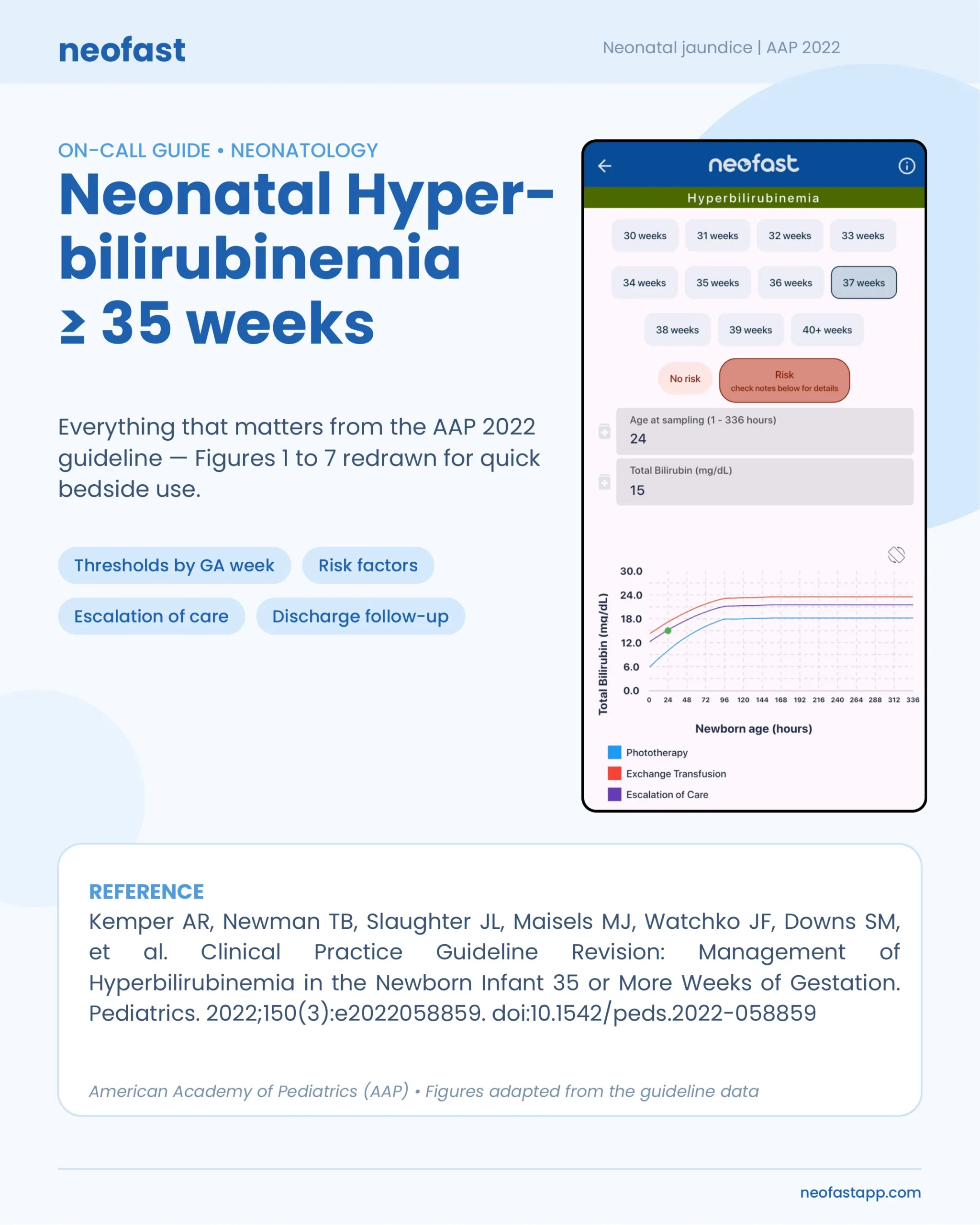
ON-CALL GUIDE • NEONATOLOGY
Neonatal Hyperbilirubinemia ≥ 35 weeks
Everything that matters from the AAP 2022 guideline — Figures 1 to 7 redrawn for quick bedside use.
- Thresholds by GA week
- Risk factors
- Escalation of care
- Discharge follow-up
Reference
Kemper AR, Newman TB, Slaughter JL, Maisels MJ, Watchko JF, Downs SM, et al. Clinical Practice Guideline Revision: Management of Hyperbilirubinemia in the Newborn Infant 35 or More Weeks of Gestation. Pediatrics. 2022;150(3):e2022058859. doi:10.1542/peds.2022-058859
American Academy of Pediatrics (AAP) • Figures adapted from the guideline data
What changed in the 2022 guideline
WHY IT MATTERS?
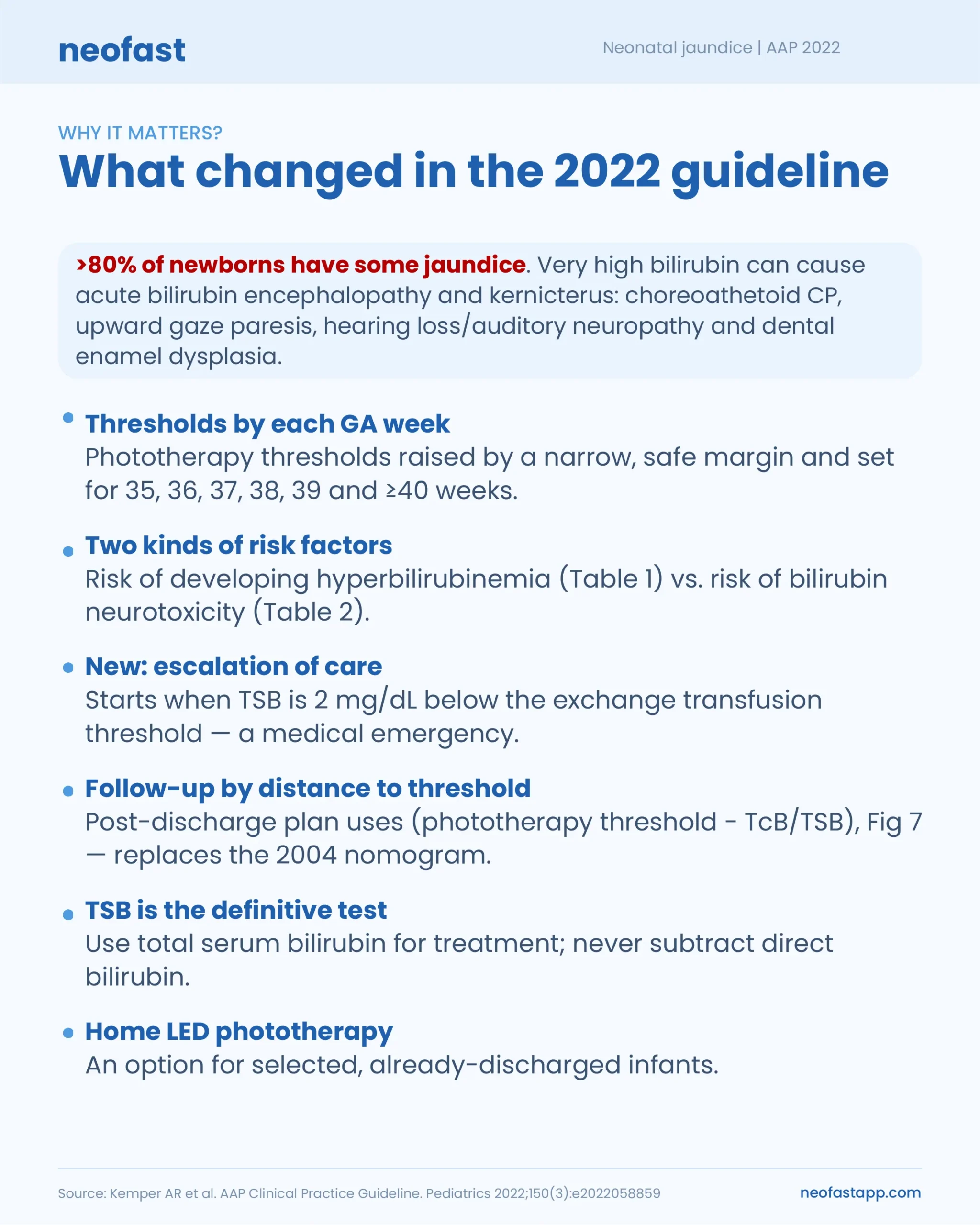
What changed in the 2022 guideline
>80% of newborns have some jaundice. Very high bilirubin can cause acute bilirubin encephalopathy and kernicterus: choreoathetoid CP, upward gaze paresis, hearing loss/auditory neuropathy and dental enamel dysplasia.
- Thresholds by each GA week
Phototherapy thresholds raised by a narrow, safe margin and set for 35, 36, 37, 38, 39 and ≥40 weeks. - Two kinds of risk factors
Risk of developing hyperbilirubinemia (Table 1) vs. risk of bilirubin neurotoxicity (Table 2). - New: escalation of care
Starts when TSB is 2 mg/dL below the exchange transfusion threshold — a medical emergency. - Follow-up by distance to threshold
Post-discharge plan uses (phototherapy threshold – TcB/TSB), Fig 7 — replaces the 2004 nomogram. - TSB is the definitive test
Use total serum bilirubin for treatment; never subtract direct bilirubin. - Home LED phototherapy
An option for selected, already-discharged infants.
Know the two kinds of risk factors
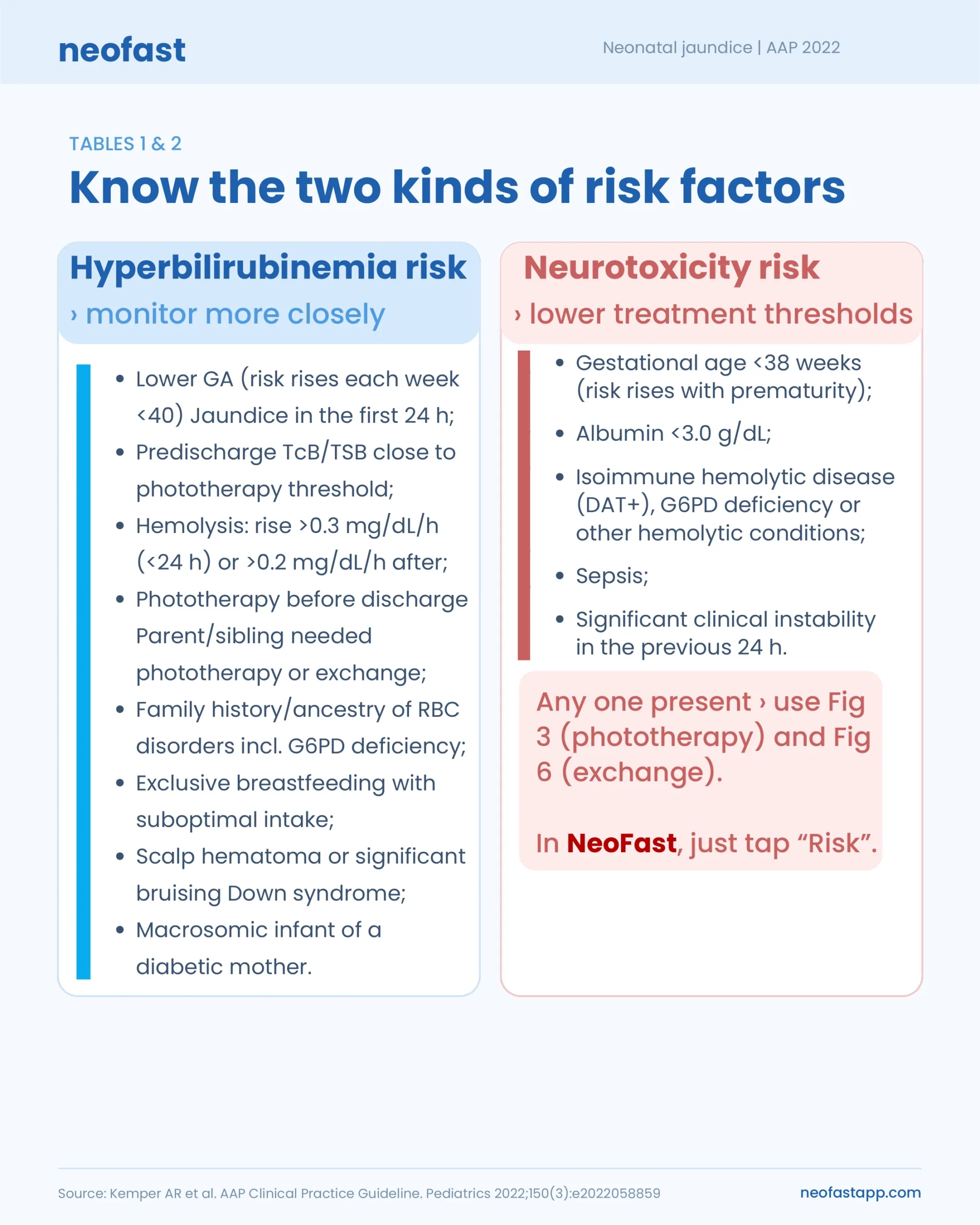
TABLES 1 & 2
Know the two kinds of risk factors
| Hyperbilirubinemia risk › monitor more closely | Neurotoxicity risk › lower treatment thresholds |
|---|---|
|
|
Any one present › use Fig 3 (phototherapy) and Fig 6 (exchange).
In NeoFast, just tap “Risk”.
Maternal anti-erythrocyte antibodies: early approach
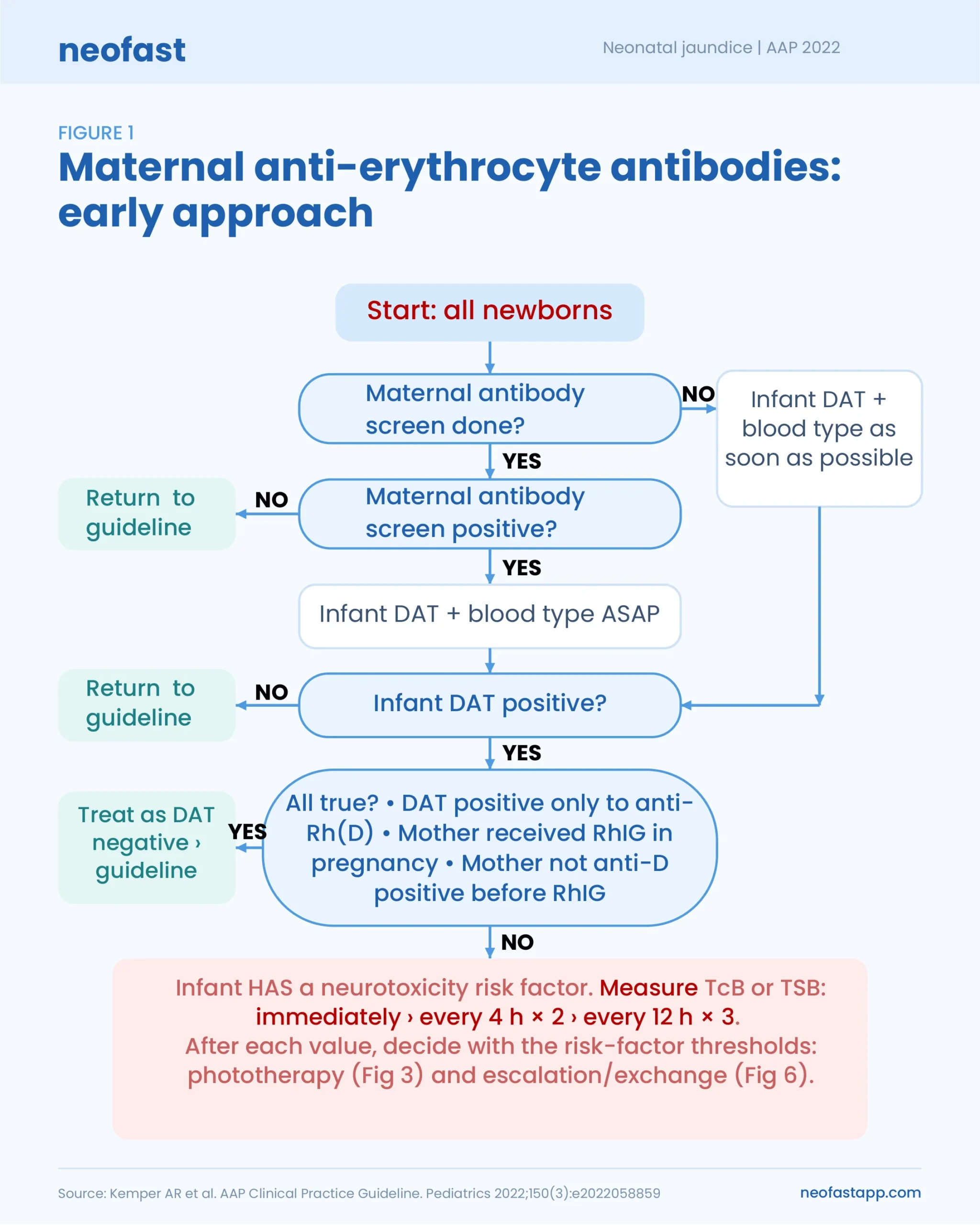
FIGURE 1
Maternal anti-erythrocyte antibodies: early approach
- Start: all newborns
- Maternal antibody screen done? → NO → Infant DAT + blood type as soon as possible → (go to Infant DAT positive?)
- Maternal antibody screen done? → YES → Maternal antibody screen positive? → NO → Return to guideline
- Maternal antibody screen positive? → YES → Infant DAT + blood type ASAP
- Infant DAT positive? → NO → Return to guideline
- Infant DAT positive? → YES → All true? • DAT positive only to anti-Rh(D) • Mother received RhIG in pregnancy • Mother not anti-D positive before RhIG
- All true? → YES → Treat as DAT negative › guideline
- All true? → NO → Infant HAS a neurotoxicity risk factor. Measure TcB or TSB: immediately › every 4 h × 2 › every 12 h × 3. After each value, decide with the risk-factor thresholds: phototherapy (Fig 3) and escalation/exchange (Fig 6).
Screen every baby — then trust the TSB
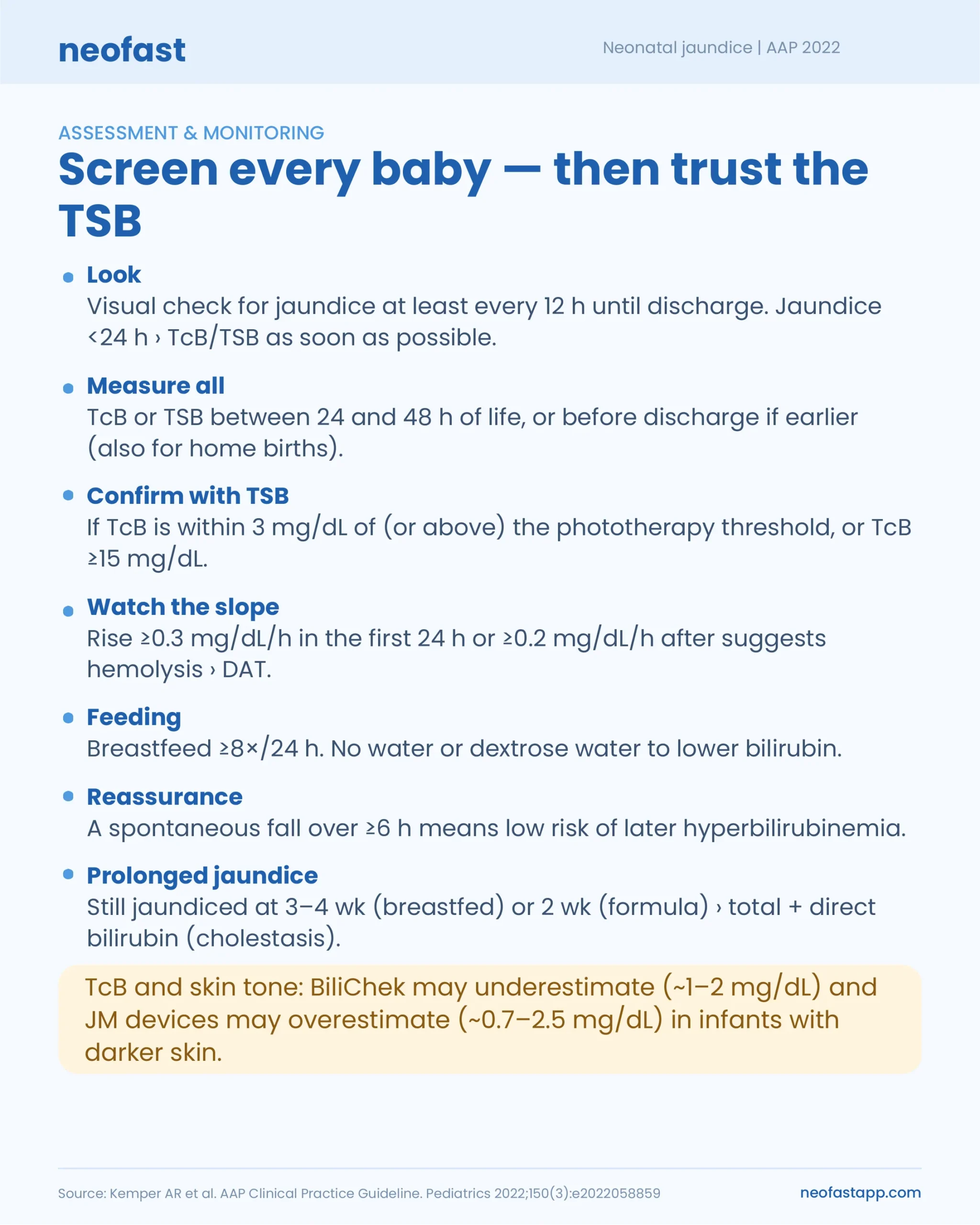
ASSESSMENT & MONITORING
Screen every baby — then trust the TSB
- Look
Visual check for jaundice at least every 12 h until discharge. Jaundice <24 h › TcB/TSB as soon as possible. - Measure all
TcB or TSB between 24 and 48 h of life, or before discharge if earlier (also for home births). - Confirm with TSB
If TcB is within 3 mg/dL of (or above) the phototherapy threshold, or TcB ≥15 mg/dL. - Watch the slope
Rise ≥0.3 mg/dL/h in the first 24 h or ≥0.2 mg/dL/h after suggests hemolysis › DAT. - Feeding
Breastfeed ≥8×/24 h. No water or dextrose water to lower bilirubin. - Reassurance
A spontaneous fall over ≥6 h means low risk of later hyperbilirubinemia. - Prolonged jaundice
Still jaundiced at 3–4 wk (breastfed) or 2 wk (formula) › total + direct bilirubin (cholestasis).
TcB and skin tone: BiliChek may underestimate (~1–2 mg/dL) and JM devices may overestimate (~0.7–2.5 mg/dL) in infants with darker skin.
Phototherapy thresholds — no neurotoxicity risk factors
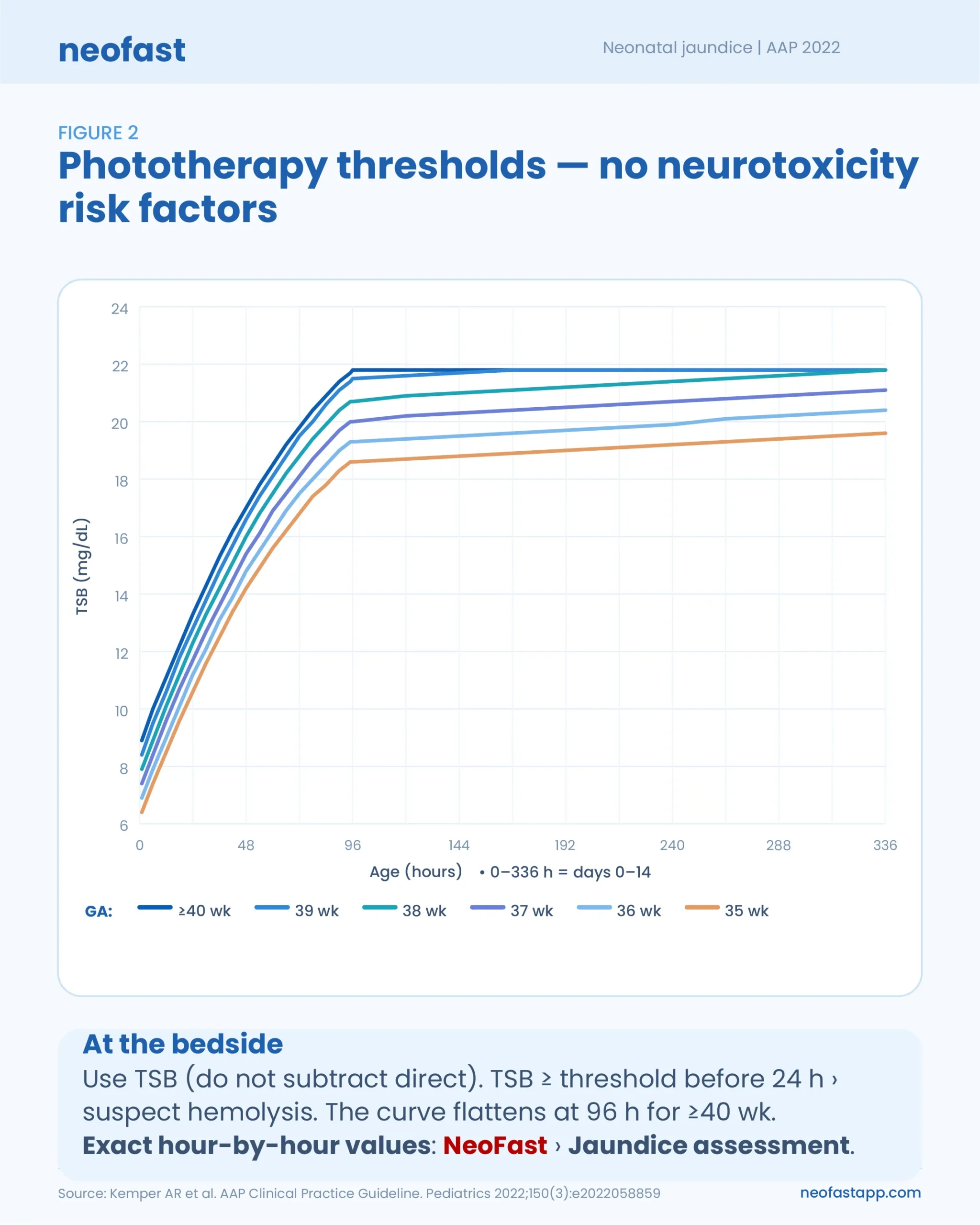
FIGURE 2
Phototherapy thresholds — no neurotoxicity risk factors
| GA | Line color |
|---|---|
| ≥40 wk | Dark blue |
| 39 wk | Blue |
| 38 wk | Teal |
| 37 wk | Purple |
| 36 wk | Light blue |
| 35 wk | Orange |
X-axis: Age (hours), 0–336 h = days 0–14. Y-axis: TSB (mg/dL), 6–24.
At the bedside
Use TSB (do not subtract direct). TSB ≥ threshold before 24 h › suspect hemolysis. The curve flattens at 96 h for ≥40 wk.
Exact hour-by-hour values: NeoFast › Jaundice assessment.
Starting & monitoring phototherapy
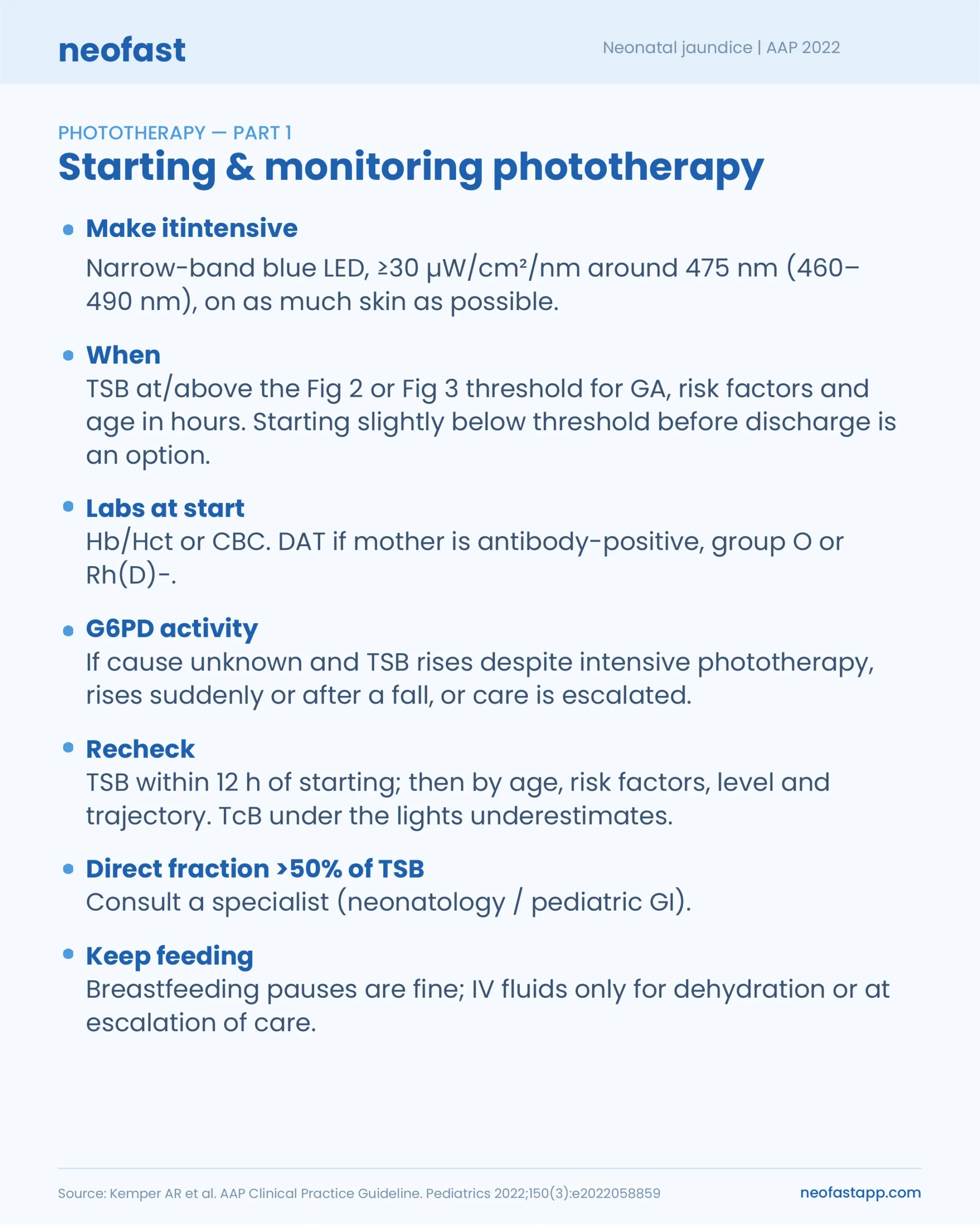
PHOTOTHERAPY — PART 1
Starting & monitoring phototherapy
- Make it intensive
Narrow-band blue LED, ≥30 µW/cm²/nm around 475 nm (460–490 nm), on as much skin as possible. - When
TSB at/above the Fig 2 or Fig 3 threshold for GA, risk factors and age in hours. Starting slightly below threshold before discharge is an option. - Labs at start
Hb/Hct or CBC. DAT if mother is antibody-positive, group O or Rh(D)-. - G6PD activity
If cause unknown and TSB rises despite intensive phototherapy, rises suddenly or after a fall, or care is escalated. - Recheck
TSB within 12 h of starting; then by age, risk factors, level and trajectory. TcB under the lights underestimates. - Direct fraction >50% of TSB
Consult a specialist (neonatology / pediatric GI). - Keep feeding
Breastfeeding pauses are fine; IV fluids only for dehydration or at escalation of care.
Phototherapy thresholds — ≥1 neurotoxicity risk factor
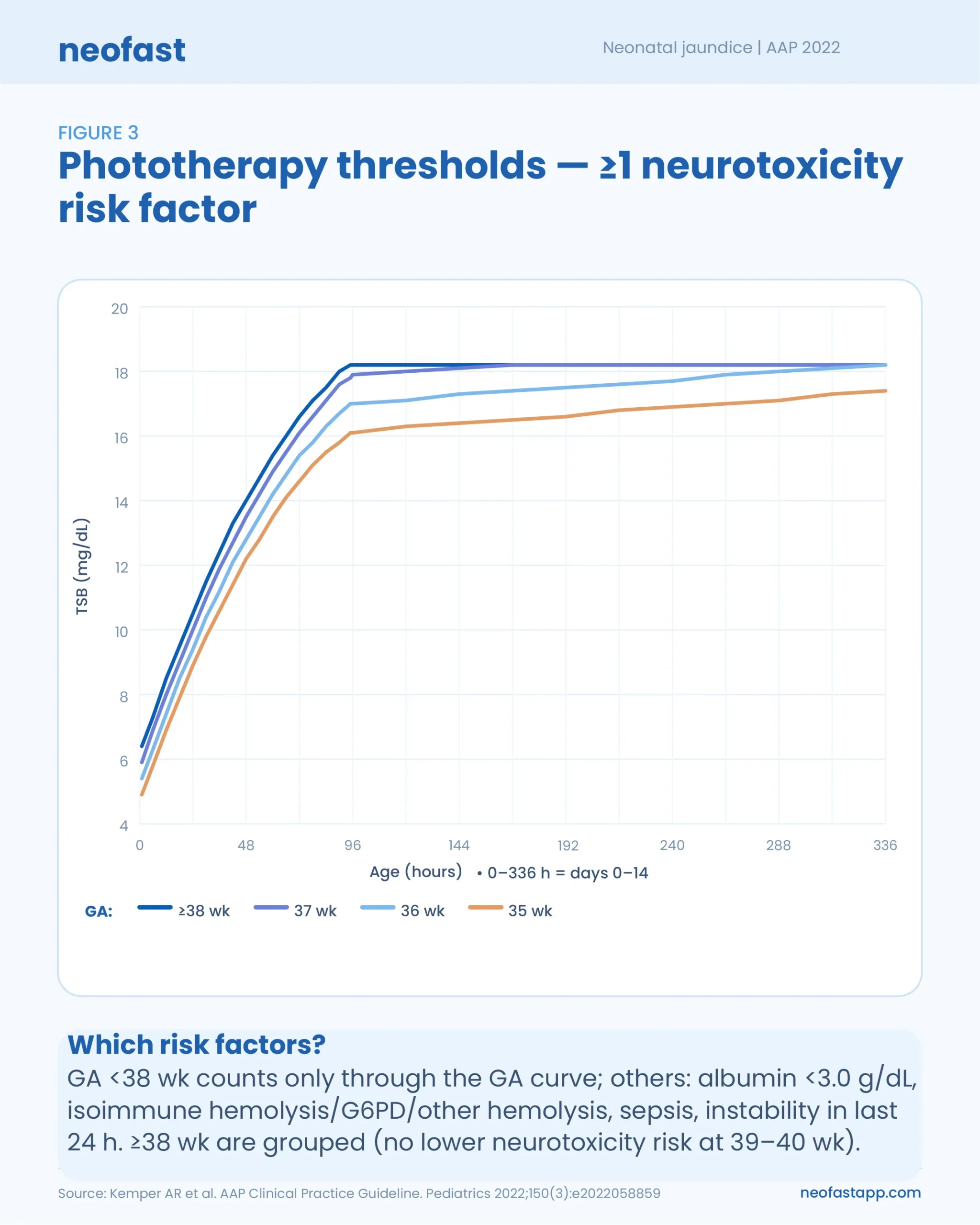
FIGURE 3
Phototherapy thresholds — ≥1 neurotoxicity risk factor
| GA | Line color |
|---|---|
| ≥38 wk | Dark blue |
| 37 wk | Purple |
| 36 wk | Light blue |
| 35 wk | Orange |
X-axis: Age (hours), 0–336 h = days 0–14. Y-axis: TSB (mg/dL), 4–20.
Which risk factors?
GA <38 wk counts only through the GA curve; others: albumin <3.0 g/dL, isoimmune hemolysis/G6PD/other hemolysis, sepsis, instability in last 24 h. ≥38 wk are grouped (no lower neurotoxicity risk at 39–40 wk).
Phototherapy — Part 2: Stopping, rebound & home phototherapy
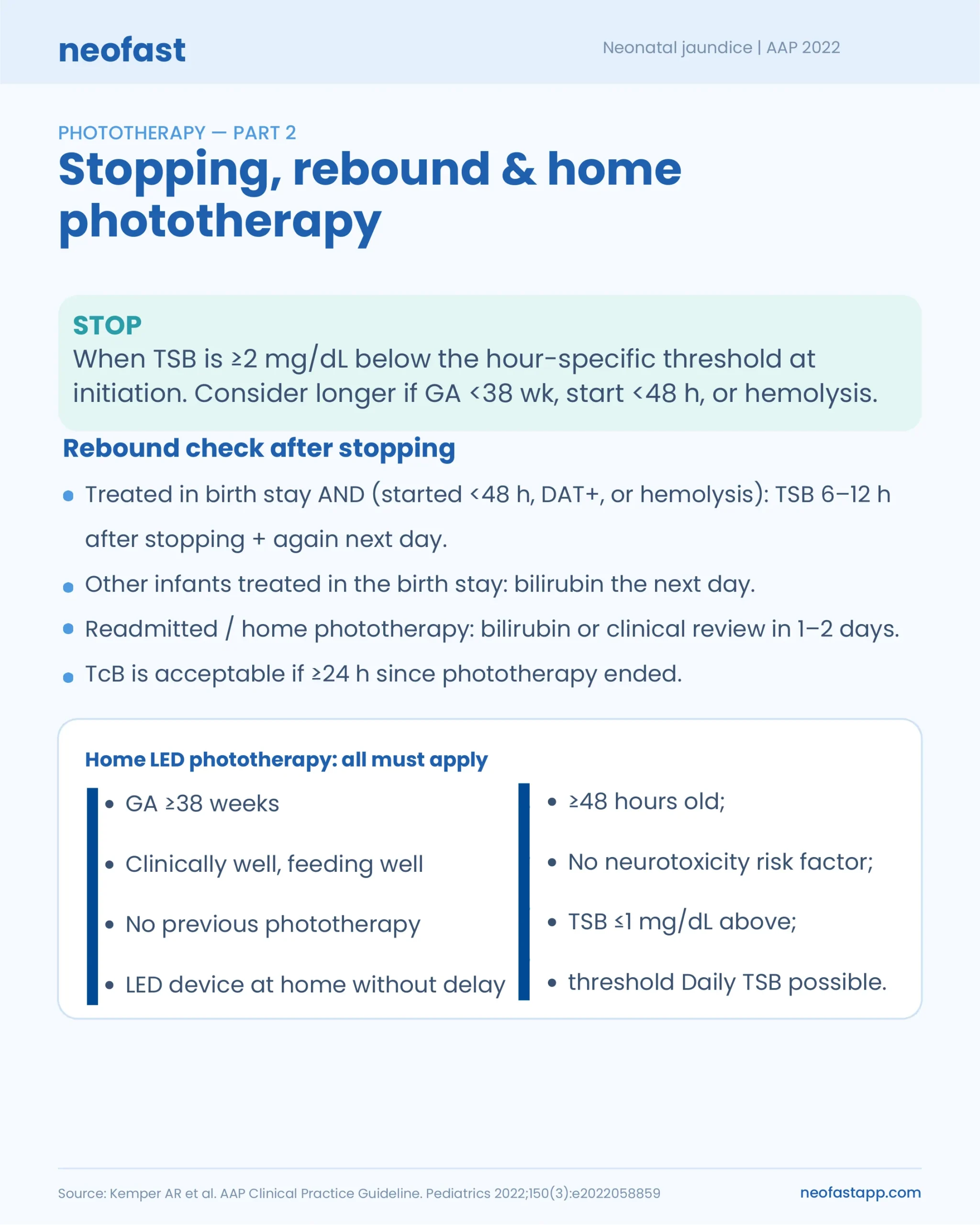
Phototherapy — Part 2
Stopping, rebound & home phototherapy
STOP
When TSB is ≥2 mg/dL below the hour-specific threshold at initiation. Consider longer if GA <38 wk, start <48 h, or hemolysis.
Rebound check after stopping
- Treated in birth stay AND (started <48 h, DAT+, or hemolysis): TSB 6–12 h after stopping + again next day.
- Other infants treated in the birth stay: bilirubin the next day.
- Readmitted / home phototherapy: bilirubin or clinical review in 1–2 days.
- TcB is acceptable if ≥24 h since phototherapy ended.
Home LED phototherapy: all must apply
- GA ≥38 weeks
- Clinically well, feeding well
- No previous phototherapy
- LED device at home without delay
- ≥48 hours old
- No neurotoxicity risk factor
- TSB ≤1 mg/dL above threshold
- Daily TSB possible
Figure 4 — Escalation of care: step by step
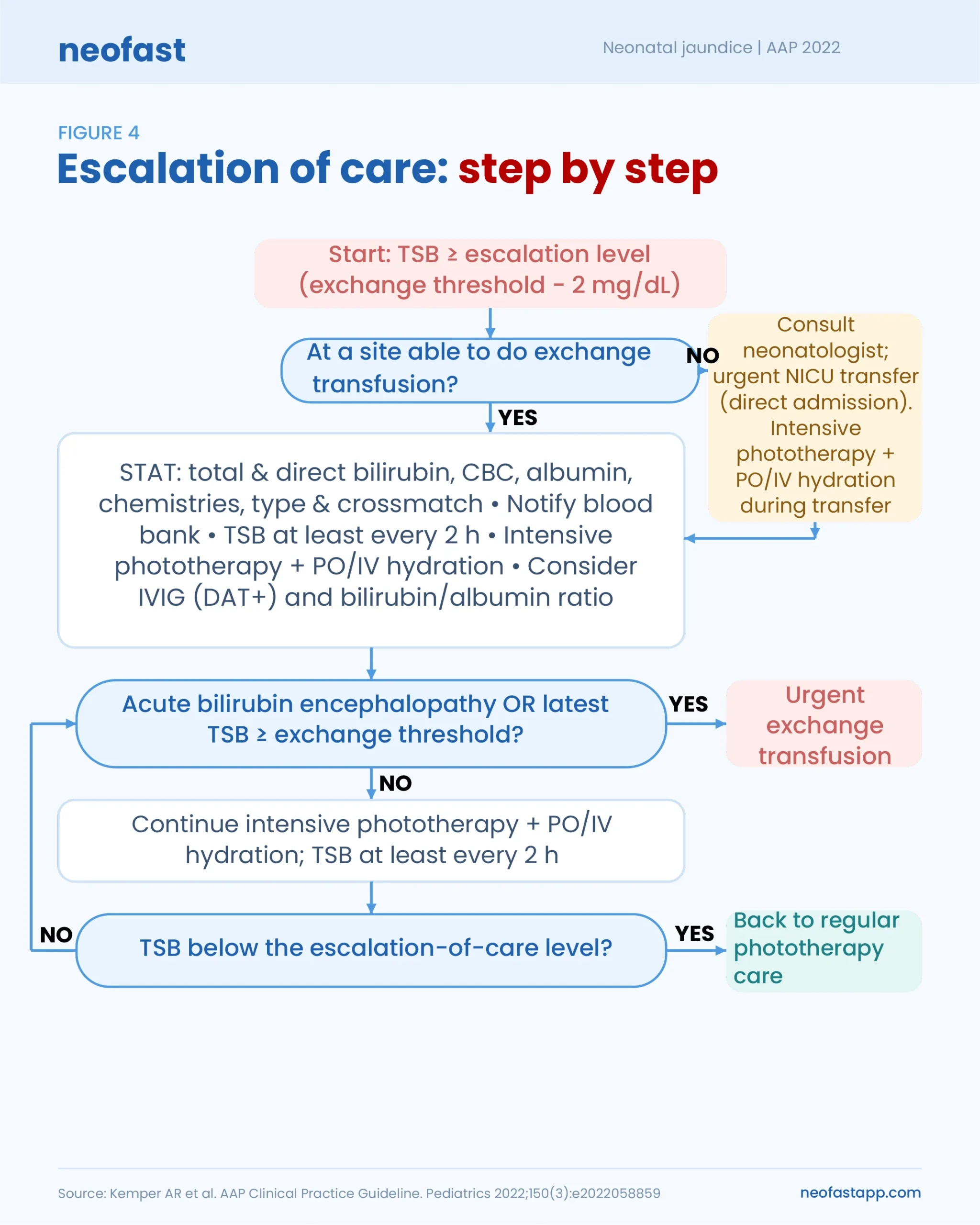
Figure 4
Escalation of care: step by step
- Start: TSB ≥ escalation level (exchange threshold − 2 mg/dL)
- Decision: At a site able to do exchange transfusion?
- NO → Consult neonatologist; urgent NICU transfer (direct admission). Intensive phototherapy + PO/IV hydration during transfer.
- YES → STAT: total & direct bilirubin, CBC, albumin, chemistries, type & crossmatch • Notify blood bank • TSB at least every 2 h • Intensive phototherapy + PO/IV hydration • Consider IVIG (DAT+) and bilirubin/albumin ratio.
- Decision: Acute bilirubin encephalopathy OR latest TSB ≥ exchange threshold?
- YES → Urgent exchange transfusion.
- NO → Continue intensive phototherapy + PO/IV hydration; TSB at least every 2 h.
- Decision: TSB below the escalation-of-care level?
- YES → Back to regular phototherapy care.
- NO → Return to the acute bilirubin encephalopathy / exchange threshold decision.
Figure 5 — Exchange transfusion thresholds (no neurotoxicity risk factors)
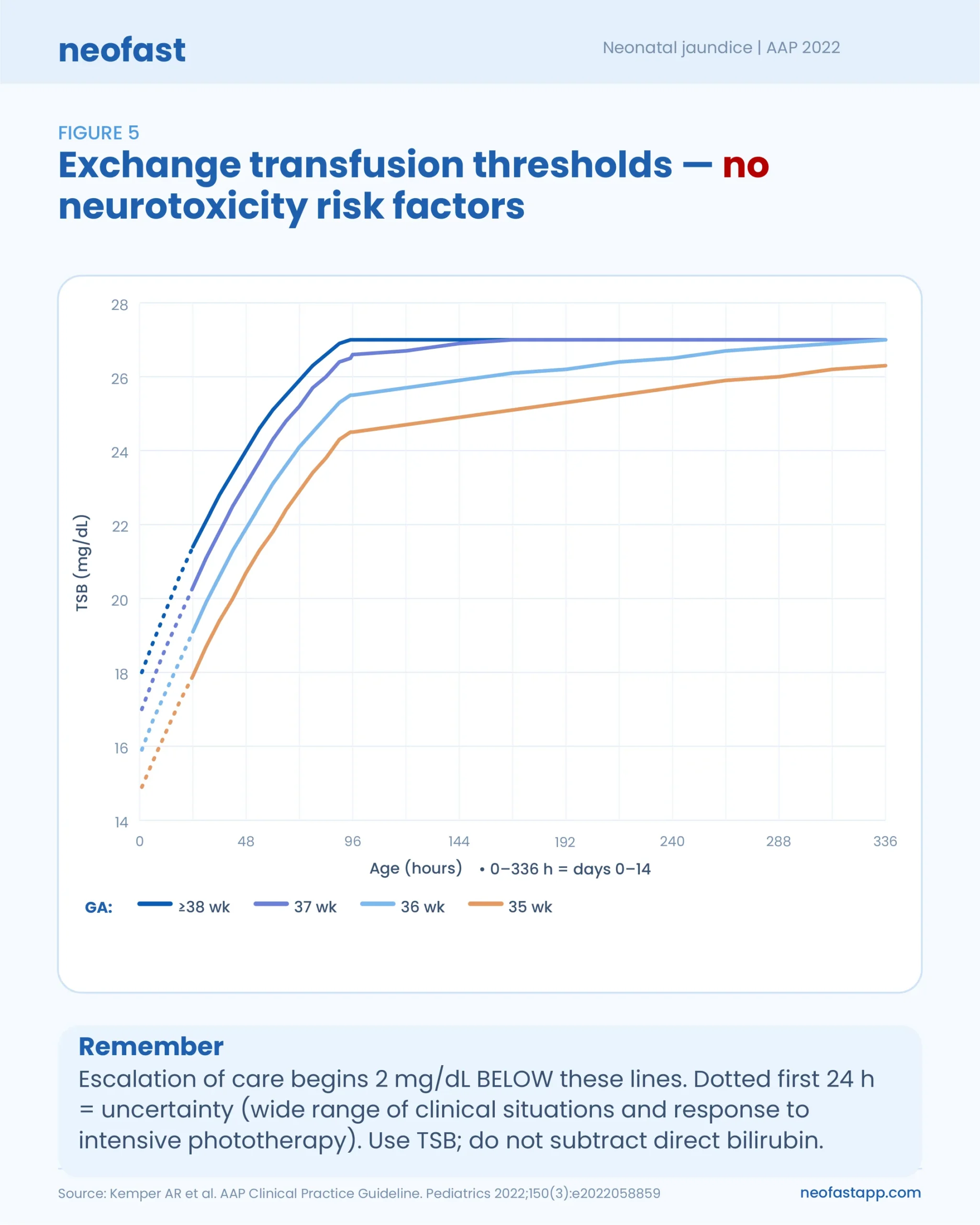
Figure 5
Exchange transfusion thresholds — no neurotoxicity risk factors
Graph: TSB (mg/dL) on the y-axis (14–28) versus Age (hours) on the x-axis (0–336 h = days 0–14).
- GA ≥38 wk: starts ~18 mg/dL at 0 h, rises to ~21.3 mg/dL by 24 h (dotted), reaching ~27 mg/dL plateau by ~96 h, remaining ~27 mg/dL through 336 h.
- GA 37 wk: starts ~17 mg/dL at 0 h, ~20.3 mg/dL by 24 h (dotted), rising to ~26.6 mg/dL by ~96 h, up to ~27 mg/dL by 336 h.
- GA 36 wk: starts ~16 mg/dL at 0 h, ~19.2 mg/dL by 24 h (dotted), rising to ~25.5 mg/dL by ~96 h, up to ~27 mg/dL by 336 h.
- GA 35 wk: starts ~15 mg/dL at 0 h, ~17.9 mg/dL by 24 h (dotted), rising to ~24.5 mg/dL by ~96 h, up to ~26.3 mg/dL by 336 h.
Remember: Escalation of care begins 2 mg/dL BELOW these lines. Dotted first 24 h = uncertainty (wide range of clinical situations and response to intensive phototherapy). Use TSB; do not subtract direct bilirubin.
Figure 6 — Exchange transfusion thresholds (≥1 neurotoxicity risk factor)
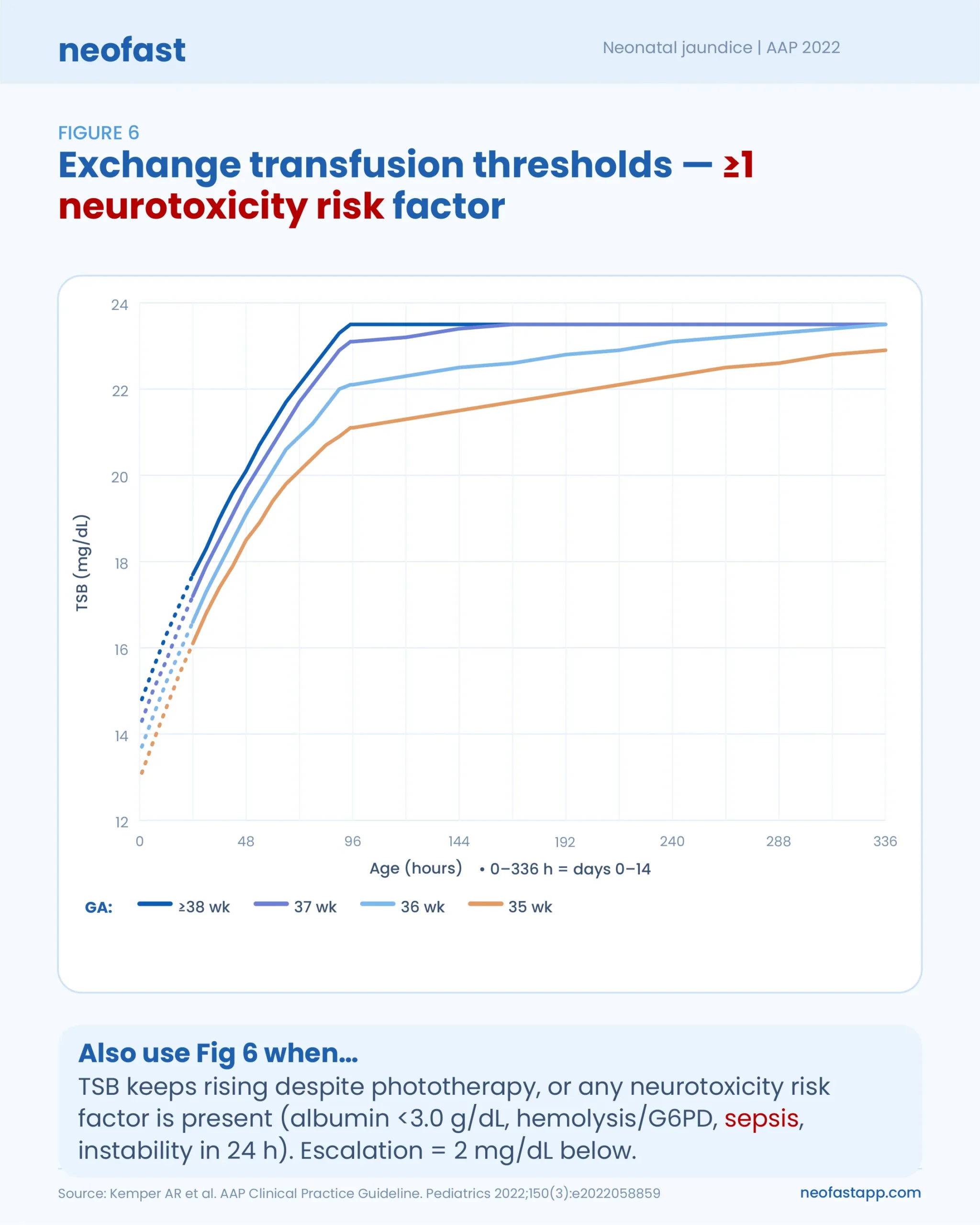
Figure 6
Exchange transfusion thresholds — ≥1 neurotoxicity risk factor
Graph: TSB (mg/dL) on the y-axis (12–24) versus Age (hours) on the x-axis (0–336 h = days 0–14).
- GA ≥38 wk: starts ~15 mg/dL at 0 h, ~17.7 mg/dL by 24 h (dotted), rising to ~23.6 mg/dL by ~96 h, remaining ~23.6 mg/dL through 336 h.
- GA 37 wk: starts ~14.2 mg/dL at 0 h, ~17.1 mg/dL by 24 h (dotted), rising to ~23.2 mg/dL by ~96 h, up to ~23.6 mg/dL by 336 h.
- GA 36 wk: starts ~13.8 mg/dL at 0 h, ~16.5 mg/dL by 24 h (dotted), rising to ~22.1 mg/dL by ~96 h, up to ~23.5 mg/dL by 336 h.
- GA 35 wk: starts ~13.2 mg/dL at 0 h, ~16.1 mg/dL by 24 h (dotted), rising to ~21.1 mg/dL by ~96 h, up to ~23 mg/dL by 336 h.
Also use Fig 6 when… TSB keeps rising despite phototherapy, or any neurotoxicity risk factor is present (albumin <3.0 g/dL, hemolysis/G6PD, sepsis, instability in 24 h). Escalation = 2 mg/dL below.
Escalation & exchange: when TSB is approaching exchange levels
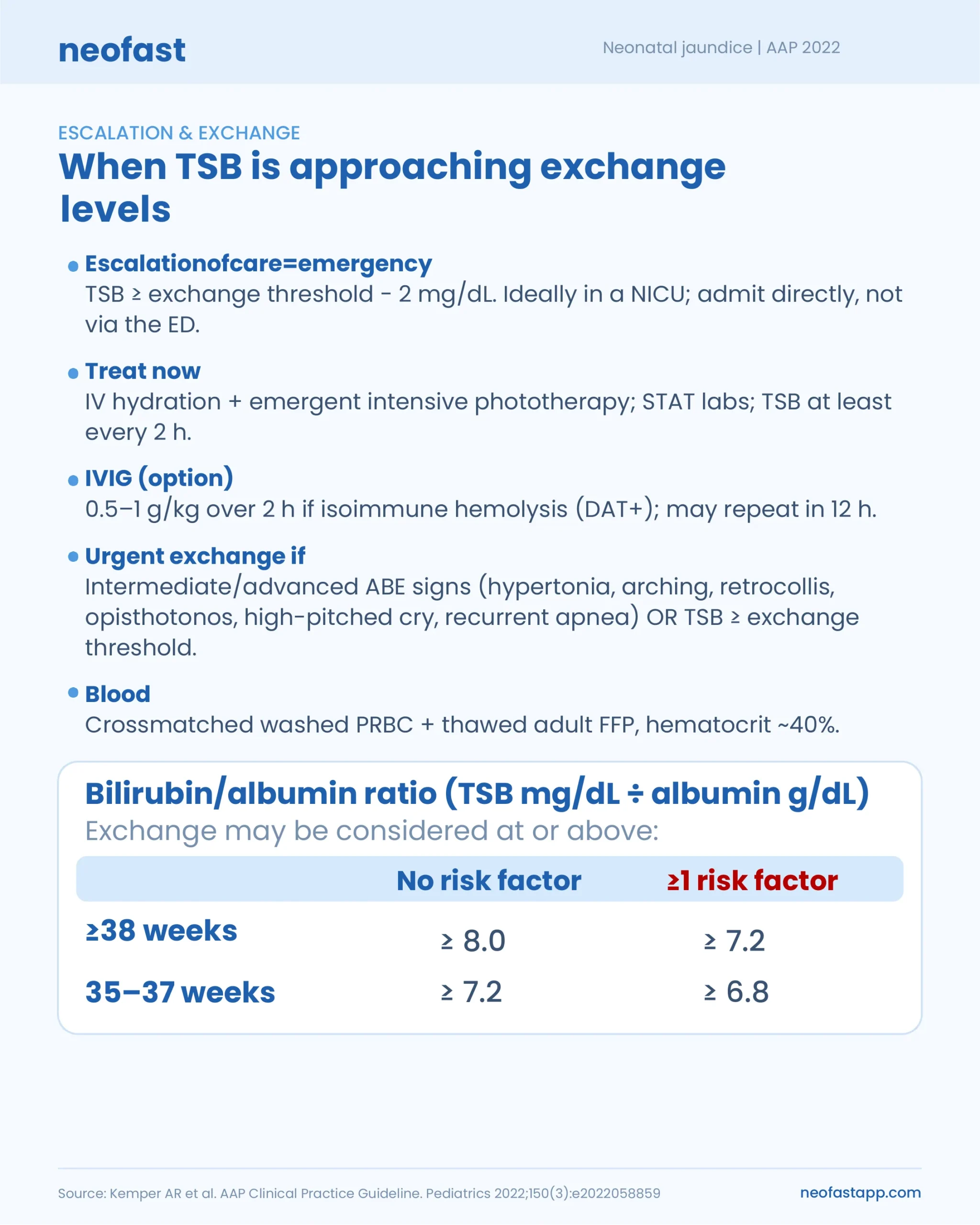
Escalation & exchange
When TSB is approaching exchange levels
- Escalation of care = emergency
TSB ≥ exchange threshold − 2 mg/dL. Ideally in a NICU; admit directly, not via the ED. - Treat now
IV hydration + emergent intensive phototherapy; STAT labs; TSB at least every 2 h. - IVIG (option)
0.5–1 g/kg over 2 h if isoimmune hemolysis (DAT+); may repeat in 12 h. - Urgent exchange if
Intermediate/advanced ABE signs (hypertonia, arching, retrocollis, opisthotonos, high-pitched cry, recurrent apnea) OR TSB ≥ exchange threshold. - Blood
Crossmatched washed PRBC + thawed adult FFP, hematocrit ~40%.
Bilirubin/albumin ratio (TSB mg/dL ÷ albumin g/dL)
Exchange may be considered at or above:
| No risk factor | ≥1 risk factor | |
|---|---|---|
| ≥38 weeks | ≥ 8.0 | ≥ 7.2 |
| 35–37 weeks | ≥ 7.2 | ≥ 6.8 |
Figure 7 — Before discharge: plan the follow-up
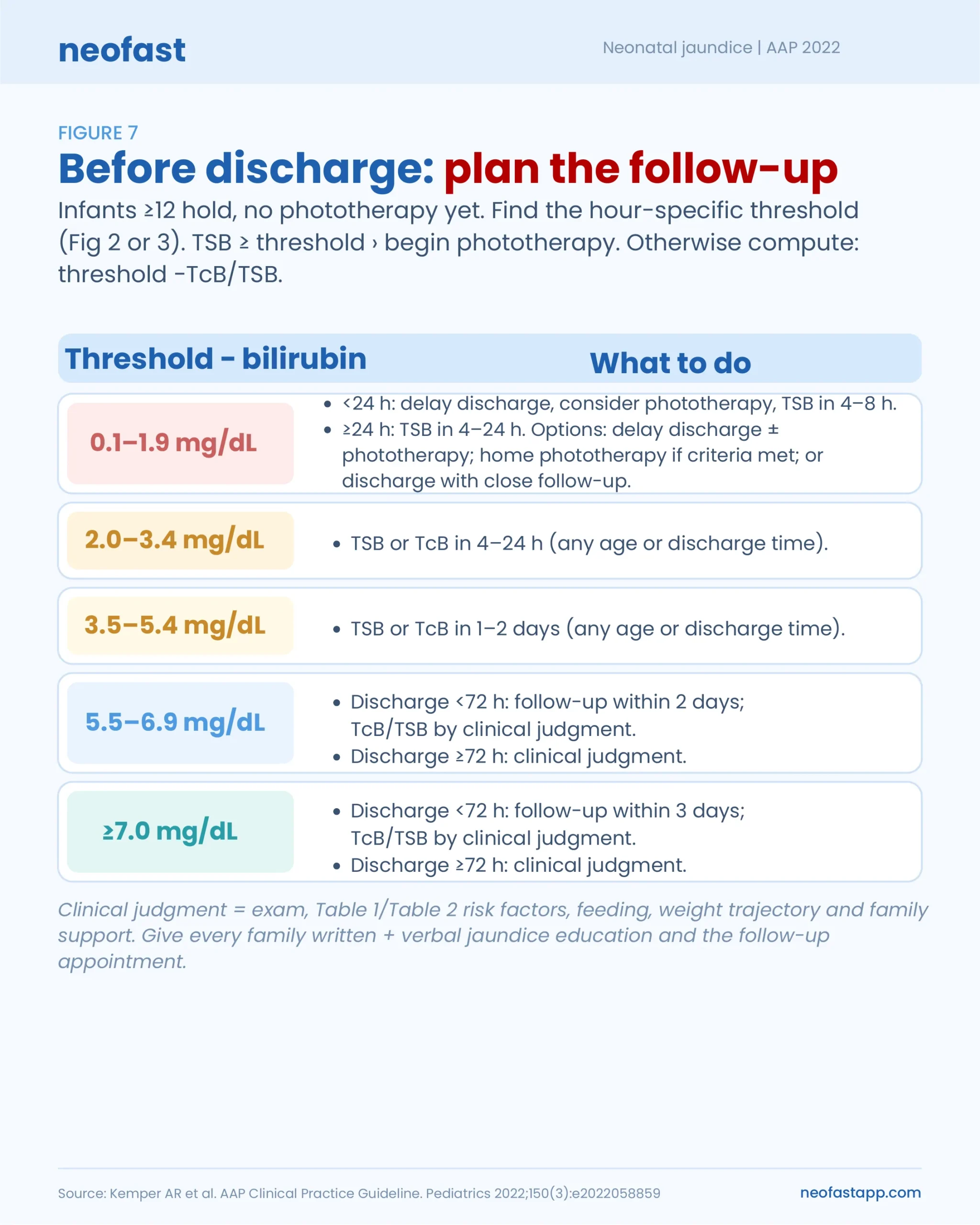
Figure 7
Before discharge: plan the follow-up
Infants ≥12 hold, no phototherapy yet. Find the hour-specific threshold (Fig 2 or 3). TSB ≥ threshold → begin phototherapy. Otherwise compute: threshold − TcB/TSB.
| Threshold − bilirubin | What to do |
|---|---|
| 0.1–1.9 mg/dL |
|
| 2.0–3.4 mg/dL |
|
| 3.5–5.4 mg/dL |
|
| 5.5–6.9 mg/dL |
|
| ≥7.0 mg/dL |
|
Clinical judgment = exam, Table 1/Table 2 risk factors, feeding, weight trajectory and family support. Give every family written + verbal jaundice education and the follow-up appointment.
NeoFast in practice: The whole AAP 2022 algorithm in 3 taps
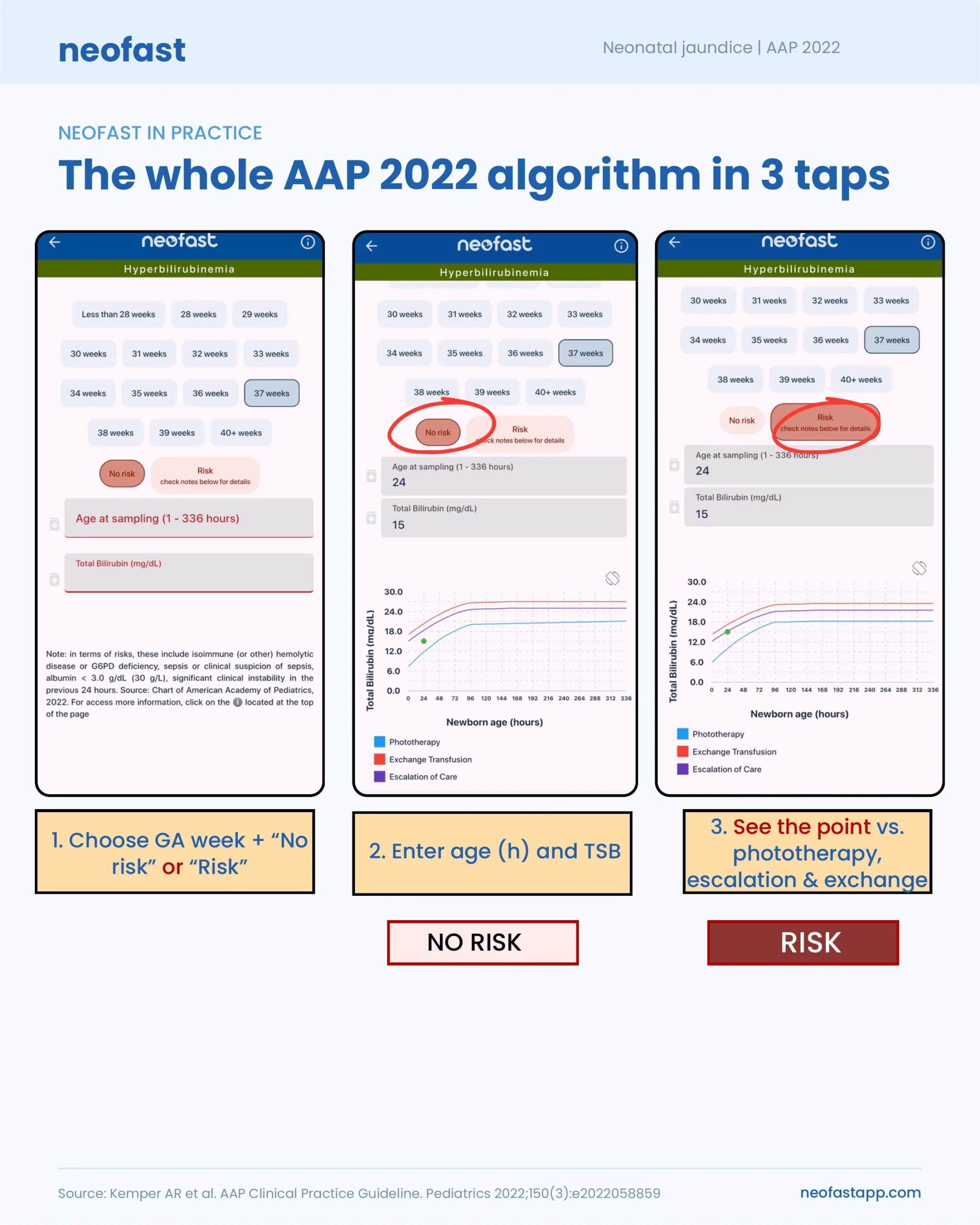
NeoFast in practice
The whole AAP 2022 algorithm in 3 taps
- 1. Choose GA week + “No risk” or “Risk”
App screen showing gestational age options from Less than 28 weeks to 40+ weeks, with 37 weeks selected, and “No risk”/”Risk” toggle buttons. Risk note: in terms of risks, these include isoimmune (or other) hemolytic disease or G6PD deficiency, sepsis or clinical suspicion of sepsis, albumin < 3.0 g/dL (30 g/L), significant clinical instability in the previous 24 hours. Source: Chart of American Academy of Pediatrics, 2022. - 2. Enter age (h) and TSB
App screen with 37 weeks and “No risk” selected, Age at sampling = 24 hours, Total Bilirubin = 15 mg/dL, showing a graph of Total Bilirubin (mg/dL) vs Newborn age (hours) with Phototherapy, Exchange Transfusion, and Escalation of Care lines plotted; result labeled NO RISK. - 3. See the point vs. phototherapy, escalation & exchange
App screen with 37 weeks and “Risk” selected, same Age at sampling = 24 hours and Total Bilirubin = 15 mg/dL, showing the graph with the point now falling in a higher-risk zone; result labeled RISK.
Made for the night shift: Why neonatologists keep NeoFast open on call?
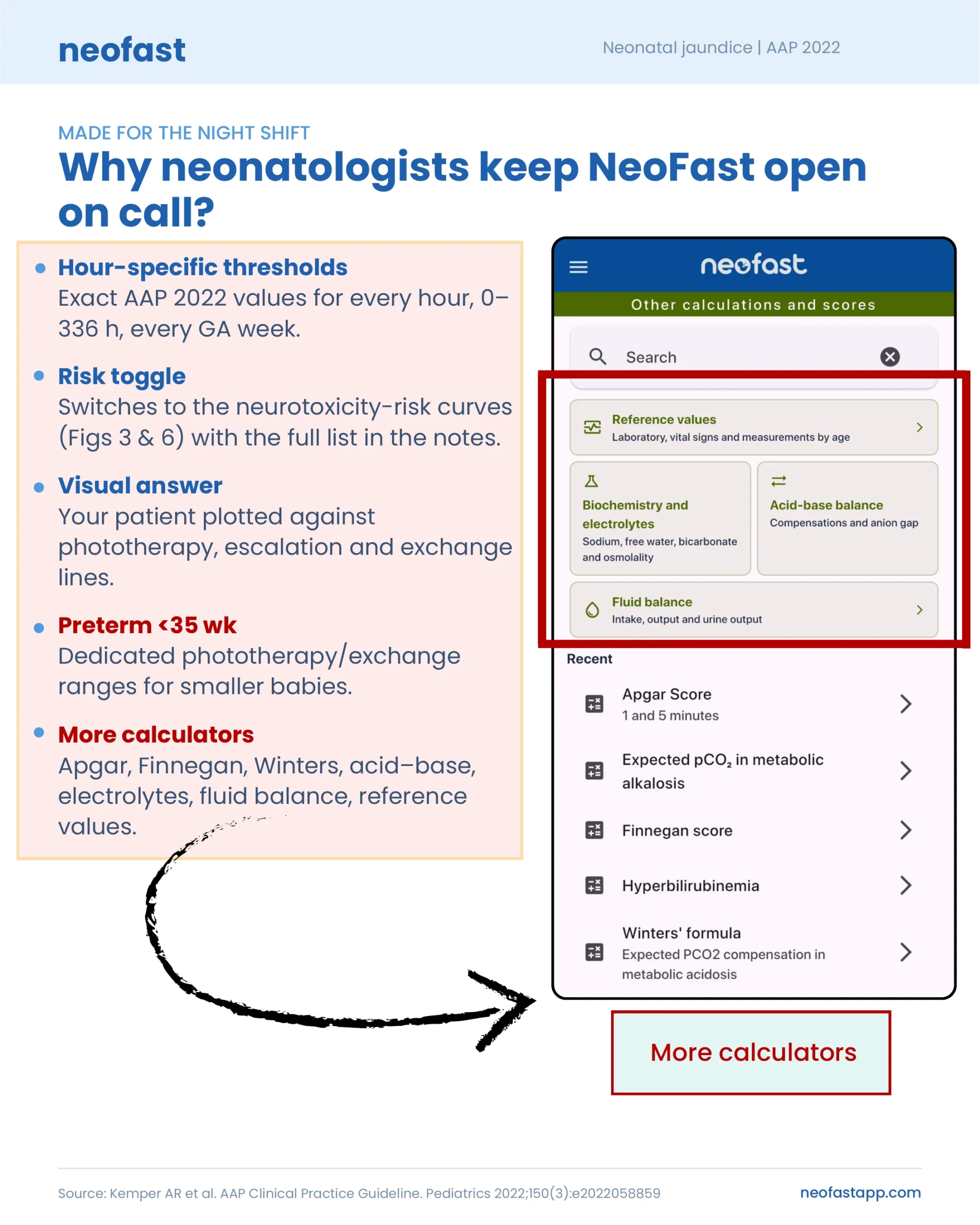
Made for the night shift
Why neonatologists keep NeoFast open on call?
- Hour-specific thresholds
Exact AAP 2022 values for every hour, 0–336 h, every GA week. - Risk toggle
Switches to the neurotoxicity-risk curves (Figs 3 & 6) with the full list in the notes. - Visual answer
Your patient plotted against phototherapy, escalation and exchange lines. - Preterm <35 wk
Dedicated phototherapy/exchange ranges for smaller babies. - More calculators
Apgar, Finnegan, Winters, acid–base, electrolytes, fluid balance, reference values.
More calculators
- Reference values — Laboratory, vital signs and measurements by age
- Biochemistry and electrolytes — Sodium, free water, bicarbonate and osmolality
- Acid-base balance — Compensations and anion gap
- Fluid balance — Intake, output and urine output
Recent
- Apgar Score — 1 and 5 minutes
- Expected pCO₂ in metabolic alkalosis
- Finnegan score
- Hyperbilirubinemia
- Winters’ formula — Expected PCO2 compensation in metabolic acidosis
Why Neonatologists Keep NeoFast Open on Call
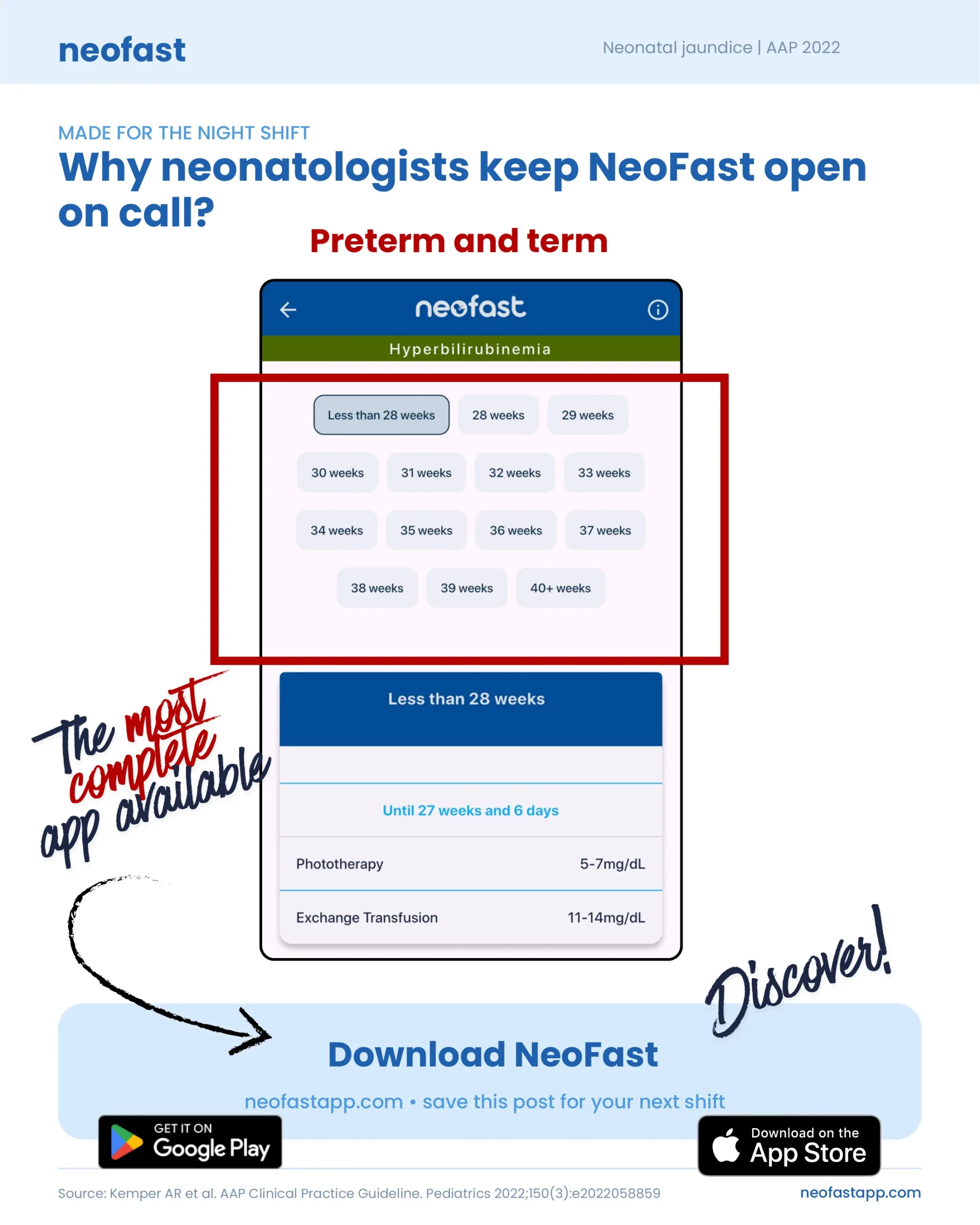
MADE FOR THE NIGHT SHIFT
Why neonatologists keep NeoFast open on call?
Preterm and term
- Less than 28 weeks
- 28 weeks
- 29 weeks
- 30 weeks
- 31 weeks
- 32 weeks
- 33 weeks
- 34 weeks
- 35 weeks
- 36 weeks
- 37 weeks
- 38 weeks
- 39 weeks
- 40+ weeks
Less than 28 weeks
| Until 27 weeks and 6 days | |
|---|---|
| Phototherapy | 5-7mg/dL |
| Exchange Transfusion | 11-14mg/dL |
The most complete app available
Discover!
Download NeoFast
neofastapp.com • save this post for your next shift
Frequently asked questions
When does escalation of care start according to the AAP 2022 guideline?
Escalation of care starts when TSB is 2 mg/dL below the exchange transfusion threshold; this is considered a medical emergency, ideally managed in a NICU with direct admission rather than via the ED.
What are the criteria for home LED phototherapy in a newborn ≥35 weeks?
All of the following must apply: GA ≥38 weeks, clinically well and feeding well, no previous phototherapy, an LED device available at home without delay, age ≥48 hours, no neurotoxicity risk factor, TSB ≤1 mg/dL above threshold, and daily TSB monitoring is possible.
What is the bilirubin/albumin ratio threshold for considering exchange transfusion?
Exchange may be considered at or above a TSB(mg/dL)/albumin(g/dL) ratio of 8.0 (no risk factor) or 7.2 (≥1 risk factor) for infants ≥38 weeks, and 7.2 (no risk factor) or 6.8 (≥1 risk factor) for infants 35-37 weeks.
How should phototherapy be stopped and rebound bilirubin monitored?
Stop phototherapy when TSB is ≥2 mg/dL below the hour-specific threshold used at initiation (consider longer duration if GA <38 weeks, started <48 h, or hemolysis present). For infants treated during the birth stay who started <48 h, are DAT-positive, or have hemolysis, recheck TSB 6-12 h after stopping and again the next day; other birth-stay infants need bilirubin the next day; readmitted or home-phototherapy infants need bilirubin or clinical review in 1-2 days. TcB is acceptable if ≥24 h since phototherapy ended.
What is the IVIG dose for isoimmune hemolytic disease nearing exchange transfusion thresholds?
IVIG 0.5-1 g/kg over 2 hours is an option for DAT-positive isoimmune hemolysis, and the dose may be repeated in 12 hours.