Key takeaways
- Perinatal palliative care is coordinated, interdisciplinary care that can coexist with full intensive care and does not mean giving up on the baby.
- Three groups should trigger consideration of palliative care: extremely preterm infants at the limit of viability, babies with life-limiting diagnoses, and long-suffering NICU patients who plateau despite good intensive care.
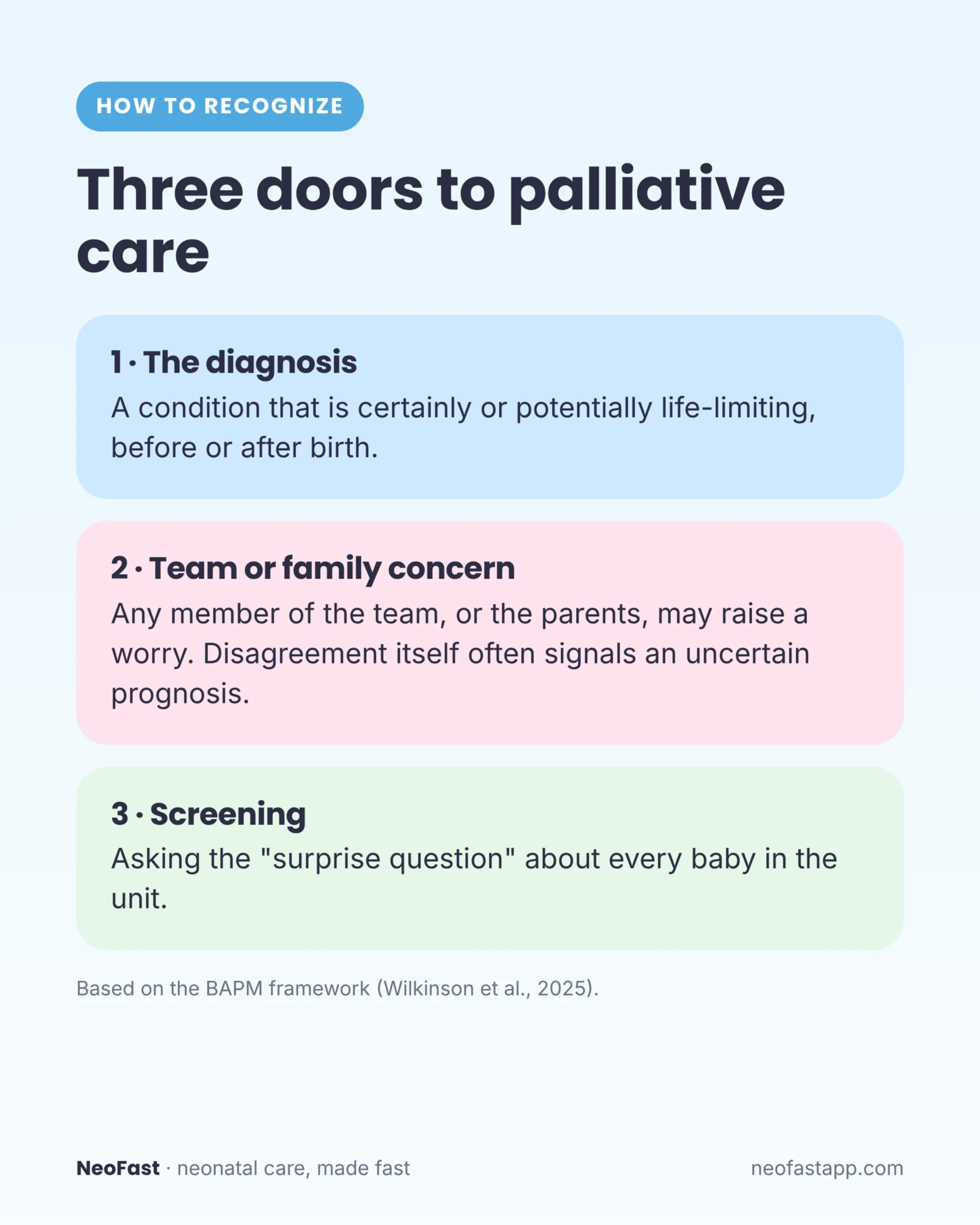
- The BAPM framework describes three doors into palliative care: the diagnosis itself, team or family concern, and screening with the surprise question.
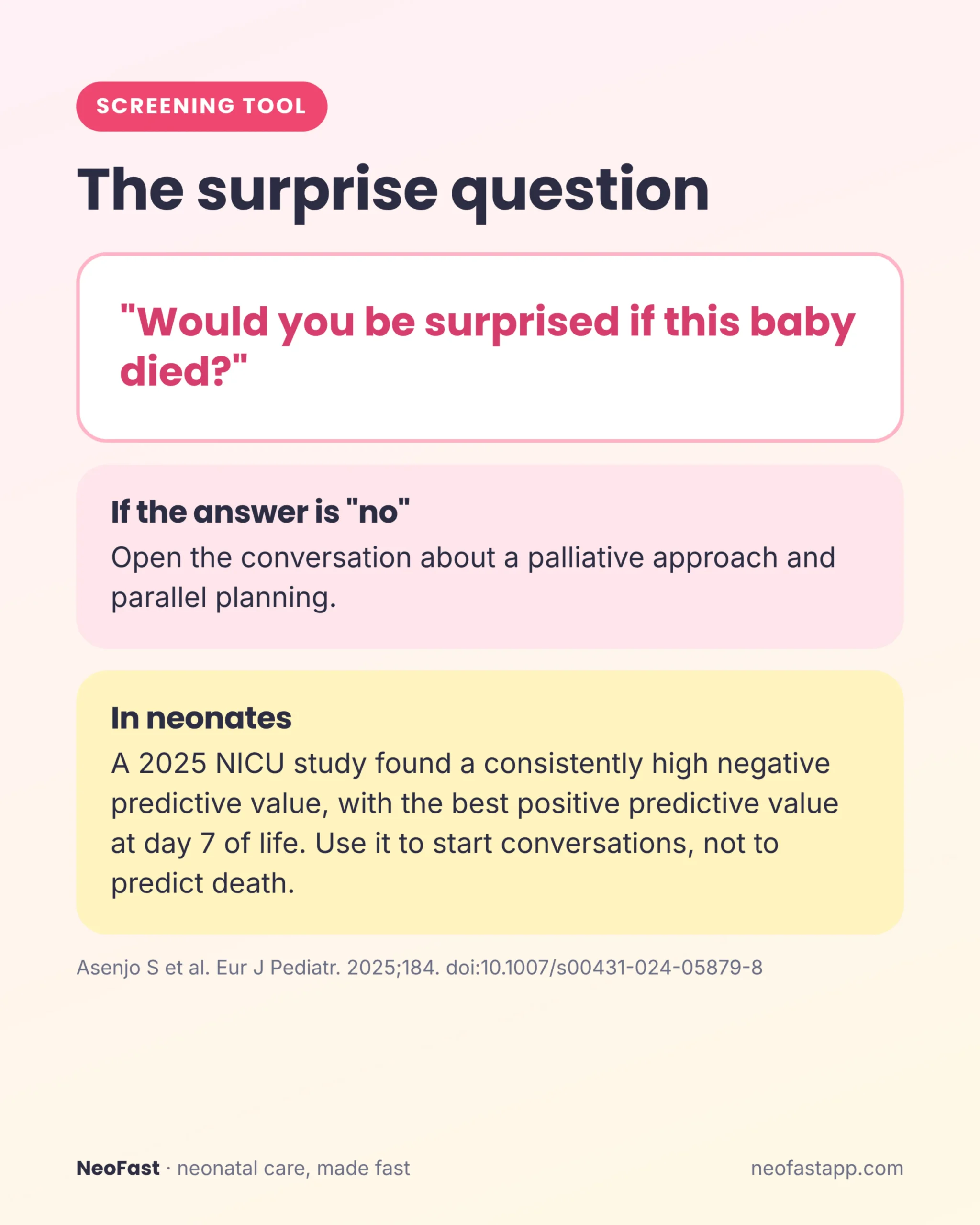
- A 2025 NICU study found the surprise question (Would you be surprised if this baby died?) has consistently high negative predictive value, with the best positive predictive value at day 7 of life.
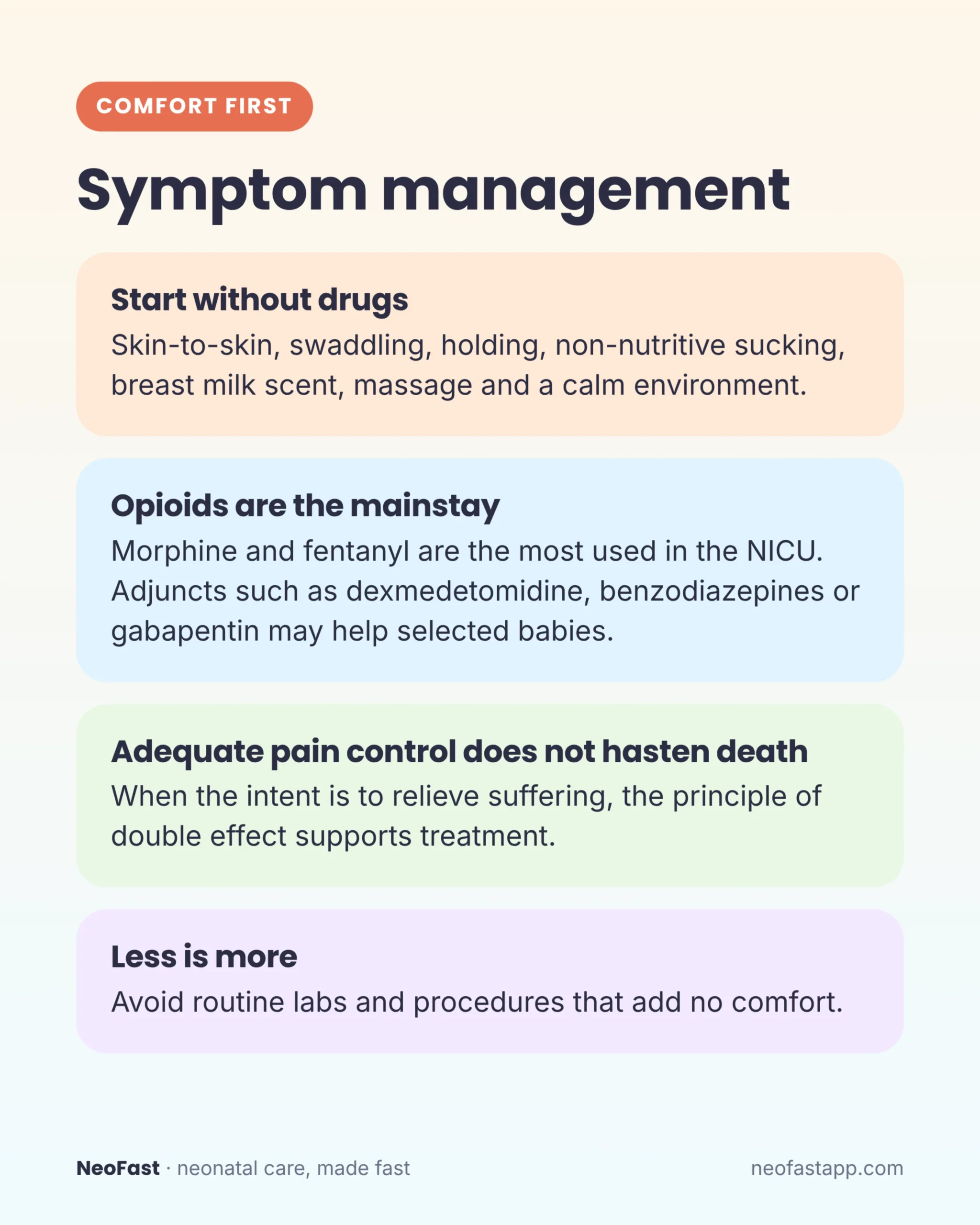
- Morphine and fentanyl are the mainstay opioids for symptom management in the NICU, and adequate pain control under the principle of double effect does not hasten death.
References
- Ellis KL, Carter BS. Perinatal Palliative Care. In: Martin RJ, Fanaroff AA (eds). Fanaroff and Martin’s Neonatal-Perinatal Medicine, 12th ed. Elsevier; ch. 44, p. 752–763.
- Wilkinson D, Bertaud S, Mancini A, Murdoch E; BAPM Working Group. Recognising uncertainty: an integrated framework for palliative care in perinatal medicine. Arch Dis Child Fetal Neonatal Ed. 2025;110:F236–F244.
- Asenjo S et al. Eur J Pediatr. 2025;184. doi:10.1007/s00431-024-05879-8
- Adapted from Box 44.2 (Ellis & Carter).
Neonatal palliative care
Neonatal palliative care
Who benefits, how to recognize them and what the care includes. Hint: it is not only end-of-life care.
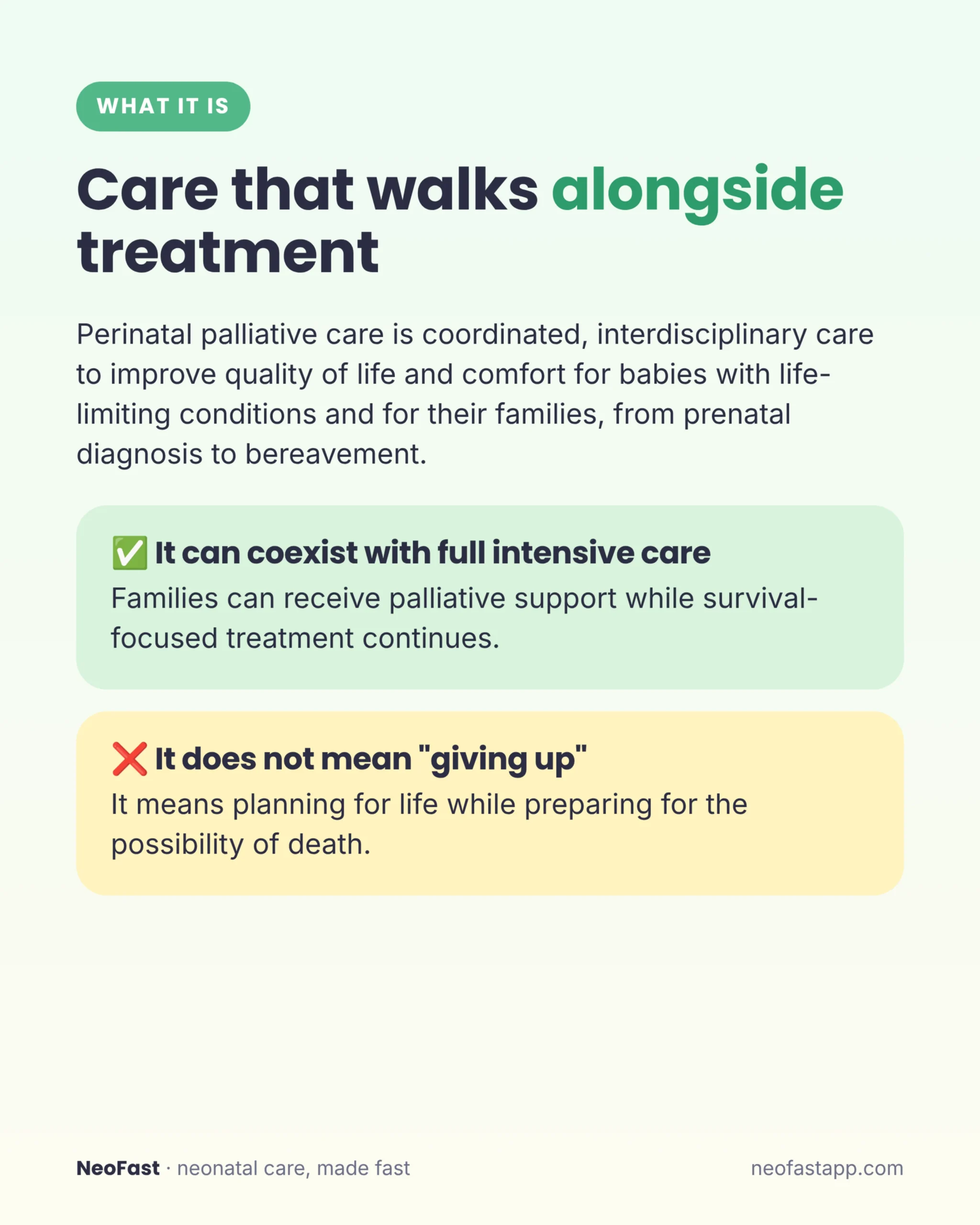
Care that walks alongside treatment
Care that walks alongside treatment
Perinatal palliative care is coordinated, interdisciplinary care to improve quality of life and comfort for babies with life-limiting conditions and for their families, from prenatal diagnosis to bereavement.
- ✅ It can coexist with full intensive care
Families can receive palliative support while survival-focused treatment continues.
- ❌ It does not mean “giving up”
It means planning for life while preparing for the possibility of death.
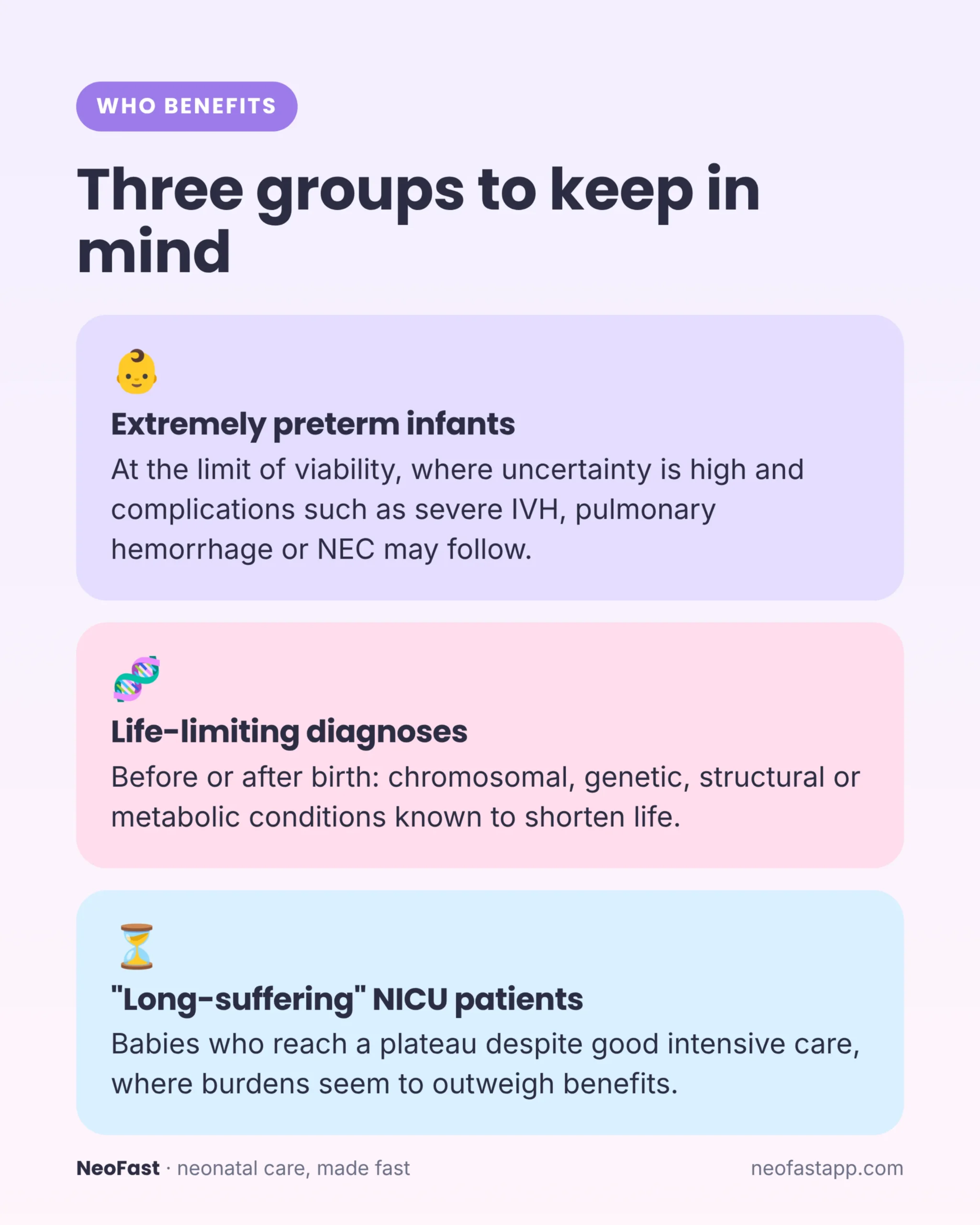
Three groups to keep in mind
Three groups to keep in mind
- 👶 Extremely preterm infants
At the limit of viability, where uncertainty is high and complications such as severe IVH, pulmonary hemorrhage or NEC may follow.
- 🧬 Life-limiting diagnoses
Before or after birth: chromosomal, genetic, structural or metabolic conditions known to shorten life.
- ⏳ “Long-suffering” NICU patients
Babies who reach a plateau despite good intensive care, where burdens seem to outweigh benefits.
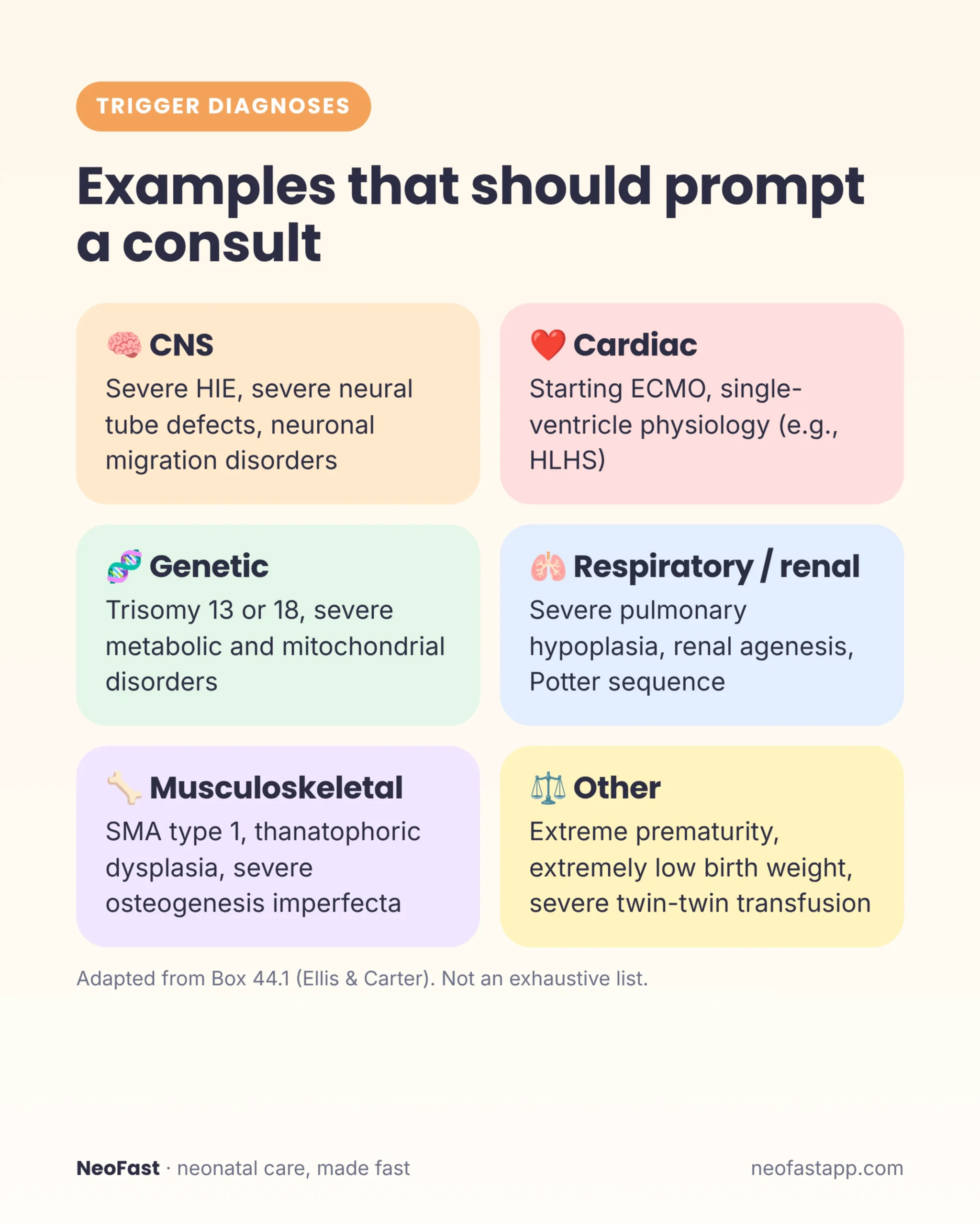
Examples that should prompt a consult
Examples that should prompt a consult
| 🧠 CNS | ❤️ Cardiac |
|---|---|
| Severe HIE, severe neural tube defects, neuronal migration disorders | Starting ECMO, single-ventricle physiology (e.g., HLHS) |
| 🧬 Genetic | 🫁 Respiratory / renal |
| Trisomy 13 or 18, severe metabolic and mitochondrial disorders | Severe pulmonary hypoplasia, renal agenesis, Potter sequence |
| 🦴 Musculoskeletal | ⚖️ Other |
| SMA type 1, thanatophoric dysplasia, severe osteogenesis imperfecta | Extreme prematurity, extremely low birth weight, severe twin-twin transfusion |
Adapted from Box 44.1 (Ellis & Carter). Not an exhaustive list.
Three doors to palliative care
Three doors to palliative care
- 1 · The diagnosis
A condition that is certainly or potentially life-limiting, before or after birth.
- 2 · Team or family concern
Any member of the team, or the parents, may raise a worry. Disagreement itself often signals an uncertain prognosis.
- 3 · Screening
Asking the “surprise question” about every baby in the unit.
Based on the BAPM framework (Wilkinson et al., 2025).
The surprise question
The surprise question
“Would you be surprised if this baby died?”
- If the answer is “no”
Open the conversation about a palliative approach and parallel planning.
- In neonates
A 2025 NICU study found a consistently high negative predictive value, with the best positive predictive value at day 7 of life. Use it to start conversations, not to predict death.
Asenjo S et al. Eur J Pediatr. 2025;184. doi:10.1007/s00431-024-05879-8
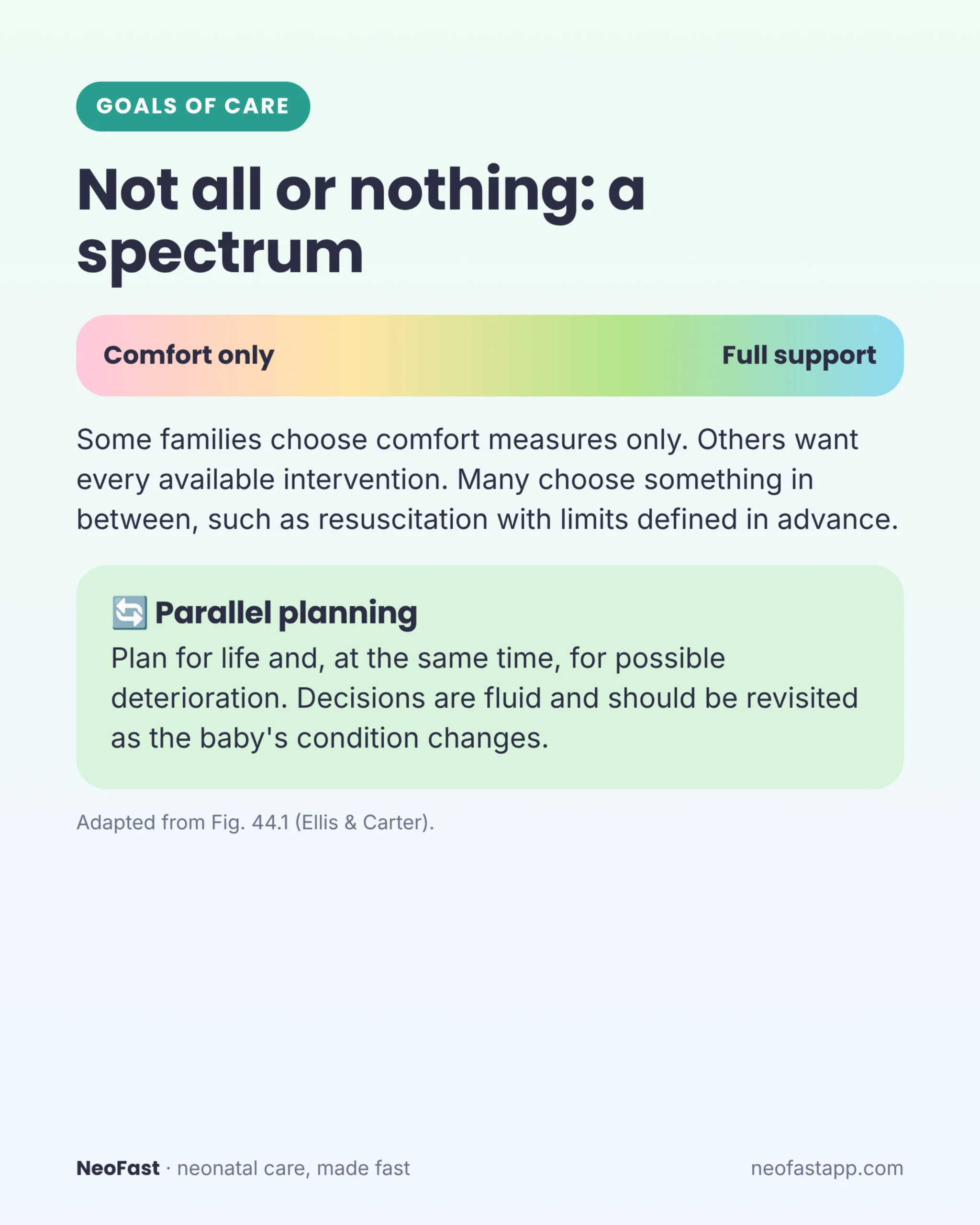
Not all or nothing: a spectrum
Not all or nothing: a spectrum
Comfort only — Full support
Some families choose comfort measures only. Others want every available intervention. Many choose something in between, such as resuscitation with limits defined in advance.
- 🔁 Parallel planning
Plan for life and, at the same time, for possible deterioration. Decisions are fluid and should be revisited as the baby’s condition changes.
Adapted from Fig. 44.1 (Ellis & Carter).
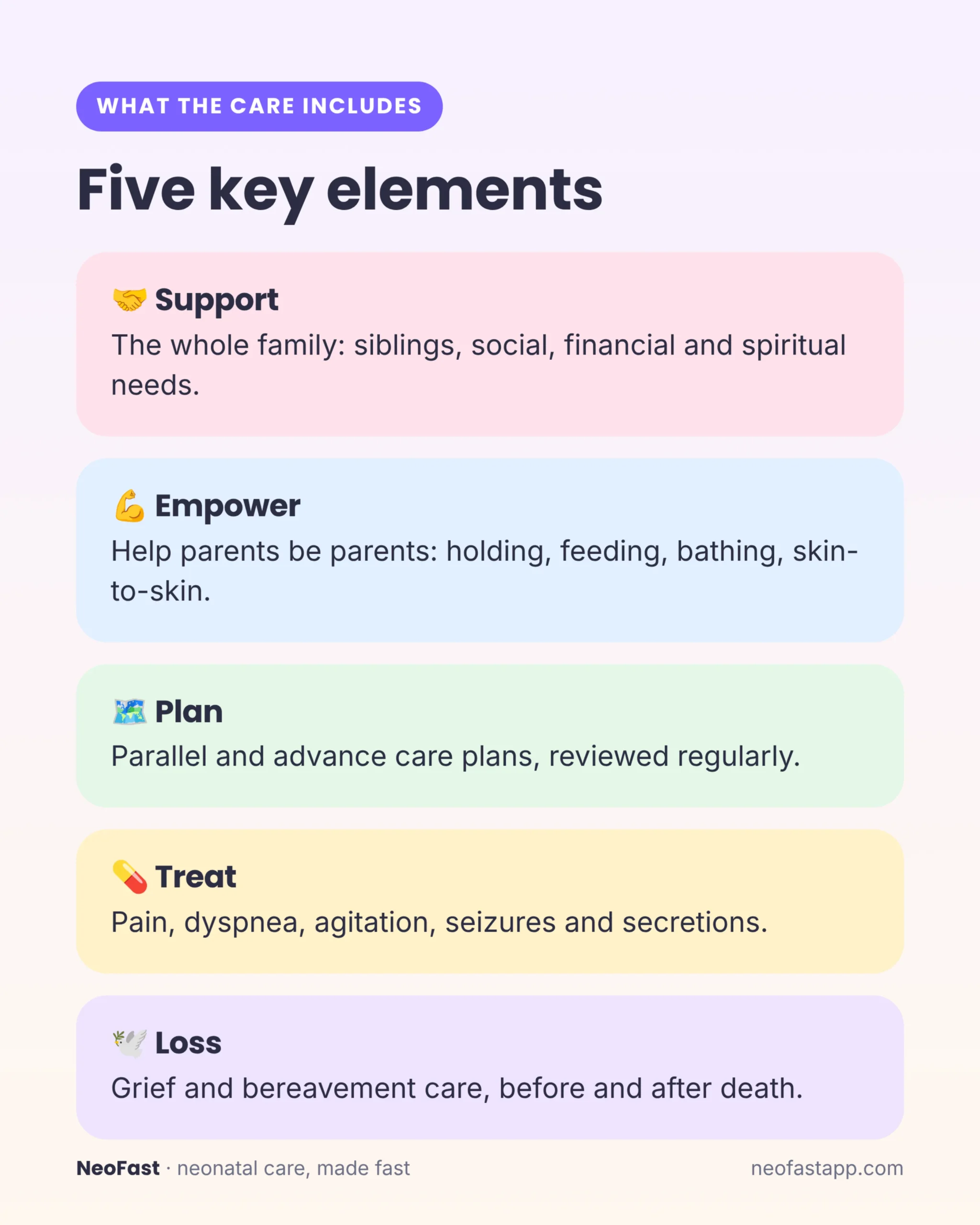
Five key elements
Five key elements
- 🤝 Support
The whole family: siblings, social, financial and spiritual needs.
- 💪 Empower
Help parents be parents: holding, feeding, bathing, skin-to-skin.
- 🗺️ Plan
Parallel and advance care plans, reviewed regularly.
- 💊 Treat
Pain, dyspnea, agitation, seizures and secretions.
- 🕊️ Loss
Grief and bereavement care, before and after death.
Symptom management
COMFORT FIRST
Symptom management
Start without drugs
Skin-to-skin, swaddling, holding, non-nutritive sucking, breast milk scent, massage and a calm environment.
Opioids are the mainstay
Morphine and fentanyl are the most used in the NICU. Adjuncts such as dexmedetomidine, benzodiazepines or gabapentin may help selected babies.
Adequate pain control does not hasten death
When the intent is to relieve suffering, the principle of double effect supports treatment.
Less is more
Avoid routine labs and procedures that add no comfort.
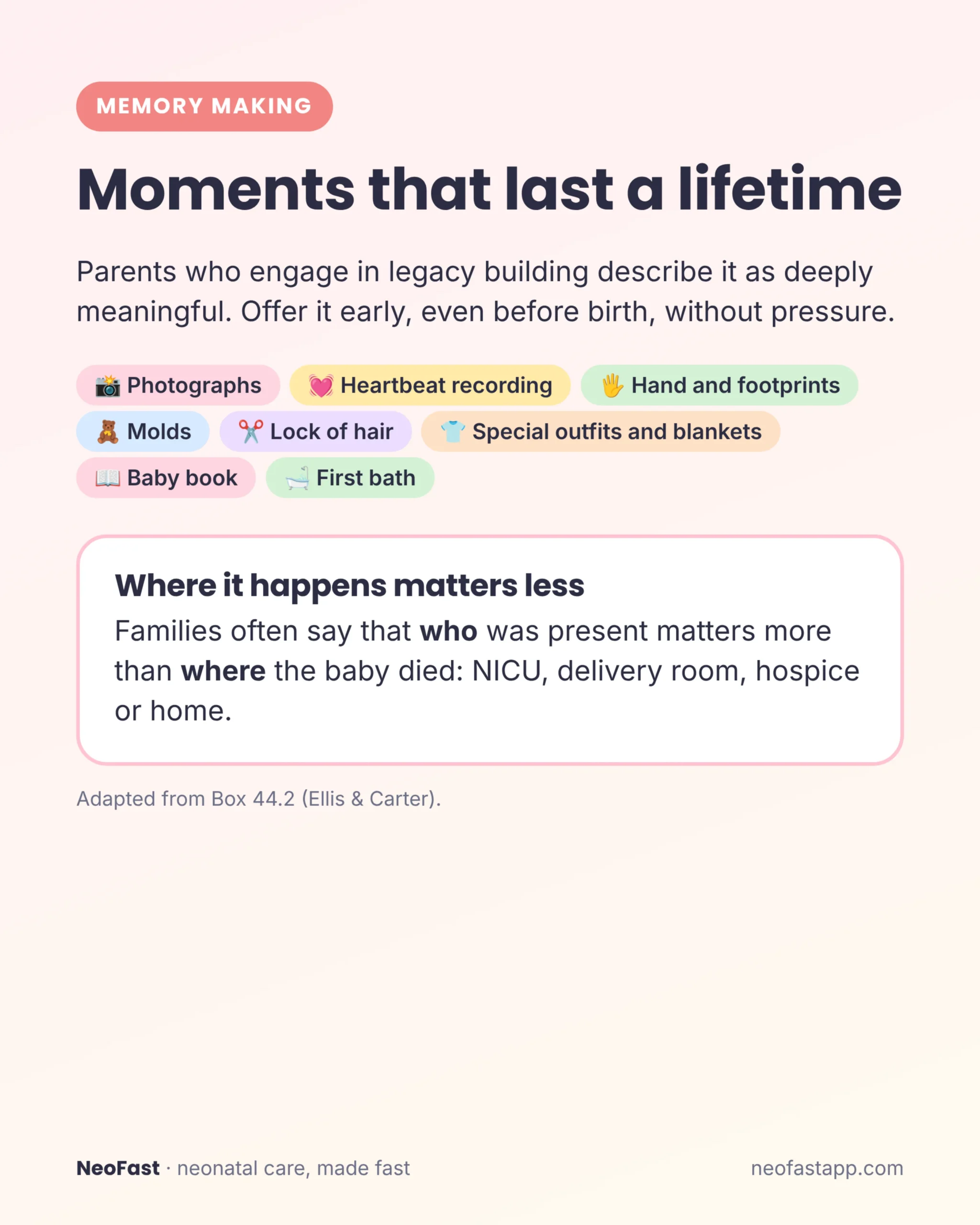
Moments that last a lifetime
MEMORY MAKING
Moments that last a lifetime
Parents who engage in legacy building describe it as deeply meaningful. Offer it early, even before birth, without pressure.
- 📸 Photographs
- 💗 Heartbeat recording
- 🖐️ Hand and footprints
- 🧸 Molds
- ✂️ Lock of hair
- 👕 Special outfits and blankets
- 📖 Baby book
- 🛁 First bath
Where it happens matters less
Families often say that who was present matters more than where the baby died: NICU, delivery room, hospice or home.
Adapted from Box 44.2 (Ellis & Carter).
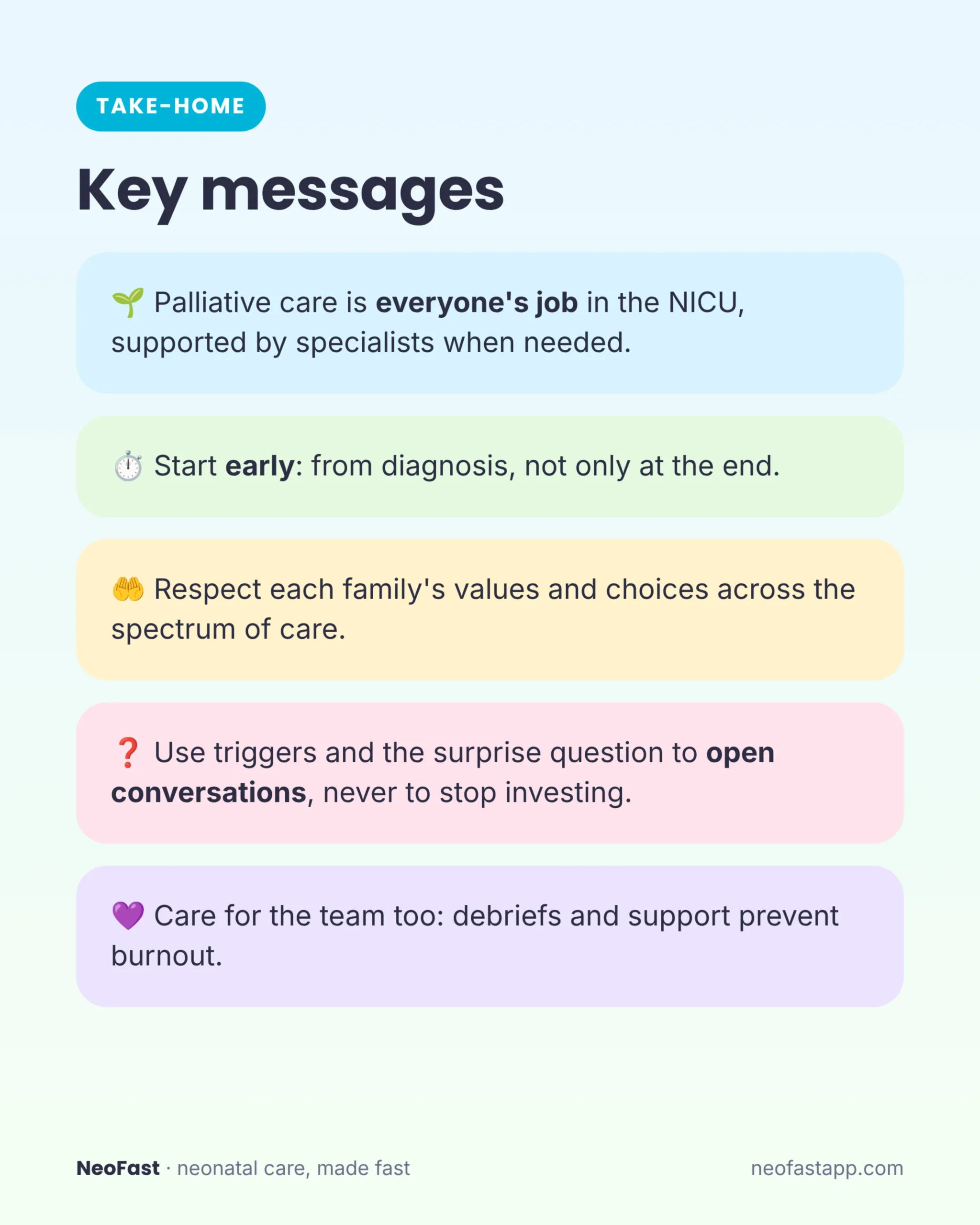
Key messages
TAKE-HOME
Key messages
- 🌱 Palliative care is everyone’s job in the NICU, supported by specialists when needed.
- ⏱️ Start early: from diagnosis, not only at the end.
- 🙌 Respect each family’s values and choices across the spectrum of care.
- ❓ Use triggers and the surprise question to open conversations, never to stop investing.
- 💜 Care for the team too: debriefs and support prevent burnout.
NEOFAST
Neonatal care, made fast.
Calculators and clinical tools built for the NICU, based on the literature.
🌐 Website
neofastapp.com
✈️ Telegram
t.me/neofastapp
Save this post and share it with your team 🤍
Frequently asked questions
What is the surprise question in neonatal palliative care and when is it most predictive?
The surprise question is “Would you be surprised if this baby died?” A 2025 NICU study found it has a consistently high negative predictive value, with the best positive predictive value at day 7 of life. It should be used to start conversations about a palliative approach, not to predict death.
Does starting palliative care mean stopping intensive care?
No. Perinatal palliative care can coexist with full intensive care; families can receive palliative support while survival-focused treatment continues. It does not mean giving up, but planning for life while preparing for the possibility of death.
Which babies should prompt a palliative care consult?
Three groups: extremely preterm infants at the limit of viability with risk of severe IVH, pulmonary hemorrhage or NEC; babies with life-limiting diagnoses such as trisomy 13 or 18, severe HIE, HLHS, SMA type 1, or severe pulmonary hypoplasia; and long-suffering NICU patients who plateau despite good intensive care where burdens seem to outweigh benefits.
What drugs are used for symptom management in neonatal palliative care?
Morphine and fentanyl are the most used opioids in the NICU as the mainstay of symptom management. Adjuncts such as dexmedetomidine, benzodiazepines or gabapentin may help selected babies. Non-drug measures like skin-to-skin, swaddling, holding, non-nutritive sucking, breast milk scent, massage and a calm environment should be tried first.
What are the key elements of a neonatal palliative care plan?
Five key elements: support the whole family (siblings, social, financial, spiritual needs); empower parents to be parents (holding, feeding, bathing, skin-to-skin); plan parallel and advance care plans reviewed regularly; treat pain, dyspnea, agitation, seizures and secretions; and provide grief and bereavement care before and after death.