Key takeaways
- The golden rule for PIP Limit (Pmax) in Volume Guarantee is Working PIP + 5 cmH2O, e.g., if working PIP is 18 cmH2O, set the PIP Limit to 23 cmH2O.
- SIPPV+VG supports 100% of spontaneous breaths with a full target volume, reducing work of breathing and preventing muscle fatigue seen in SIMV.
- During Volume Guarantee weaning, target tidal volume must be maintained at 4.0-6.0 mL/kg; lowering it below physiological levels increases work of breathing and causes atelectasis.
- In the bedside case, an ETT secretion plug caused pressure truncation at the 23 cmH2O PIP limit, dropping delivered Vt from a 4.5 mL target to 3.1 mL, triggering Low Volume and Low Vt alarms until suctioning restored normal ventilation.
- Setting the PIP Limit too high (e.g., an arbitrary 35-40 cmH2O default) removes the barotrauma safety ceiling and increases risk of pneumothorax and pulmonary interstitial emphysema (PIE).
References
- Goldsmith’s Assisted Ventilation of the Neonate: An Evidence-Based Approach to Newborn Respiratory Care (7th Edition, 2022). Editors: Martin Keszler & K. Suresh Gautham.
SIPPV indication and use in the Neonatal Unit – Targeted Ventilation
Synchronized Intermittent Positive Pressure Ventilation (SIPPV)+VG vs. SIMV, PIP Limit Adjustment, Weaning Protocols & Bedside Case Study
Bibliographic References
1. Goldsmith’s Assisted Ventilation of the Neonate: An Evidence-Based Approach to Newborn Respiratory Care (7th Edition, 2022). Editors: Martin Keszler & K. Suresh Gautham.
Advantages of SIPPV+VG (A/C+VG) Over Conventional SIMV
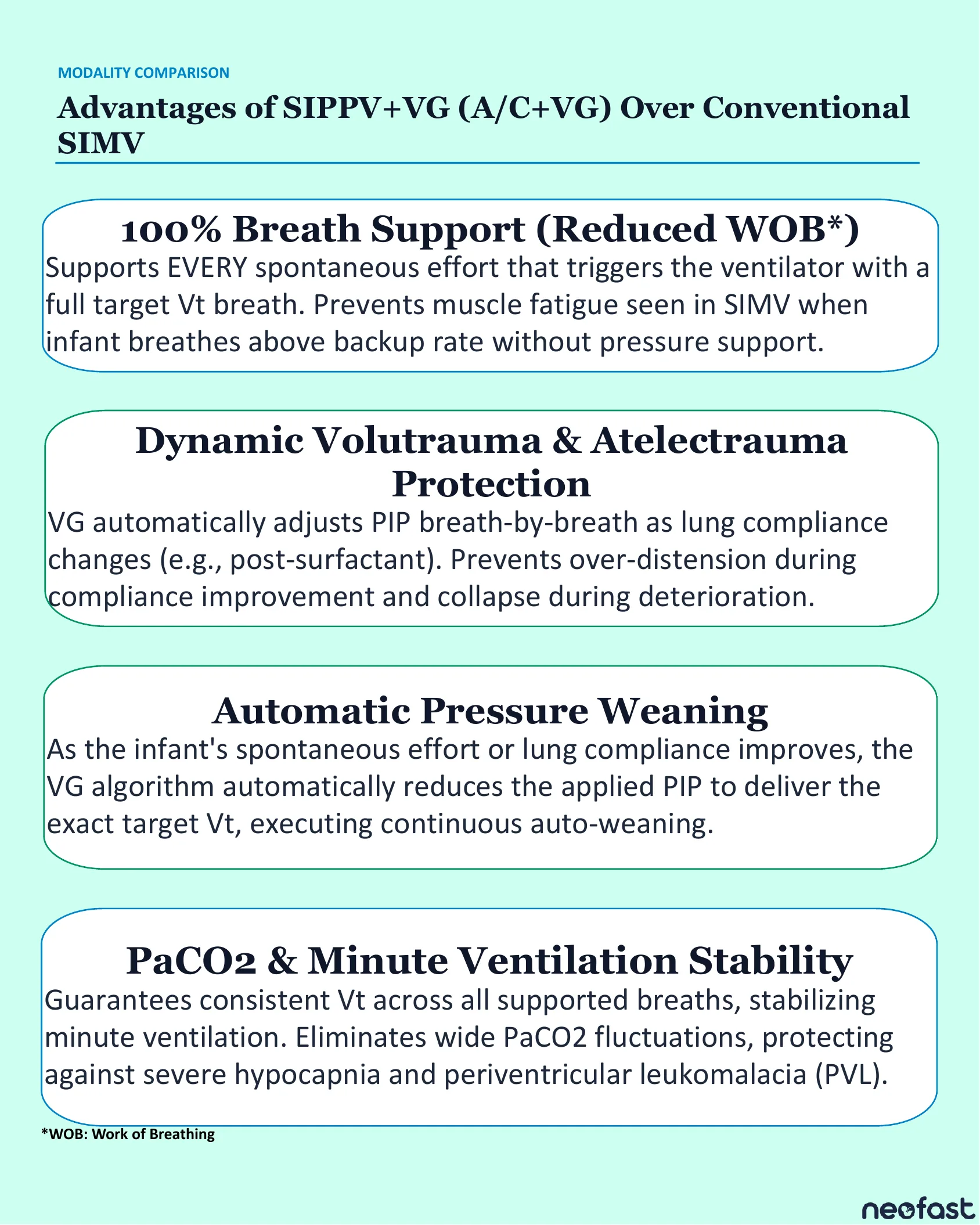
100% Breath Support (Reduced WOB*)
Supports EVERY spontaneous effort that triggers the ventilator with a full target Vt breath. Prevents muscle fatigue seen in SIMV when infant breathes above backup rate without pressure support.
Dynamic Volutrauma & Atelectrauma Protection
VG automatically adjusts PIP breath-by-breath as lung compliance changes (e.g., post-surfactant). Prevents over-distension during compliance improvement and collapse during deterioration.
Automatic Pressure Weaning
As the infant’s spontaneous effort or lung compliance improves, the VG algorithm automatically reduces the applied PIP to deliver the exact target Vt, executing continuous auto-weaning.
PaCO2 & Minute Ventilation Stability
Guarantees consistent Vt across all supported breaths, stabilizing minute ventilation. Eliminates wide PaCO2 fluctuations, protecting against severe hypocapnia and periventricular leukomalacia (PVL).
*WOB: Work of Breathing
Setting and Adjusting the PIP Limit (Pmax) in VG
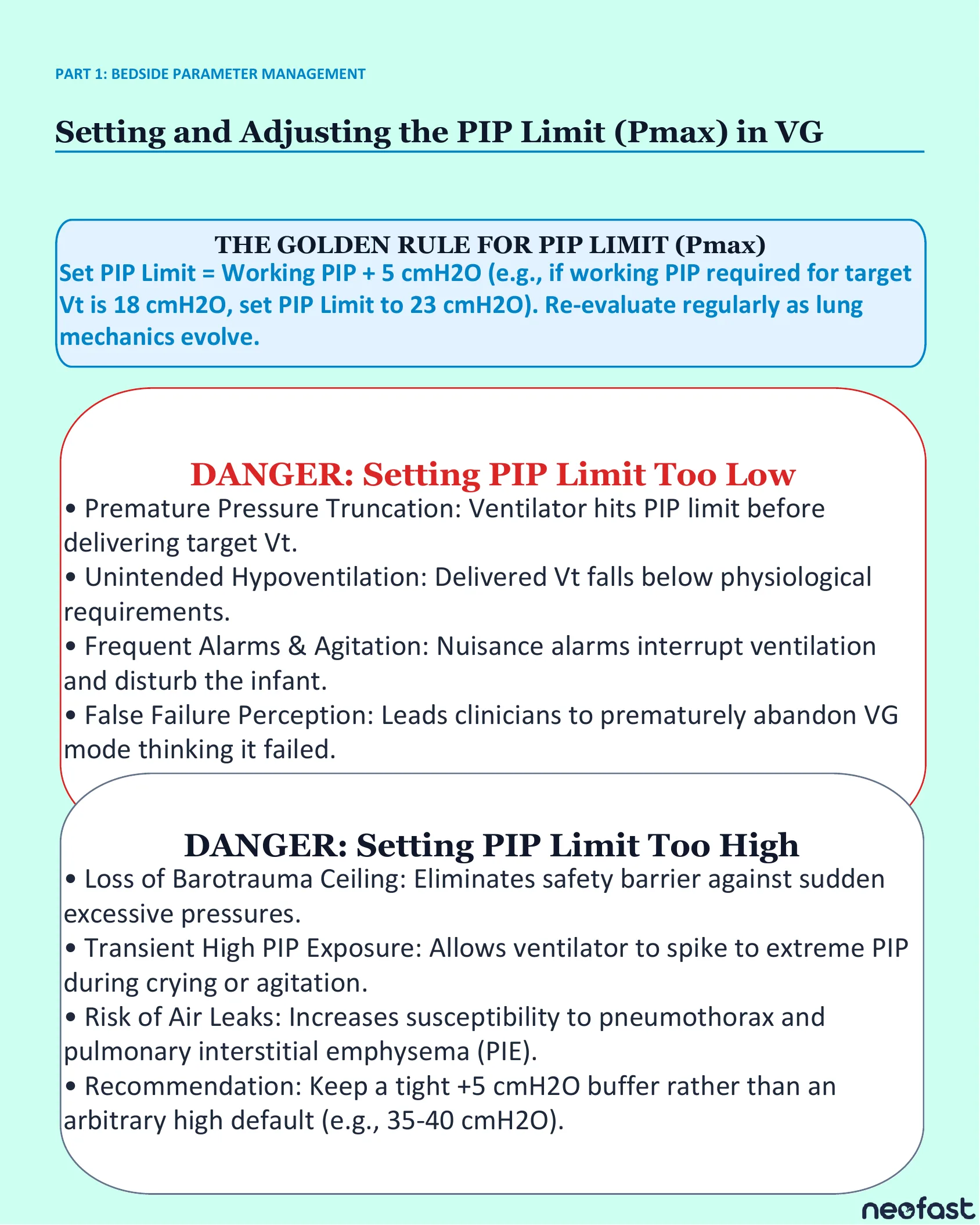
The Golden Rule for PIP Limit (Pmax)
Set PIP Limit = Working PIP + 5 cmH2O (e.g., if working PIP required for target Vt is 18 cmH2O, set PIP Limit to 23 cmH2O). Re-evaluate regularly as lung mechanics evolve.
Danger: Setting PIP Limit Too Low
- Premature Pressure Truncation: Ventilator hits PIP limit before delivering target Vt.
- Unintended Hypoventilation: Delivered Vt falls below physiological requirements.
- Frequent Alarms & Agitation: Nuisance alarms interrupt ventilation and disturb the infant.
- False Failure Perception: Leads clinicians to prematurely abandon VG mode thinking it failed.
Danger: Setting PIP Limit Too High
- Loss of Barotrauma Ceiling: Eliminates safety barrier against sudden excessive pressures.
- Transient High PIP Exposure: Allows ventilator to spike to extreme PIP during crying or agitation.
- Risk of Air Leaks: Increases susceptibility to pneumothorax and pulmonary interstitial emphysema (PIE).
- Recommendation: Keep a tight +5 cmH2O buffer rather than an arbitrary high default (e.g., 35-40 cmH2O).
Bedside Clinical Case: Managing PIP Limit & Secretion Plug in RDS
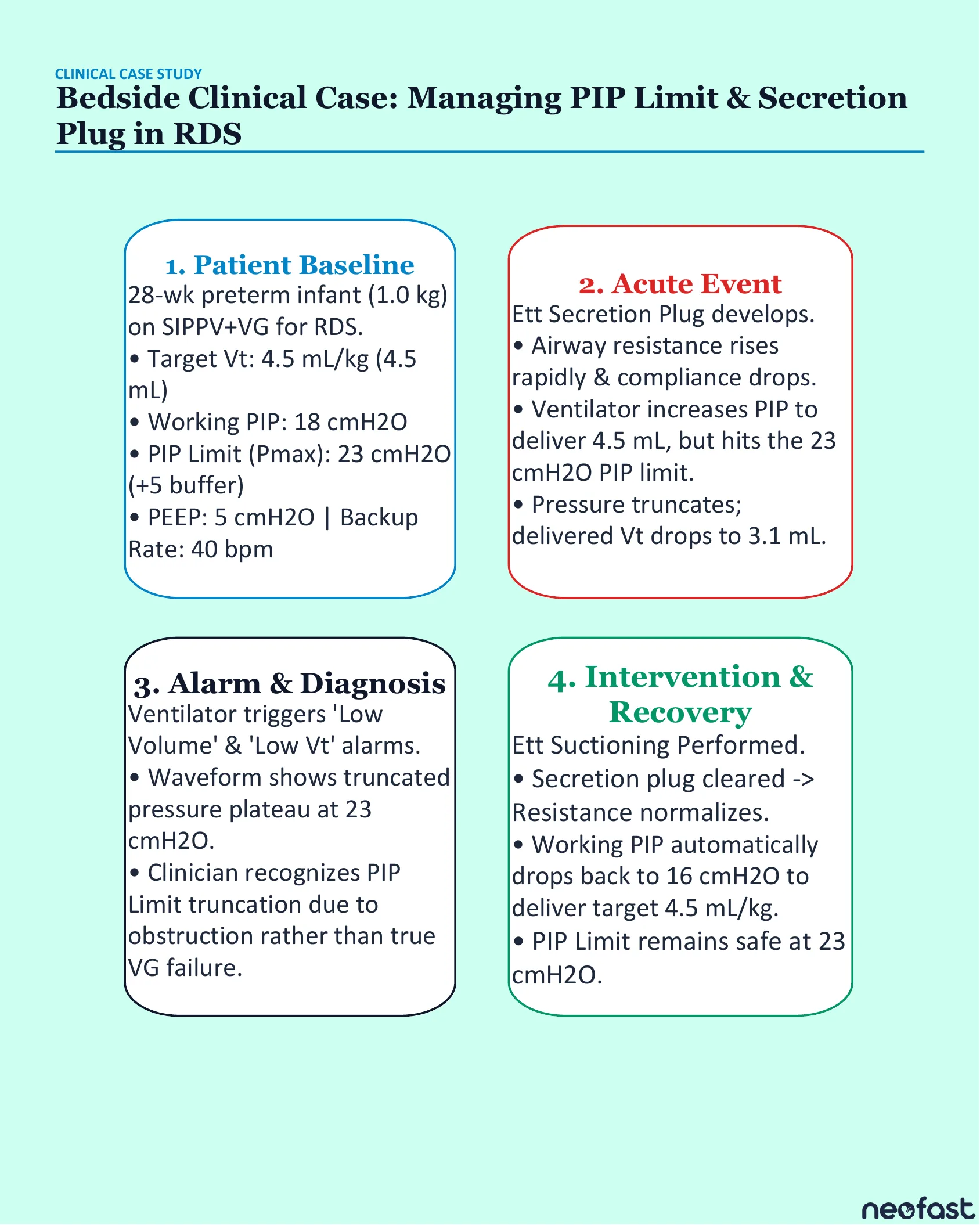
1. Patient Baseline
28-wk preterm infant (1.0 kg) on SIPPV+VG for RDS.
- Target Vt: 4.5 mL/kg (4.5 mL)
- Working PIP: 18 cmH2O
- PIP Limit (Pmax): 23 cmH2O (+5 buffer)
- PEEP: 5 cmH2O | Backup Rate: 40 bpm
2. Acute Event
ETT Secretion Plug develops.
- Airway resistance rises rapidly & compliance drops.
- Ventilator increases PIP to deliver 4.5 mL, but hits the 23 cmH2O PIP limit.
- Pressure truncates; delivered Vt drops to 3.1 mL.
3. Alarm & Diagnosis
Ventilator triggers ‘Low Volume’ & ‘Low Vt’ alarms.
- Waveform shows truncated pressure plateau at 23 cmH2O.
- Clinician recognizes PIP Limit truncation due to obstruction rather than true VG failure.
4. Intervention & Recovery
ETT Suctioning Performed.
- Secretion plug cleared -> Resistance normalizes.
- Working PIP automatically drops back to 16 cmH2O to deliver target 4.5 mL/kg.
- PIP Limit remains safe at 23 cmH2O.
Volume Guarantee Weaning Protocol & Extubation Criteria
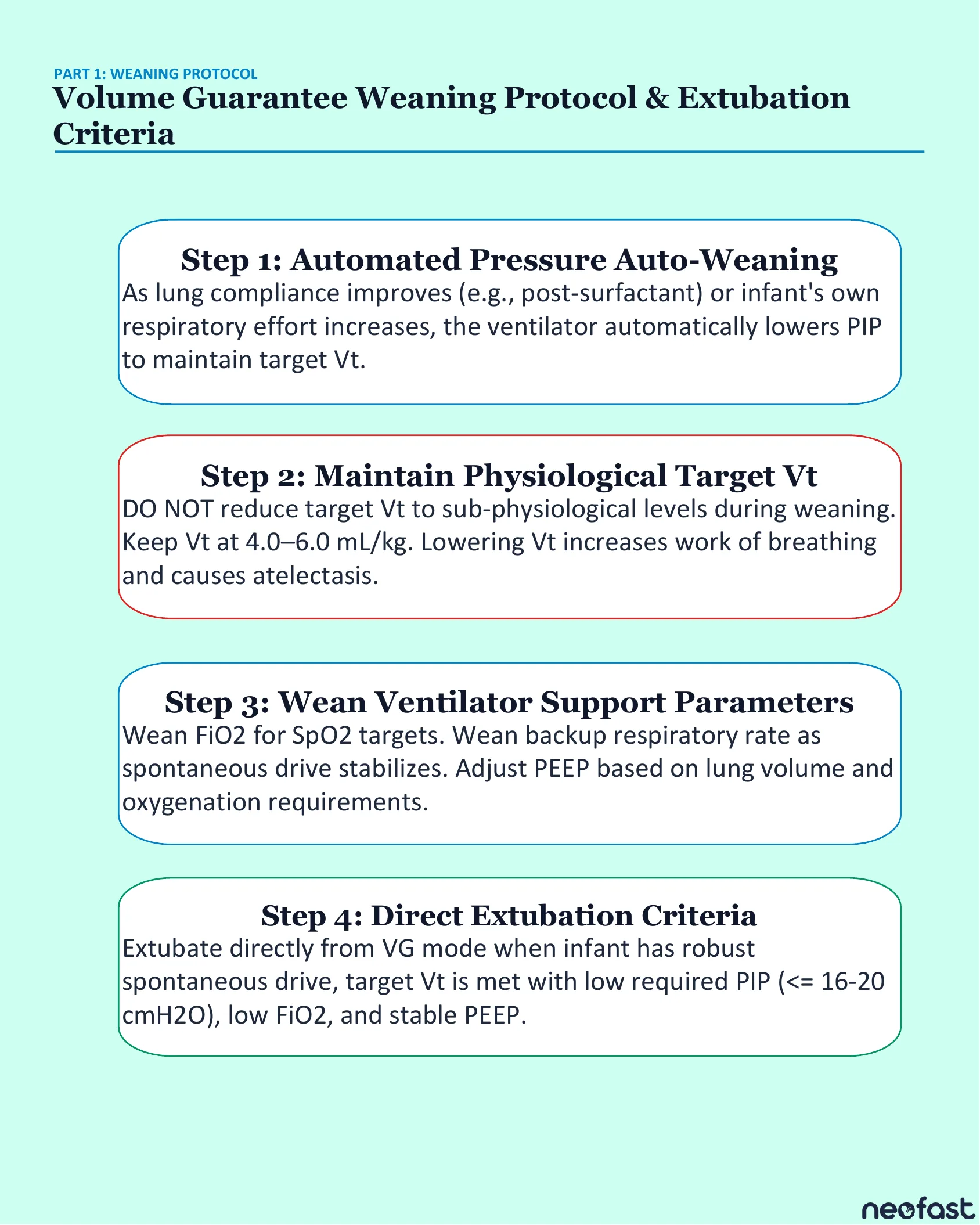
Step 1: Automated Pressure Auto-Weaning
As lung compliance improves (e.g., post-surfactant) or infant’s own respiratory effort increases, the ventilator automatically lowers PIP to maintain target Vt.
Step 2: Maintain Physiological Target Vt
DO NOT reduce target Vt to sub-physiological levels during weaning. Keep Vt at 4.0–6.0 mL/kg. Lowering Vt increases work of breathing and causes atelectasis.
Step 3: Wean Ventilator Support Parameters
Wean FiO2 for SpO2 targets. Wean backup respiratory rate as spontaneous drive stabilizes. Adjust PEEP based on lung volume and oxygenation requirements.
Step 4: Direct Extubation Criteria
Extubate directly from VG mode when infant has robust spontaneous drive, target Vt is met with low required PIP (<= 16-20 cmH2O), low FiO2, and stable PEEP.
Key Bedside Rules & Clinical Takeaways
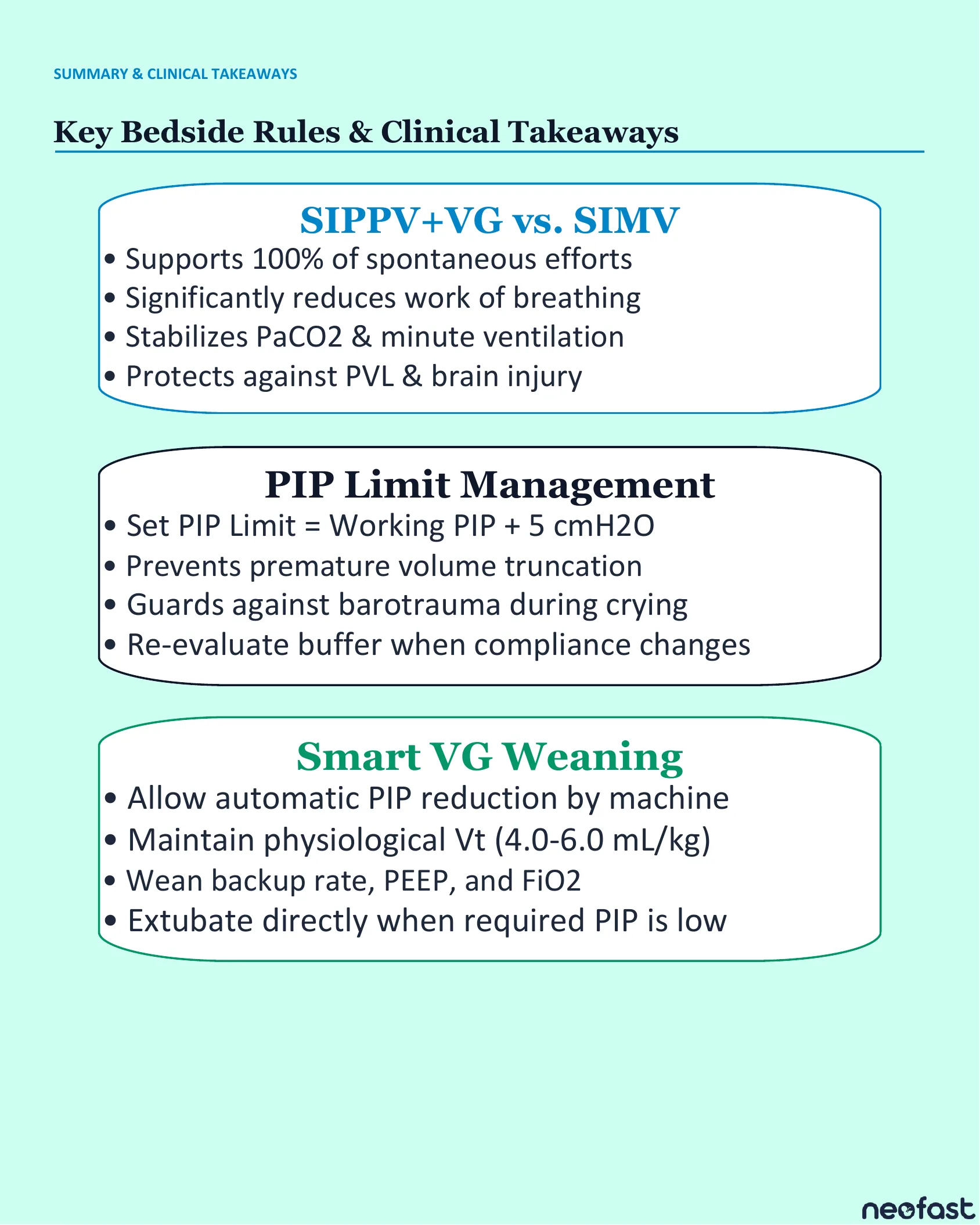
SIPPV+VG vs. SIMV
- Supports 100% of spontaneous efforts
- Significantly reduces work of breathing
- Stabilizes PaCO2 & minute ventilation
- Protects against PVL & brain injury
PIP Limit Management
- Set PIP Limit = Working PIP + 5 cmH2O
- Prevents premature volume truncation
- Guards against barotrauma during crying
- Re-evaluate buffer when compliance changes
Smart VG Weaning
- Allow automatic PIP reduction by machine
- Maintain physiological Vt (4.0-6.0 mL/kg)
- Wean backup rate, PEEP, and FiO2
- Extubate directly when required PIP is low

Intuitive, Smart & Secure.
NEONATAL TOOL
- Hidratação Venosa
- Medicação Contínua
- Medicamentos
- Intubação
- Outros cálculos e escores
- Procedimentos
- Monitorização respiratória e hemodinâmica
- Crescimento e Desenvolvimento
Get it on Google Play | Download on the App Store
Frequently asked questions
What is the recommended PIP Limit (Pmax) setting in Volume Guarantee ventilation?
Set the PIP Limit equal to the Working PIP plus 5 cmH2O (for example, if working PIP is 18 cmH2O, set PIP Limit to 23 cmH2O), and re-evaluate regularly as lung mechanics evolve.
Why is SIPPV+VG preferred over conventional SIMV?
SIPPV+VG supports 100% of spontaneous triggered breaths with a full target volume (reducing work of breathing), provides dynamic volutrauma/atelectrauma protection via breath-by-breath PIP adjustment, enables automatic pressure weaning, and stabilizes PaCO2 and minute ventilation to protect against PVL.
What happens if the PIP Limit is set too low in VG mode?
The ventilator hits the PIP limit before delivering the target Vt (premature pressure truncation), causing unintended hypoventilation, frequent nuisance alarms, and can lead clinicians to falsely conclude that VG mode has failed.
What target tidal volume should be maintained during VG weaning?
Maintain Vt at 4.0-6.0 mL/kg during weaning; do not reduce target Vt to sub-physiological levels, as this increases work of breathing and causes atelectasis.
How was a secretion plug identified in the bedside case study?
In a 28-week, 1.0 kg infant on SIPPV+VG (target Vt 4.5 mL/kg, working PIP 18 cmH2O, PIP limit 23 cmH2O), an ETT secretion plug raised resistance and dropped compliance, causing the ventilator to hit the 23 cmH2O PIP limit and truncate delivered Vt to 3.1 mL, triggering Low Volume/Low Vt alarms with a truncated pressure plateau waveform; suctioning cleared the plug and working PIP returned to 16 cmH2O.