Key takeaways
- The 2022 AAP revision slightly raised the treatment thresholds for both phototherapy and exchange transfusion because bilirubin neurotoxicity (Kernicterus) generally occurs at much higher levels than previously recommended.
- All infants greater than 35 weeks require a Transcutaneous (TcB) or Total Serum Bilirubin (TSB) measurement between 12–24 hours of life.
- Hemolysis is likely if the rate of rise of bilirubin exceeds 0.2 mg/dL per hour.
- The ‘Escalation of Care’ zone is triggered when TSB reaches 2 mg/dL below the exchange transfusion threshold, requiring direct NICU admission, intensive phototherapy, hydration, and STAT labs.
- Urgent exchange transfusion is required without waiting when TSB is ≥5 mg/dL above the exchange threshold graph line, when it is rising despite intensive phototherapy, or when clinical signs of Acute Bilirubin Encephalopathy (hypertonia, retrocollis, opisthotonos, high-pitched cry) are present.
References
- Klaus & Fanaroff Box 15.5 & 15.6
- AAP Clinical Practice Guideline Revision 2022
- Kemper AR, et al. Pediatrics 2022;150 (3)
- Bhutani VK, et al.; Guidelines for Acute Care of the Neonate, Edition 33, 2025-2026
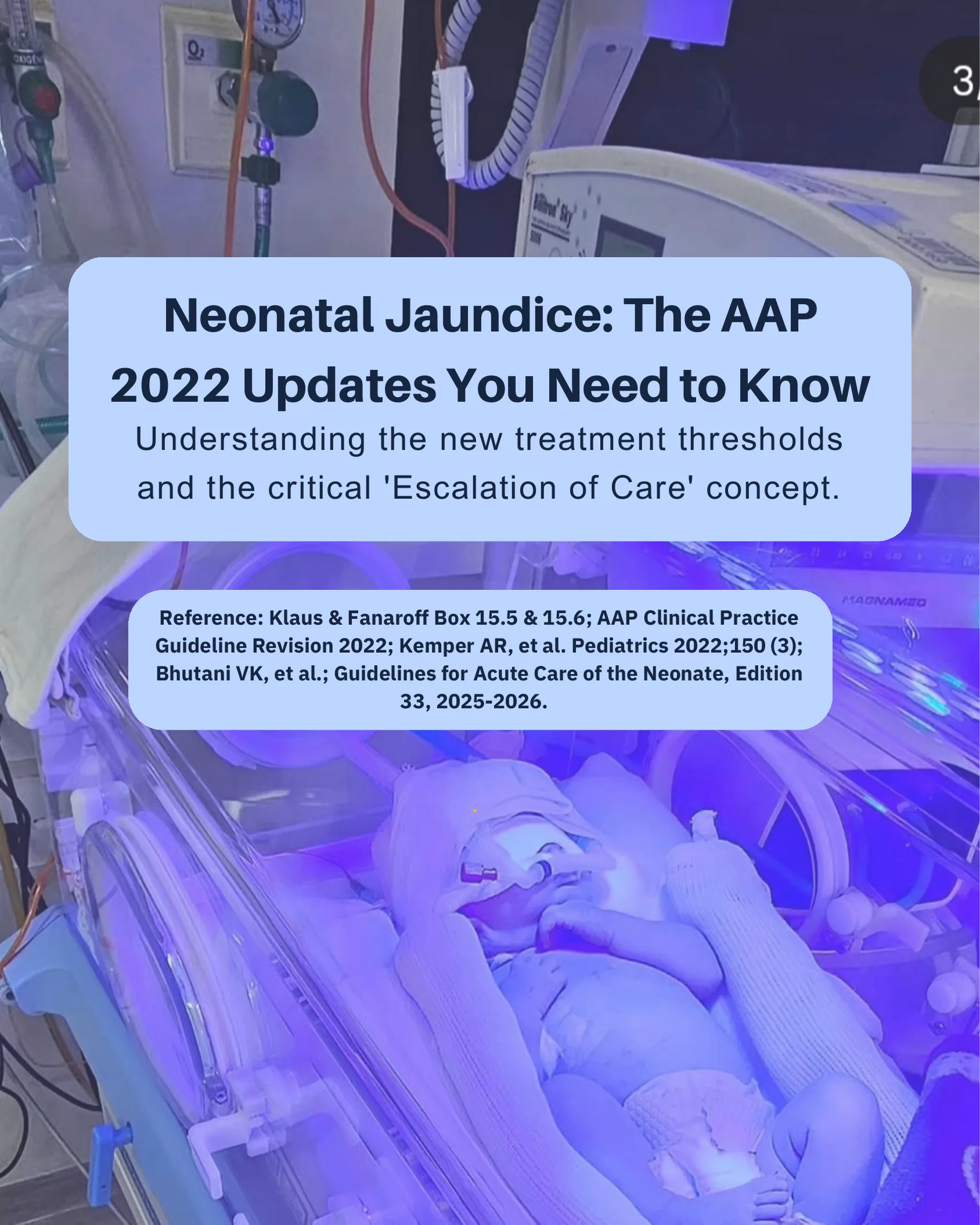
Neonatal Jaundice: The AAP 2022 Updates You Need to Know
Neonatal Jaundice: The AAP 2022 Updates You Need to Know
Understanding the new treatment thresholds and the critical ‘Escalation of Care’ concept.
Reference: Klaus & Fanaroff Box 15.5 & 15.6; AAP Clinical Practice Guideline Revision 2022; Kemper AR, et al. Pediatrics 2022;150 (3); Bhutani VK, et al.; Guidelines for Acute Care of the Neonate, Edition 33, 2025-2026.
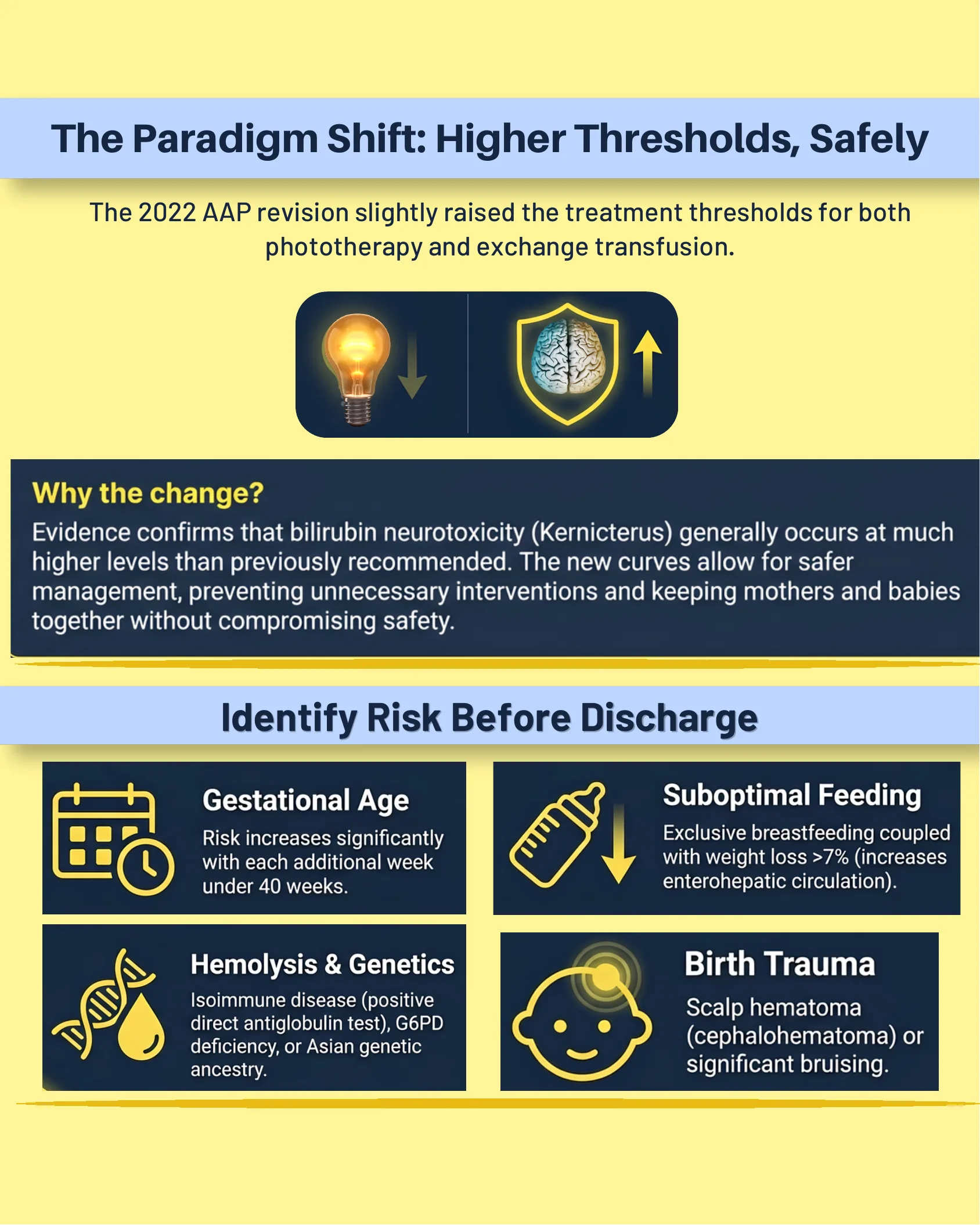
The Paradigm Shift: Higher Thresholds, Safely
The Paradigm Shift: Higher Thresholds, Safely
The 2022 AAP revision slightly raised the treatment thresholds for both phototherapy and exchange transfusion.
Why the change?
Evidence confirms that bilirubin neurotoxicity (Kernicterus) generally occurs at much higher levels than previously recommended. The new curves allow for safer management, preventing unnecessary interventions and keeping mothers and babies together without compromising safety.
Identify Risk Before Discharge
- Gestational Age: Risk increases significantly with each additional week under 40 weeks.
- Suboptimal Feeding: Exclusive breastfeeding coupled with weight loss >7% (increases enterohepatic circulation).
- Hemolysis & Genetics: Isoimmune disease (positive direct antiglobulin test), G6PD deficiency, or Asian genetic ancestry.
- Birth Trauma: Scalp hematoma (cephalohematoma) or significant bruising.
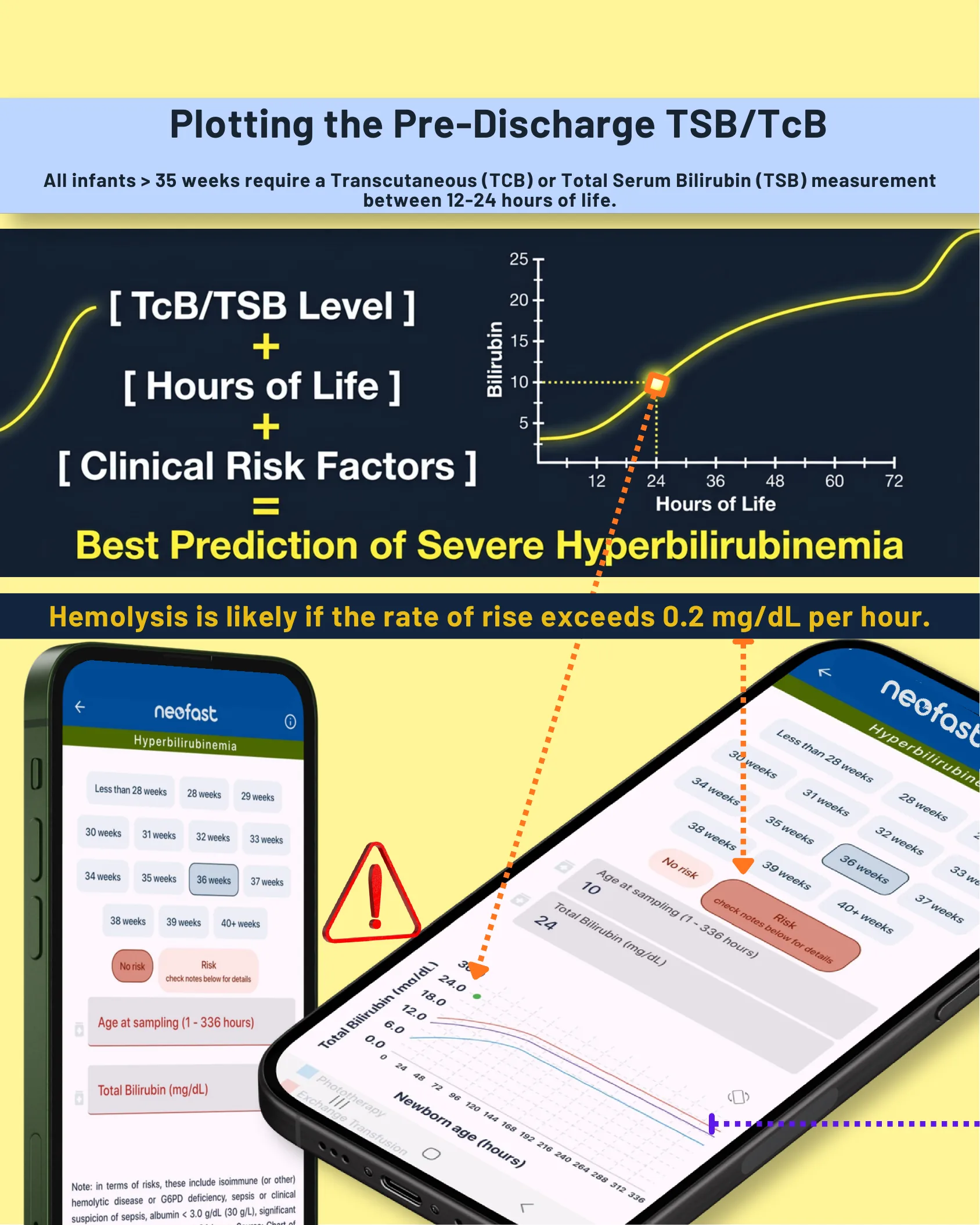
Plotting the Pre-Discharge TSB/TcB
Plotting the Pre-Discharge TSB/TcB
All infants > 35 weeks require a Transcutaneous (TCB) or Total Serum Bilirubin (TSB) measurement between 12–24 hours of life.
[ TcB/TSB Level ] + [ Hours of Life ] + [ Clinical Risk Factors ] = Best Prediction of Severe Hyperbilirubinemia
Hemolysis is likely if the rate of rise exceeds 0.2 mg/dL per hour.
- NeoFast app: Hyperbilirubinemia module with gestational age selectors (Less than 28 weeks through 40+ weeks)
- Risk classification: No risk / Risk (check notes below for details)
- Fields: Age at sampling (1–336 hours), Total Bilirubin (mg/dL)
- Note: in terms of risks, these include isoimmune (or other) hemolytic disease or G6PD deficiency, sepsis or clinical suspicion of sepsis, albumin < 3.0 g/dL (30 g/L), significant [bruising]
- Chart tracking: Total Bilirubin (mg/dL) vs Newborn age (hours), with Phototherapy and Exchange Transfusion threshold lines plotted from 0 to 336 hours
Entering the ‘Escalation of Care’ Zone
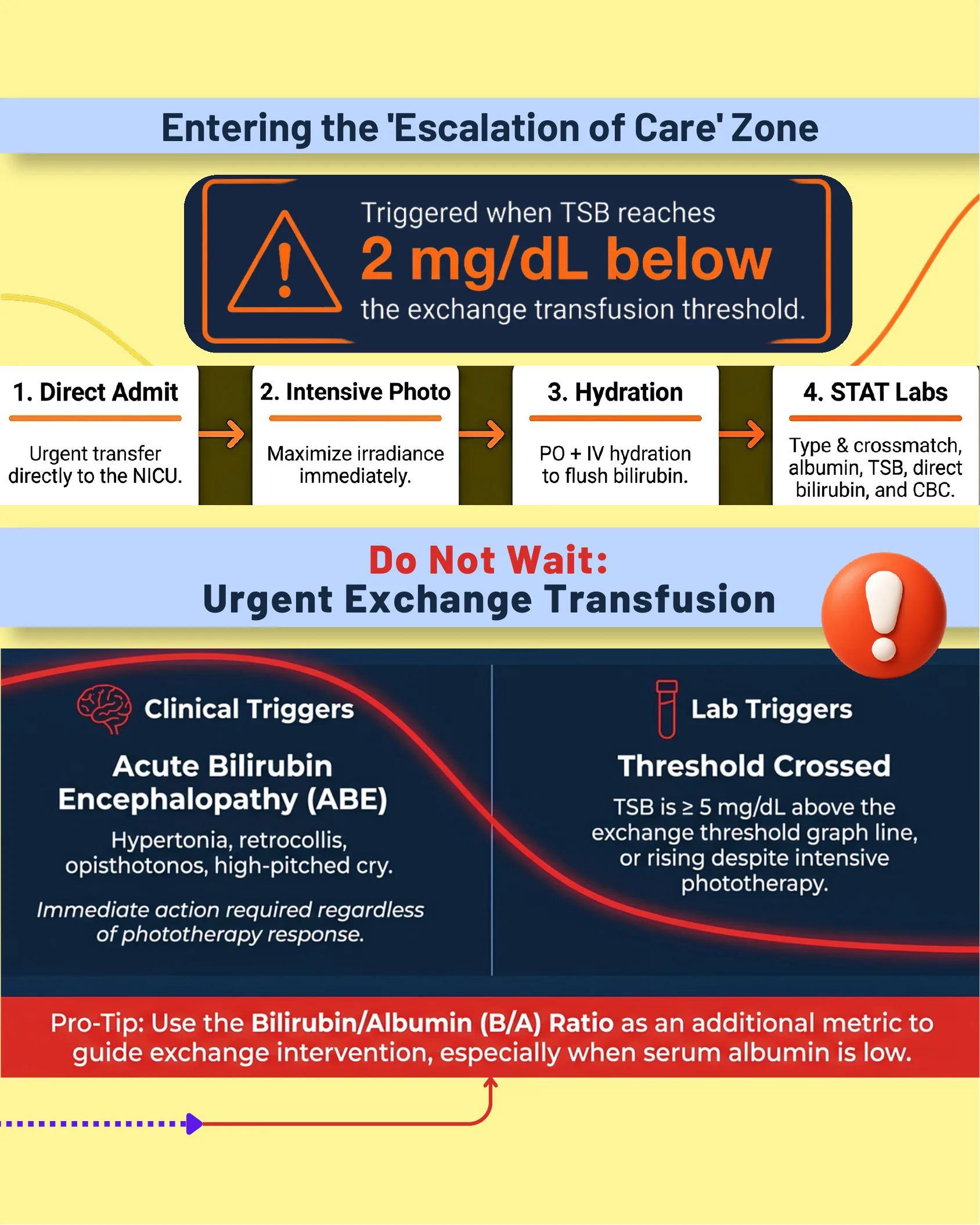
Entering the ‘Escalation of Care’ Zone
Triggered when TSB reaches 2 mg/dL below the exchange transfusion threshold.
- 1. Direct Admit: Urgent transfer directly to the NICU.
- 2. Intensive Photo: Maximize irradiance immediately.
- 3. Hydration: PO + IV hydration to flush bilirubin.
- 4. STAT Labs: Type & crossmatch, albumin, TSB, direct bilirubin, and CBC.
Do Not Wait: Urgent Exchange Transfusion
- Clinical Triggers – Acute Bilirubin Encephalopathy (ABE): Hypertonia, retrocollis, opisthotonos, high-pitched cry. Immediate action required regardless of phototherapy response.
- Lab Triggers – Threshold Crossed: TSB is ≥ 5 mg/dL above the exchange threshold graph line, or rising despite intensive phototherapy.
Pro-Tip: Use the Bilirubin/Albumin (B/A) Ratio as an additional metric to guide exchange intervention, especially when serum albumin is low.
The Outpatient Checklist
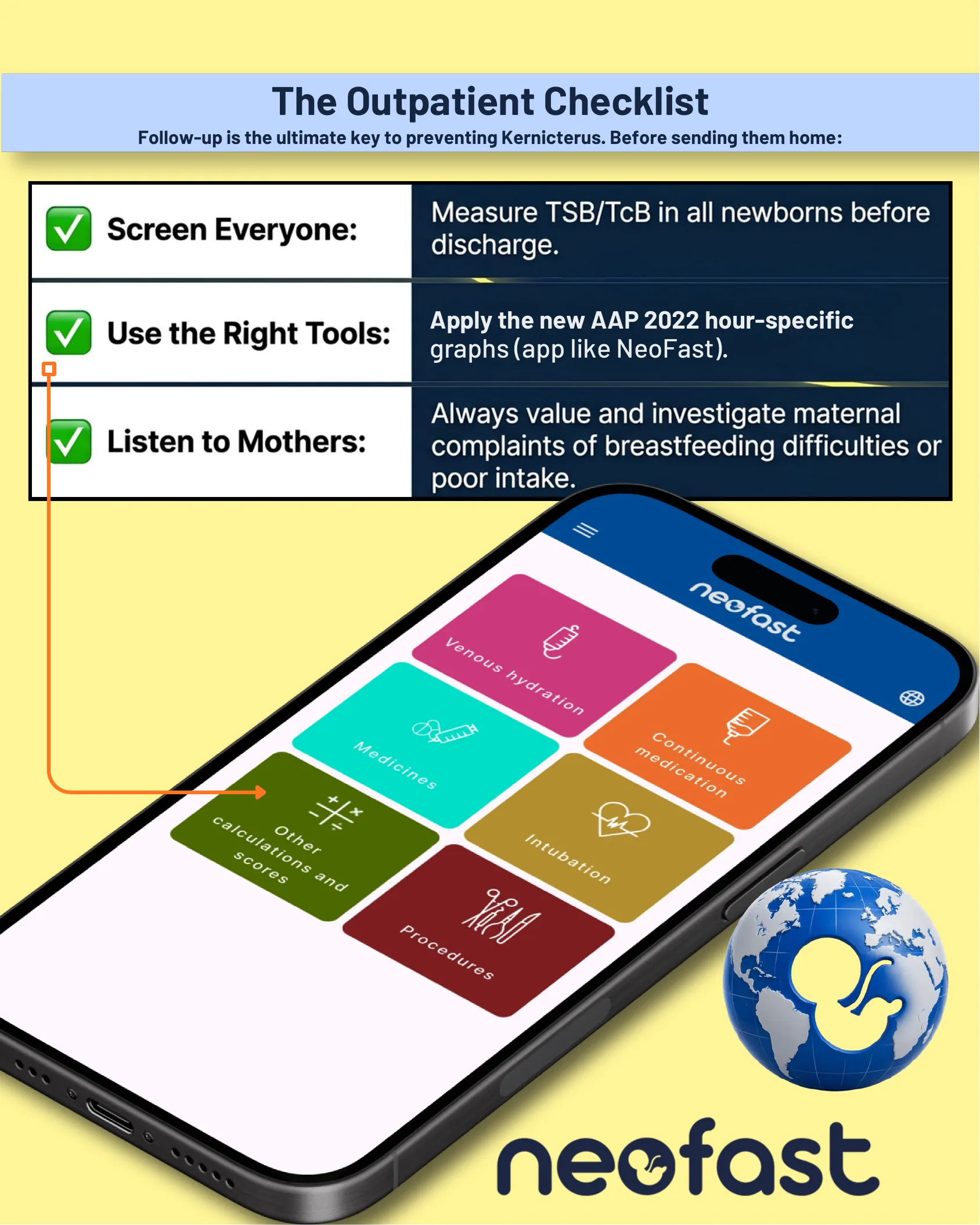
The Outpatient Checklist
Follow-up is the ultimate key to preventing Kernicterus. Before sending them home:
- Screen Everyone: Measure TSB/TcB in all newborns before discharge.
- Use the Right Tools: Apply the new AAP 2022 hour-specific graphs (app like NeoFast).
- Listen to Mothers: Always value and investigate maternal complaints of breastfeeding difficulties or poor intake.
NeoFast app menu options: Venous hydration, Medicines, Continuous medication, Other calculations and scores, Intubation, Procedures.
Frequently asked questions
Why did the AAP raise the bilirubin treatment thresholds in the 2022 guideline revision?
Evidence confirms that bilirubin neurotoxicity (Kernicterus) generally occurs at much higher levels than previously recommended, so the new curves allow for safer management, preventing unnecessary interventions and keeping mothers and babies together without compromising safety.
When should the pre-discharge TSB/TcB be measured in newborns?
All infants greater than 35 weeks require a Transcutaneous (TcB) or Total Serum Bilirubin (TSB) measurement between 12–24 hours of life.
What rate of bilirubin rise suggests hemolysis in a newborn?
Hemolysis is likely if the rate of rise exceeds 0.2 mg/dL per hour.
What defines the ‘Escalation of Care’ zone in neonatal hyperbilirubinemia management?
It is triggered when TSB reaches 2 mg/dL below the exchange transfusion threshold, requiring direct admission to the NICU, maximizing irradiance with intensive phototherapy, PO plus IV hydration to flush bilirubin, and STAT labs (type & crossmatch, albumin, TSB, direct bilirubin, and CBC).
What are the triggers for urgent exchange transfusion without delay?
Clinical triggers include signs of Acute Bilirubin Encephalopathy (hypertonia, retrocollis, opisthotonos, high-pitched cry), requiring immediate action regardless of phototherapy response. Lab triggers include TSB ≥5 mg/dL above the exchange threshold graph line, or TSB rising despite intensive phototherapy; the Bilirubin/Albumin (B/A) Ratio can be used as an additional metric, especially when serum albumin is low.
What risk factors should be identified before discharging a newborn to prevent severe hyperbilirubinemia?
Key risk factors include gestational age (risk increases significantly with each additional week under 40 weeks), suboptimal feeding (exclusive breastfeeding coupled with weight loss >7%, which increases enterohepatic circulation), hemolysis and genetics (isoimmune disease with positive direct antiglobulin test, G6PD deficiency, or Asian genetic ancestry), and birth trauma (scalp hematoma/cephalohematoma or significant bruising).