Key takeaways
- Fentanyl is roughly 100 times more potent than morphine, so 0.1 mg of fentanyl is equivalent to 10 mg of morphine.
- About 4% of neonates receiving fentanyl doses of 2.2–6.5 mcg/kg/dose developed chest wall rigidity, sometimes with laryngospasm, though rigidity has been reported even at 1 mcg/kg.
- Chest wall rigidity presents as a rigid chest and abdomen with little or no chest rise despite bag ventilation, falling SpO2, and sometimes bradycardia.
- Naloxone 0.1 mg/kg/dose IV (suggested range 0.05–0.2 mg/kg/dose) reverses fentanyl-induced chest wall rigidity and can be repeated every 2–3 minutes if needed.
- Prevention relies on giving fentanyl slowly with a flush and having the naloxone dose ready before starting the infusion.
References
- Fentanyl. In: Lexicomp. Wolters Kluwer Clinical Drug Information; 2024.
- Fentanyl. In: Micromedex. Truven Health Analytics; 2022.
- Taketomo CK, Hodding JH, Kraus DM. Pediatric & Neonatal Dosage Handbook. 30th ed. APhA-Lexicomp; 2023.
- Fahnenstich H, Steffan J, Kau N, Bartmann P. Fentanyl-induced chest wall rigidity and laryngospasm in preterm and term infants. Crit Care Med. 2000;28:836–9.
- Gaertner VD, et al. Intrapulmonary tidal volumes in a preterm infant with chest wall rigidity. Front Pediatr. 2022;10:979763.
- Allen KA. Premedication for neonatal intubation: what medications are recommended and why? Adv Neonatal Care. 2012.
Fentanyl and the “wooden chest”
NEONATAL PHARMACOLOGY
Fentanyl and the “wooden chest”
Chest wall rigidity: how to recognize it, how to reverse it, and how to reach the antagonist in one tap.
Fentanyl at a glance
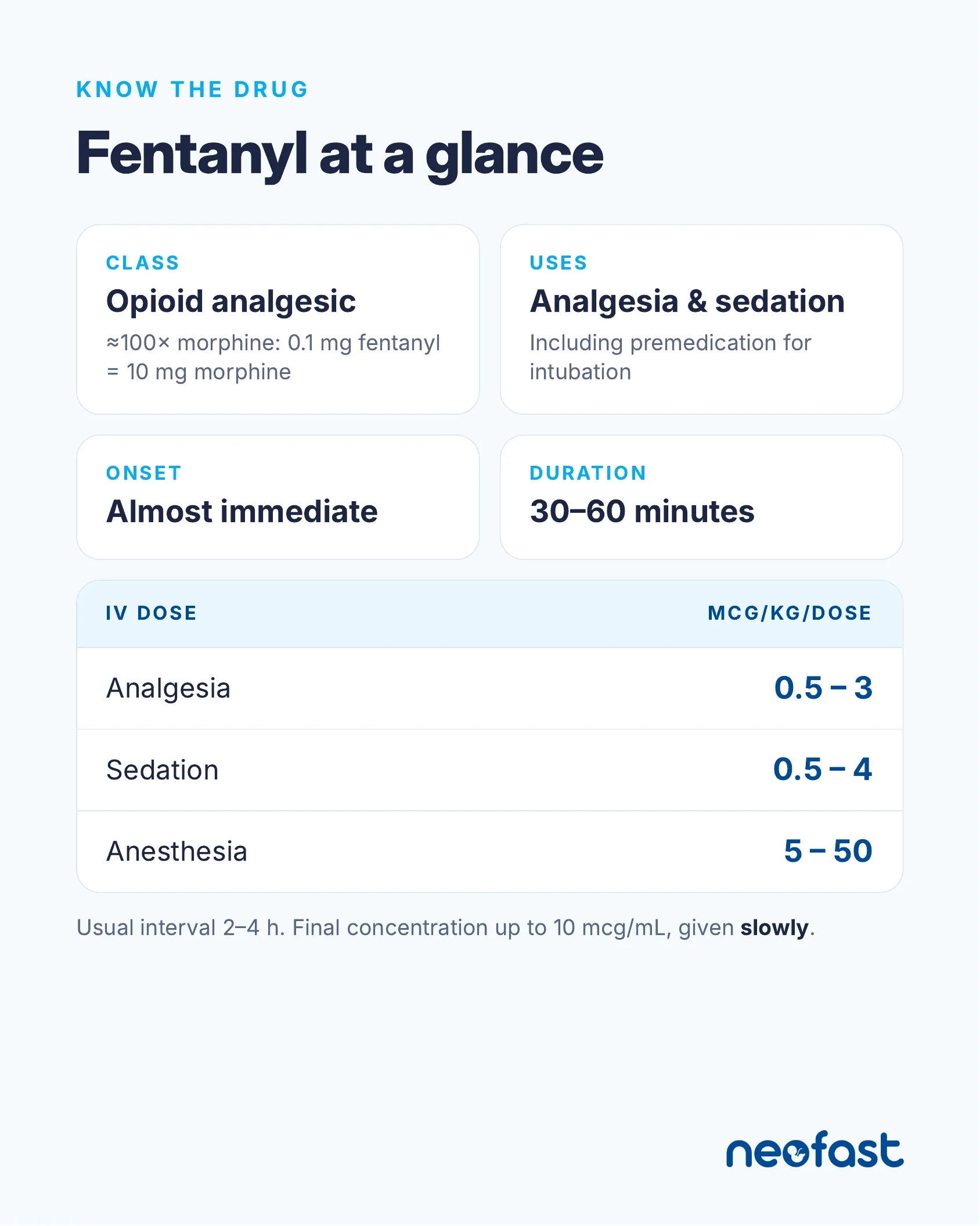
Know the drug
Fentanyl at a glance
Class: Opioid analgesic — ≈100× morphine: 0.1 mg fentanyl = 10 mg morphine
Uses: Analgesia & sedation, including premedication for intubation
Onset: Almost immediate
Duration: 30–60 minutes
| IV Dose | mcg/kg/dose |
|---|---|
| Analgesia | 0.5 – 3 |
| Sedation | 0.5 – 4 |
| Anesthesia | 5 – 50 |
Usual interval 2–4 h. Final concentration up to 10 mcg/mL, given slowly.
Adverse effects
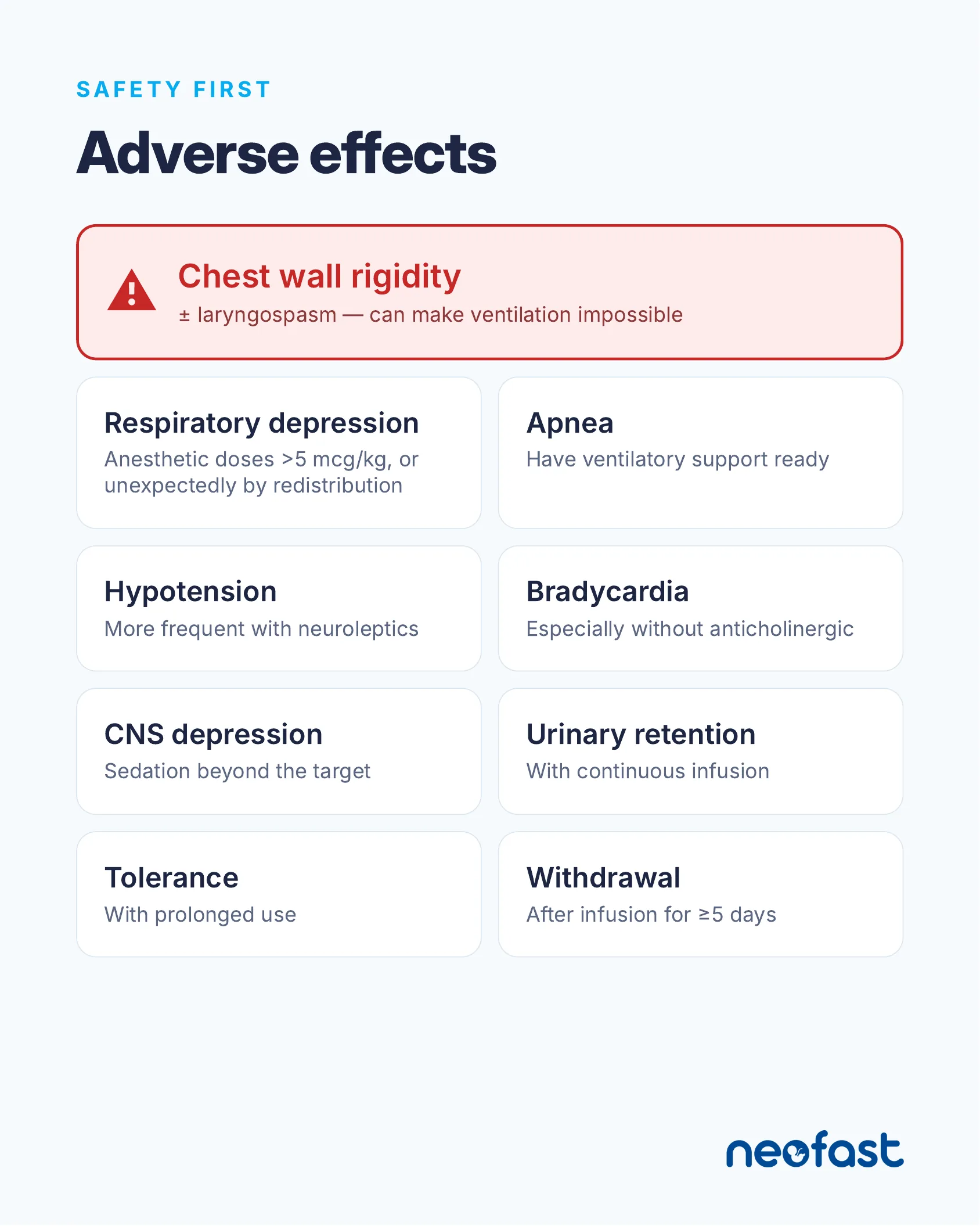
Safety first
Adverse effects
⚠ Chest wall rigidity — ± laryngospasm — can make ventilation impossible
- Respiratory depression: Anesthetic doses >5 mcg/kg, or unexpectedly by redistribution
- Apnea: Have ventilatory support ready
- Hypotension: More frequent with neuroleptics
- Bradycardia: Especially without anticholinergic
- CNS depression: Sedation beyond the target
- Urinary retention: With continuous infusion
- Tolerance: With prolonged use
- Withdrawal: After infusion for ≥5 days
Chest wall rigidity
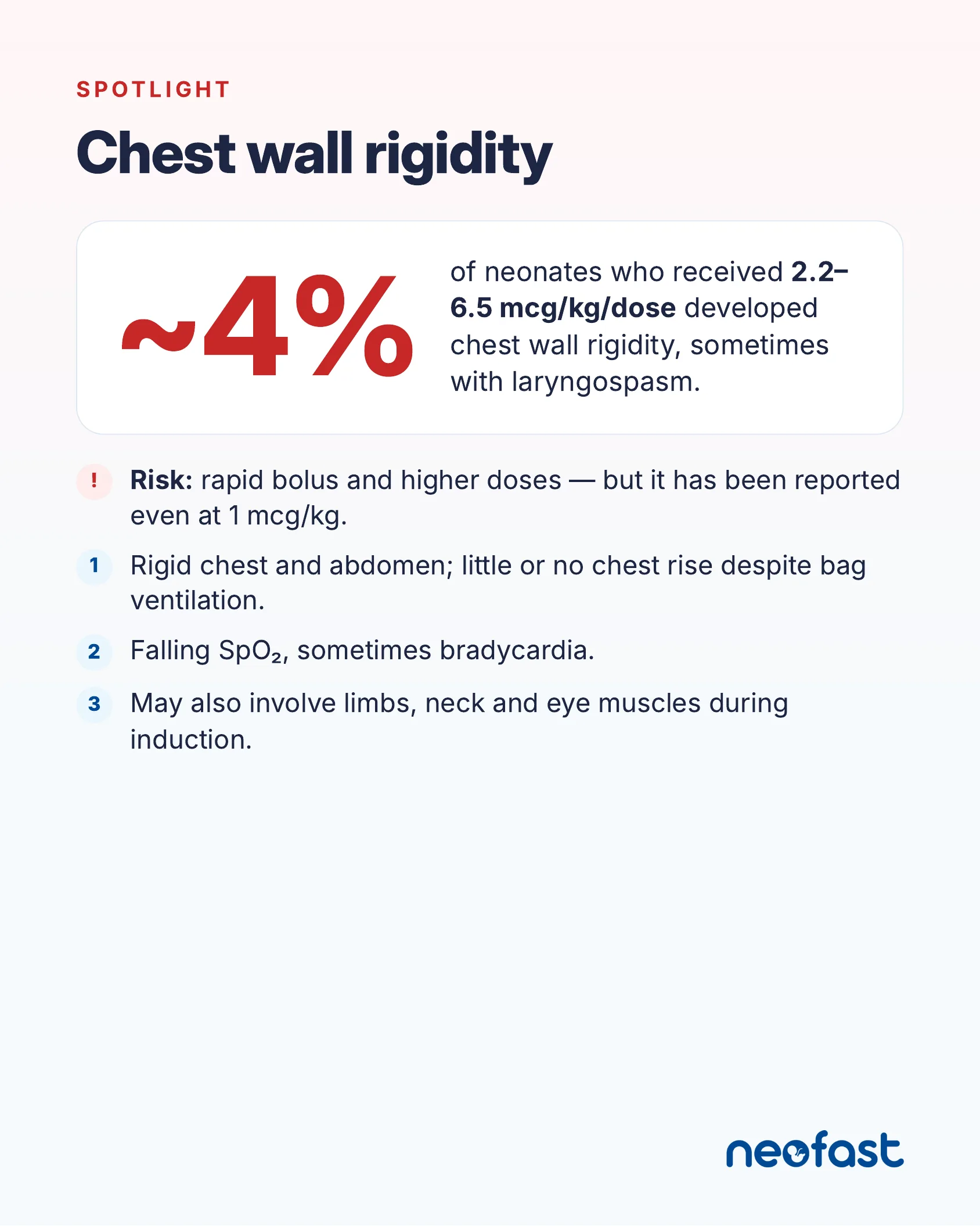
Spotlight
Chest wall rigidity
~4% of neonates who received 2.2–6.5 mcg/kg/dose developed chest wall rigidity, sometimes with laryngospasm.
- Risk: rapid bolus and higher doses — but it has been reported even at 1 mcg/kg.
- Rigid chest and abdomen; little or no chest rise despite bag ventilation.
- Falling SpO₂, sometimes bradycardia.
- May also involve limbs, neck and eye muscles during induction.
Reverse it with naloxone
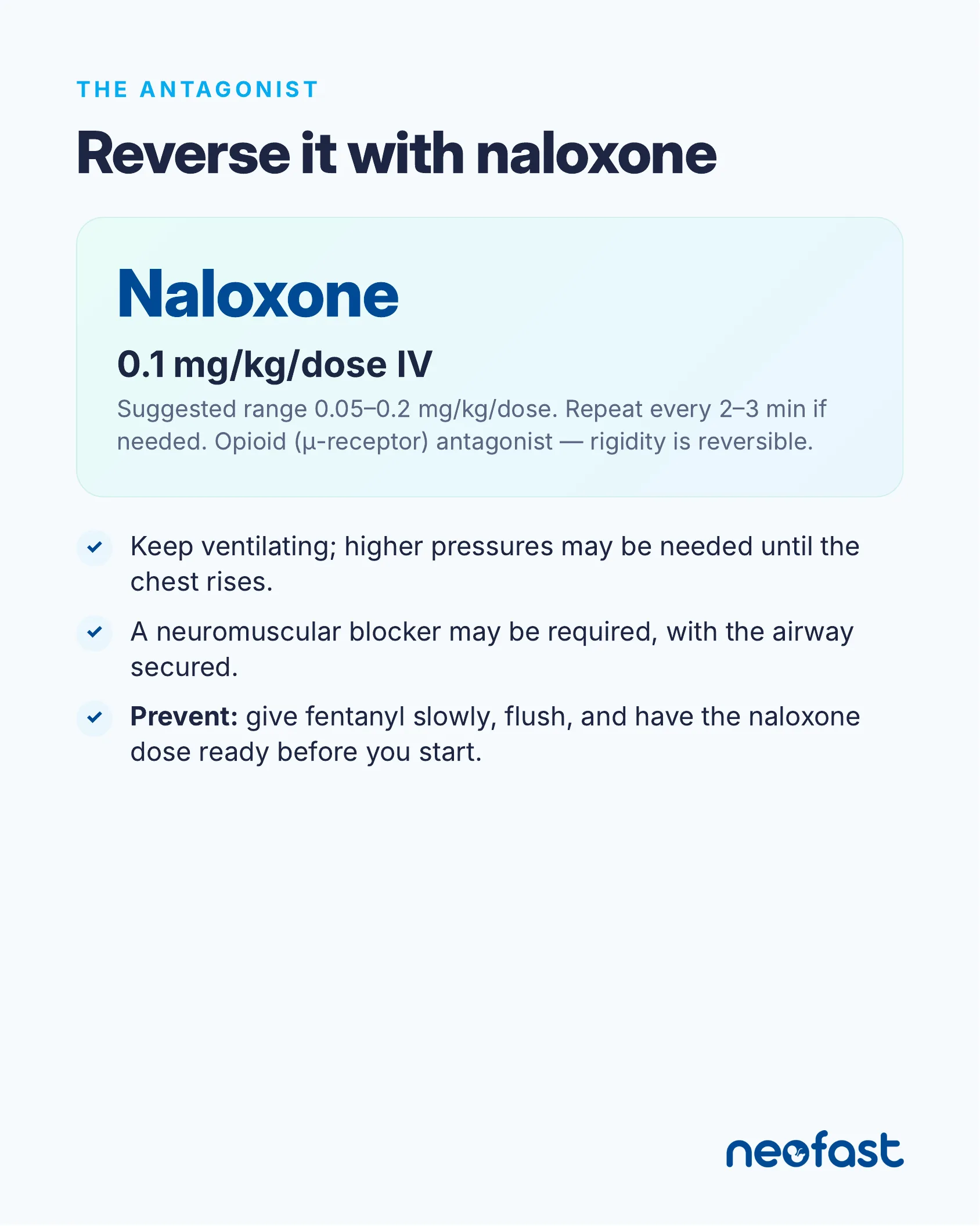
The antagonist
Reverse it with naloxone
Naloxone
0.1 mg/kg/dose IV
Suggested range 0.05–0.2 mg/kg/dose. Repeat every 2–3 min if needed. Opioid (μ-receptor) antagonist — rigidity is reversible.
- Keep ventilating; higher pressures may be needed until the chest rises.
- A neuromuscular blocker may be required, with the airway secured.
- Prevent: give fentanyl slowly, flush, and have the naloxone dose ready before you start.
Calculate fentanyl
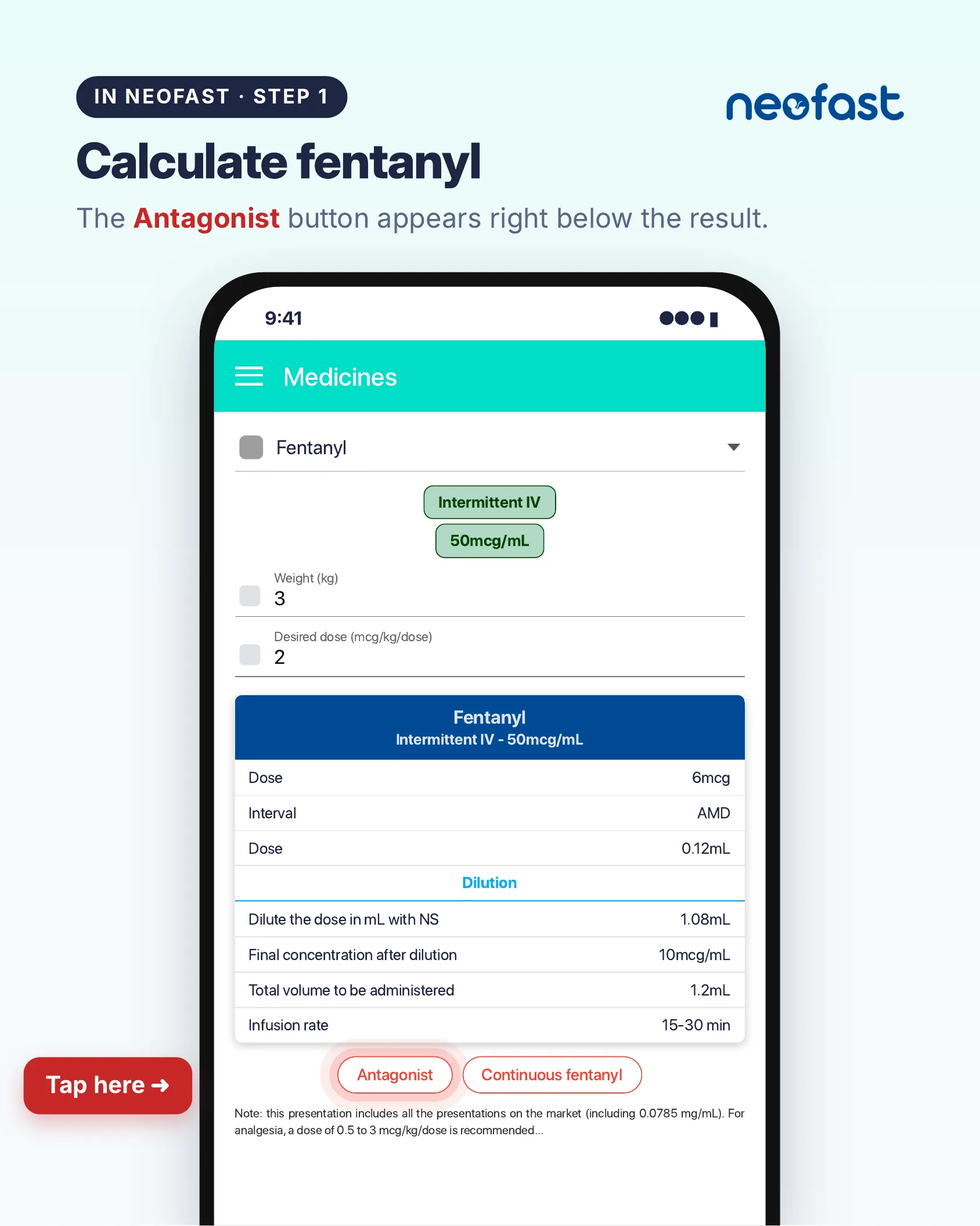
In NeoFast · Step 1
Calculate fentanyl
The Antagonist button appears right below the result.
| Fentanyl — Intermittent IV – 50mcg/mL | |
|---|---|
| Weight (kg) | 3 |
| Desired dose (mcg/kg/dose) | 2 |
| Dose | 6mcg |
| Interval | AMD |
| Dose | 0.12mL |
| Dilution | |
| Dilute the dose in mL with NS | 1.08mL |
| Final concentration after dilution | 10mcg/mL |
| Total volume to be administered | 1.2mL |
| Infusion rate | 15–30 min |
Buttons: Antagonist | Continuous fentanyl
Note: this presentation includes all the presentations on the market (including 0.0785 mg/mL). For analgesia, a dose of 0.5 to 3 mcg/kg/dose is recommended…
Naloxone opens instantly
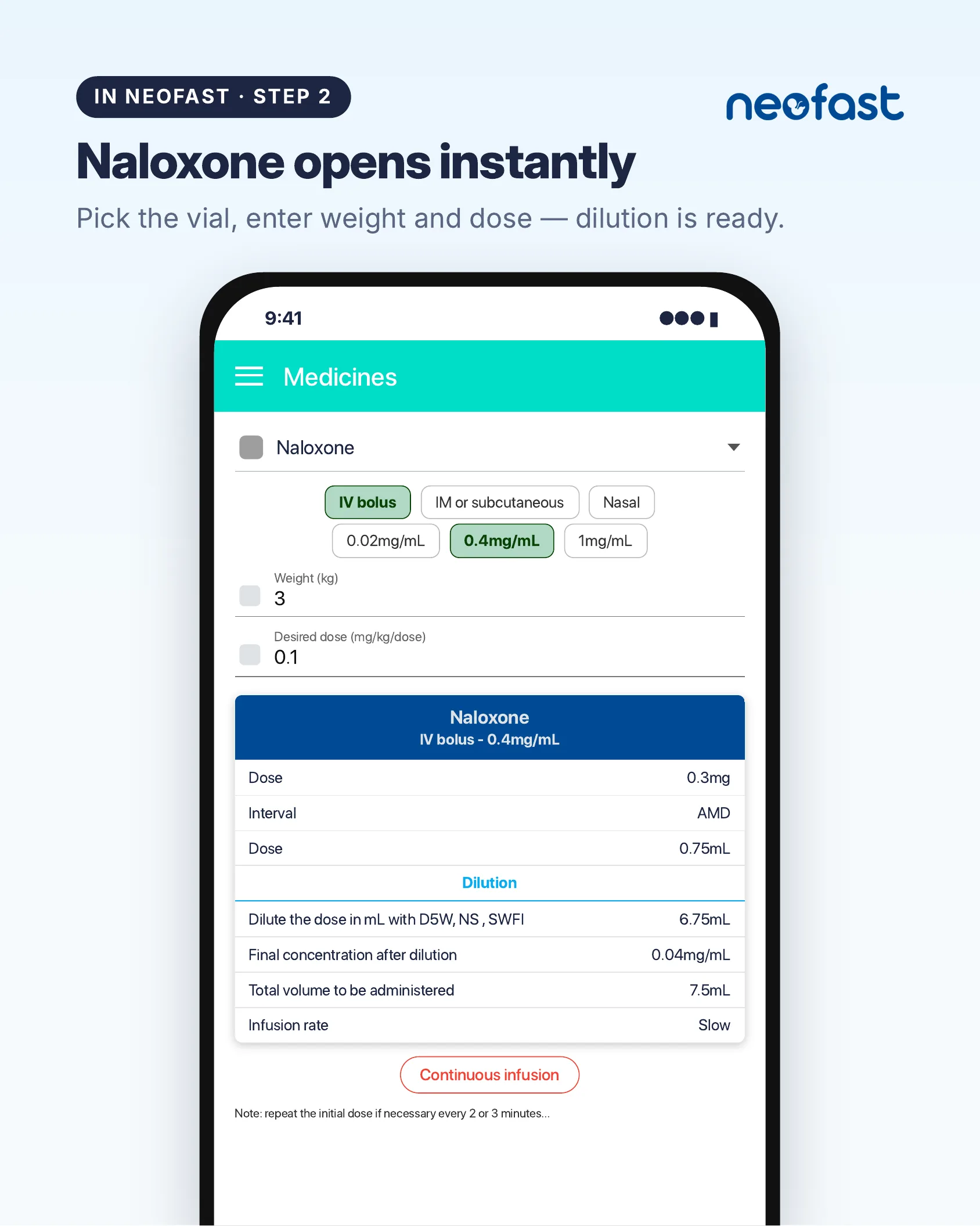
In NeoFast · Step 2
Naloxone opens instantly
Pick the vial, enter weight and dose — dilution is ready.
| Naloxone — IV bolus – 0.4mg/mL | |
|---|---|
| Weight (kg) | 3 |
| Desired dose (mg/kg/dose) | 0.1 |
| Dose | 0.3mg |
| Interval | AMD |
| Dose | 0.75mL |
| Dilution | |
| Dilute the dose in mL with D5W, NS, SWFI | 6.75mL |
| Final concentration after dilution | 0.04mg/mL |
| Total volume to be administered | 7.5mL |
| Infusion rate | Slow |
Button: Continuous infusion
Note: repeat the initial dose if necessary every 2 or 3 minutes…
The antidote is always one tap away
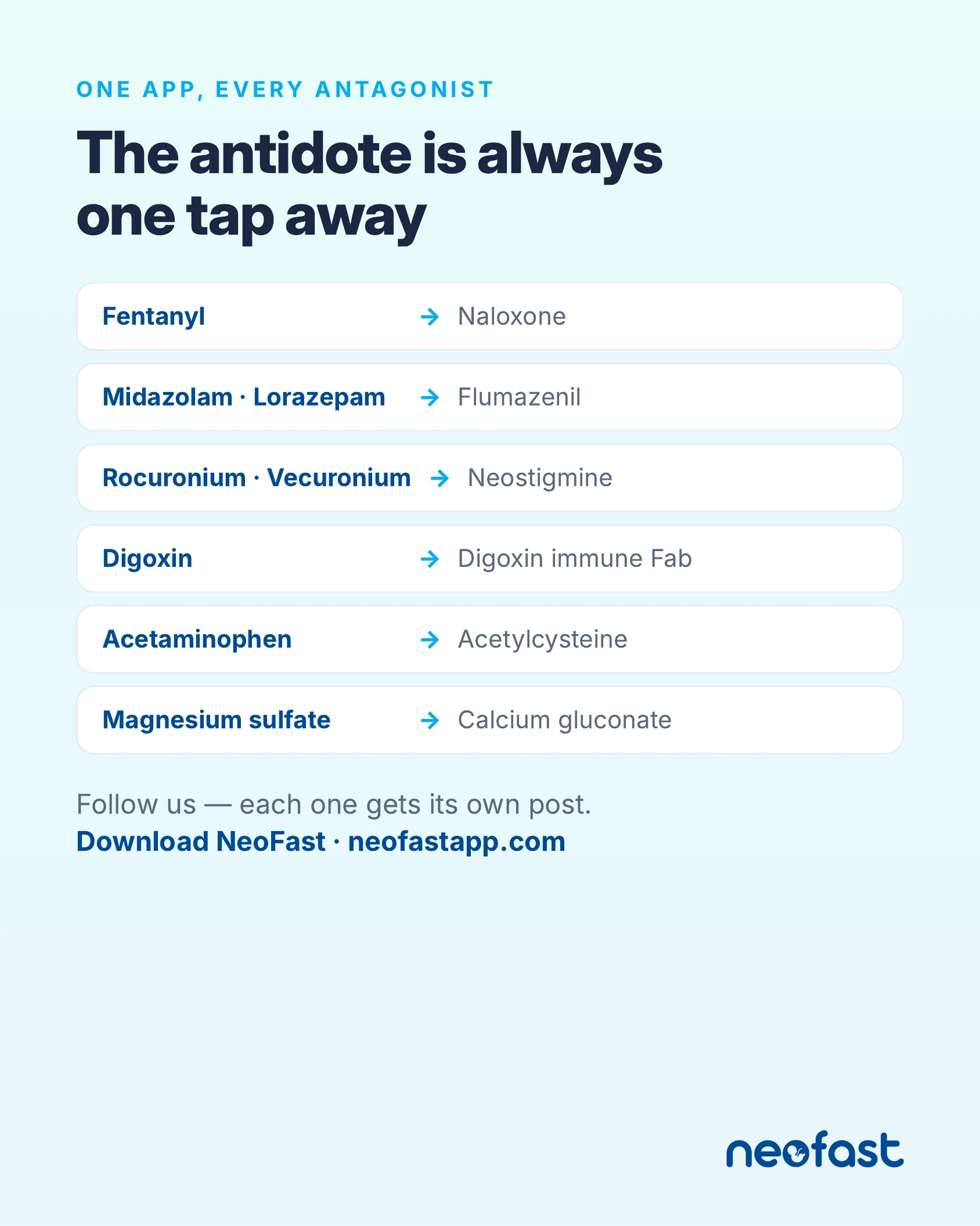
One app, every antagonist
The antidote is always one tap away
| Drug | Antidote |
|---|---|
| Fentanyl | Naloxone |
| Midazolam · Lorazepam | Flumazenil |
| Rocuronium · Vecuronium | Neostigmine |
| Digoxin | Digoxin immune Fab |
| Acetaminophen | Acetylcysteine |
| Magnesium sulfate | Calcium gluconate |
Follow us — each one gets its own post.
Download NeoFast · neofastapp.com
Frequently asked questions
What dose of fentanyl causes chest wall rigidity in neonates?
Chest wall rigidity has been reported in about 4% of neonates given 2.2–6.5 mcg/kg/dose, but it can occur even at doses as low as 1 mcg/kg, with risk increased by rapid bolus administration and higher doses.
What is the naloxone dose to reverse fentanyl-induced chest wall rigidity?
Naloxone 0.1 mg/kg/dose IV is the standard dose, with a suggested range of 0.05–0.2 mg/kg/dose; it can be repeated every 2–3 minutes if needed since it is a reversible mu-receptor opioid antagonist.
What are the signs of chest wall rigidity in a neonate receiving fentanyl?
Signs include a rigid chest and abdomen with little or no chest rise despite bag ventilation, falling SpO2, sometimes bradycardia, and possible involvement of limb, neck, and eye muscles during induction.
What is the usual IV dosing range for fentanyl in neonates?
For analgesia, 0.5–3 mcg/kg/dose; for sedation, 0.5–4 mcg/kg/dose; for anesthesia, 5–50 mcg/kg/dose, usually given every 2–4 hours, diluted to a final concentration up to 10 mcg/mL and administered slowly.
How can chest wall rigidity from fentanyl be prevented?
Prevent it by giving fentanyl slowly with a flush and having the naloxone dose ready before starting the infusion; if rigidity occurs, continue ventilating (higher pressures may be needed) and a neuromuscular blocker may be required with the airway secured.